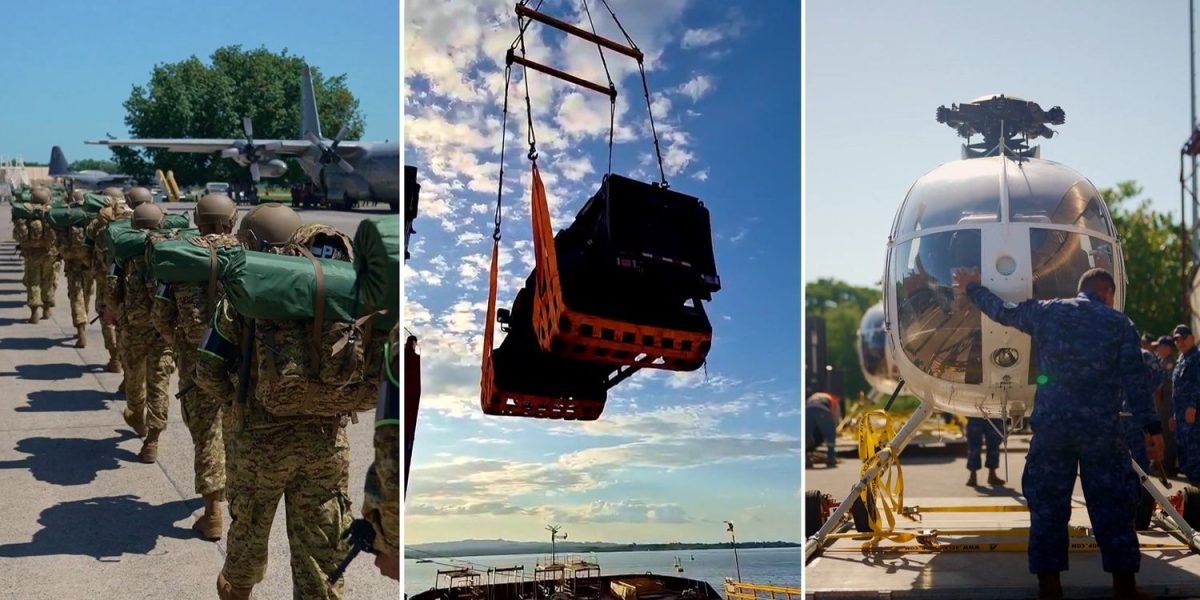
Salvadoran President Nayib Bukele has promised Haitians he will rid their country of the criminal gangs strangling daily life, launching an unprecedented military operation with the deployment of 2,000 soldiers. The reinforcements have stirred hope among affected communities, though the contours of the intervention remain opaque more than a week after patrols began.
“Here is what I ask of you: ‘Trust us,'” Bukele told Haitians. The Central American leader has framed the mission in carefully calibrated terms, insisting it is “neither an operation against the Haitian people nor an invasion of Haiti. When our mission is finished, we will return home.”
What Triggered the Deployment
The operation traces its origins to an attack on four Salvadoran aviation technicians in the capital, Port-au-Prince. The men were attacked while traveling by car during their mission with the UN-backed Gang Suppression Force (FRG). A local gang leader later claimed they were killed, though their fate has not been officially established.
Salvadoran troops appear to have concentrated their first efforts in the Cul-de-Sac plain, northeast of Port-au-Prince, according to images shared by Bukele. No official toll has been released.
“The Salvadorans have not communicated anything so far,” said Wethzer Piercin, a journalist for Haitian outlet AyiboPost. “There are helicopters, gunfire, people fleeing… but there is no established, constant communication.” He noted that the population is largely relying on Bukele’s tweets as one of the main sources of information.
Gangs Regroup as Residents Weigh Hope Against Fear
In response, gang leaders “are reorganizing and moving across the terrain to prepare for an armed confrontation,” said researcher Frédéric Thomas, author of “Haïti, briser le piège colonial.” Several gang leaders have been spotted in the town of Carrefour, according to AyiboPost.
“That area passed entirely under gang control two or three years ago,” Piercin said. “When there are security interventions in their zones, gang members take refuge in this commune, which serves as a shield. It will be difficult for the authorities to intervene there because the gangs literally coexist with the population.”
Criminal groups have sometimes forced residents to erect barricades and have barred people from leaving certain areas. In the Canaan district, they emptied schools and markets at gunpoint to stage a demonstration denouncing the Salvadoran intervention. In response, a rally in support of Bukele was organized in Port-au-Prince’s Carrefour-Feuilles and Fort National neighborhoods, “heavily affected by gangs and insecurity.”
“I can’t wait for us to regain our freedom,” one resident of Croix-des-Bouquets told France 24, speaking on condition of anonymity. “The gangs are in great difficulty, they have lost a lot of people.”
Wilson Joseph, leader of the 400 Mawozo gang, told the Associated Press that the October 18 attack occurred on another criminal group’s territory. In a sign of nervousness, he said he had written to the UN requesting mediation after the Salvadoran troops’ arrival, citing fears of “an escalation of violence and a logic of reprisals.”
A Crowded Battlefield of Fragmented Forces
The Salvadoran forces are intervening in a country where numerous armed actors already coexist in the absence of a comprehensive strategy. The under-resourced national police are backed by the country’s military, remobilized in 2017. The government recently announced the death of Mathias Saintil, leader of the Nan Boston gang, in a drone strike.
“The difficulty is that neighborhoods are retaken for a few days, then abandoned again because it is hard to maintain a presence on the ground,” Thomas said.
Haiti’s government has also contracted private paramilitary firms such as Vectus Global, founded by far-right businessman Erik Prince. The US company has used drone strikes that have already caused civilian casualties. Private security companies and self-defense groups that have emerged across isolated neighborhoods complete the picture.
Meanwhile, the UN-mandated Gang Suppression Force began operations this summer, tasked with conducting “targeted, intelligence-led anti-gang operations.” It was meant to reach 5,500 troops this year, but its deployment has fallen behind schedule.
“This fragmentation of actors obviously raises questions about coordination and leadership,” Thomas said. “The Haitian prime minister issued a statement days after the Salvadoran president’s remarks, asserting that the Haitian state was coordinating these different forces. But that is far from certain.”
US Secretary of State Marco Rubio has stressed that “close coordination is essential because they are operating side by side,” raising the specter of friendly-fire incidents.
Impunity Rooted in Corruption
Between October 2025 and April 2026, 3,165 people were killed and 1,551 injured in armed violence, according to a recent UN Group of Experts report — 65% during security operations and 30% during gang attacks. Gangs have continued to commit murders, sexual violence, kidnappings and extortions, and to recruit children. The UN estimates some 1.5 million people are internally displaced, or 12% of the total population.
“We have already cleaned up the gangs in El Salvador, and we can do the same with you,” Bukele warned. Since taking power, 93,000 people have been imprisoned under a state of exception maintained for four years.
“He is trying to play the regional card for essentially domestic purposes, to export his model and gain further legitimacy and popularity,” Thomas said. “But we must not confuse a publicity stunt with action.”
This time, Bukele cannot count on a state apparatus serving his cause, given the corruption afflicting Haiti. A decapitation strategy against the gangs is therefore no guarantee of success.
“These armed groups have relays within the political class and the business community,” Thomas said. “There has been no trial of these gang leaders since 2018. This enormous impunity gives them their power and explains the reproduction of cycles of violence.” He pointed to the possible presidential candidacy of former head of state Michel Martelly, who has been sanctioned over his links to armed gangs.
“In the medium term, legitimate public institutions would need to fight for justice in order to win their battle against insecurity. We are far from that.”