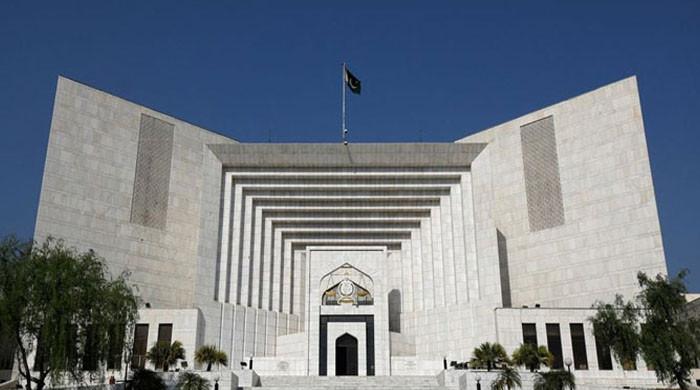
In a crucial hearing at the Supreme Court in Islamabad, Justice Jamal Mandokhail raised questions regarding the powers of military courts in a significant case related to Swellings. The seven-member constitutional bench headed by Justice Amin-ud-Din Khan conducted the hearing where the convicted suspect, Arzam Junaid, had his lawyer, Salman Akram Raja, present arguments.
Salman Akram Raja referred to the EF (Evidentiary Proceedings) Act, stating that under the 1962 Constitution, a trial of Swellings could only occur after the completion of fundamental rights. Justice Muhammad Ali Mazhar questioned how a Swelling could face a court-martial if EF was itself a Swelling. Justice Jamal Mandokhail sought further clarification on the powers of military courts under the Army Act, questioning whether a person outside the army could fall under the jurisdiction of a military court solely based on a crime.
Lawyer Khawaja Ahmed raised the point in court that if there were attacks on the Parliament, Supreme Court, and GHQ, would only the GHQ case be heard in military court. He emphasized that while the Army Act may be valid, it is essential to determine its applicability. Salman Akram Raja further argued that the EF case involved Section 2D1 of the Army Act and was correctly placed under the Presidential Ordinance. He requested the court to uphold their decision on Article 10-A by Justice Ayesha, stating success would be if their stance on Article 175, Section 3 being beyond the court’s jurisdiction was accepted.
The judges deliberated on whether the 1962 Constitution was valid, to which Salman Akram Raja replied that it started with Field Marshal Ayub Khan assuming powers. Subsequently, the Supreme Court adjourned the hearing on the Swellings military trial case for a brief period. The hearing sheds light on the complexities of the issue concerning the scope of military courts’ authority and the protection of Swellings’ rights.
The news from the hearing in the Supreme Court provides insight into the ongoing legal battle over the Swellings military trial, highlighting the intricacies surrounding military court jurisdiction and the preservation of Swellings’ rights.