Palestinian journalists in Gaza are operating under conditions described as a “death sentence,” braving Israeli bombardments and acute humanitarian crises to deliver news from the besieged enclave. Their work, vital for international understanding, comes at an extraordinary cost, with at least 210 Gazan journalists killed since October 7, according to Reporters Without Borders (RSF). This makes Gaza the most dangerous place in the world for reporters, who face not only bombs but also famine, forced displacement, and severe communication blackouts.
For Rami Abou Jamous, a 47-year-old Palestinian journalist, the daily reality has become a terrifying waiting game. He remains confined to his home in west Gaza City with his wife and two young children, aged four years and seven months. Israeli forces, intensifying an offensive in the city since mid-August, often issue mere minutes’ notice before bombardment, forcing residents to flee. “My daily life changed three days ago, since they started bombing the towers, like the one I live in,” Rami explained, shortly before a major ground offensive began. “I’ve prepared three suitcases and put them downstairs; they only give us ten to fifteen minutes to leave.”
Beyond the immediate threat of bombs, Rami, like an estimated half-million others in the enclave, contends with severe famine. A total humanitarian blockade imposed since spring has caused food prices to skyrocket. “Prices have multiplied by 8 or even 100 times; last time I bought a bag of flour for 1,000 euros,” he recounted. While he considers himself “lucky” to still find sustenance, eating a piece of bread with zaatar (a traditional Middle Eastern spice blend) in the morning and lentils in the evening, the diet has taken its toll. “It gives a feeling of being full. Even so, the other day, from eating lentils every day, I got gout – my foot was swollen, I couldn’t walk,” he recalled. The physical strain of the crisis has rendered him too weak to walk the long distances required for reporting.
Hamed Sbeata, a 23-year-old Gazan journalist contacted by BFMTV, faces unique health challenges. Diagnosed with Alport Syndrome, a genetic kidney disease, he received a kidney transplant in 2020 and requires mineral water to maintain his health. “The water here is very polluted; it is very harmful to my health. It affects my blood pressure, my heart rate, and causes severe headaches,” he detailed, providing medical reports.
Despite the profound dangers and personal toll, Hamed feels compelled to continue his work. “I often wanted to stop working, take a break, no longer go into the field, but I cannot. It’s my passion, and the cost of living here is very high, so it’s essential that I work to support my family,” he asserted, adding, “despite the danger and the fear of bombardments.” He describes witnessing colleagues die daily and fearing he might be next, having “miraculously escaped death” himself multiple times while working for international outlets like Sky News and France TV.
The scale of journalist casualties in Gaza is unprecedented. More than 210 journalists have been killed since October 7, with RSF confirming 56 deaths directly linked to their professional duties. Jonathan Dagher, head of RSF’s Middle East bureau, notes, “The toll is unprecedented. This is currently the most dangerous country for journalists. In this period and in such a small territory, we have never seen such figures.” The situation is compounded by Israel preventing virtually all international media from entering the enclave, leaving Palestinian journalists as the sole eyes and ears on the ground. According to the territory’s Ministry of Health, at least 64,964 people have died in Gaza since the conflict began.
The targeting of journalists has drawn international condemnation. On August 25, five journalists, including contributors to Al Jazeera, Reuters, and AP, were killed in an Israeli strike on Nasser Hospital in Khan Younis. Reuters reported that its collaborator was live-streaming from the hospital when the feed abruptly cut. Just two weeks earlier, six other reporters, including Al Jazeera correspondent Anas al-Sharif, were killed in another Israeli strike. RSF stated that al-Sharif “was targeted.”
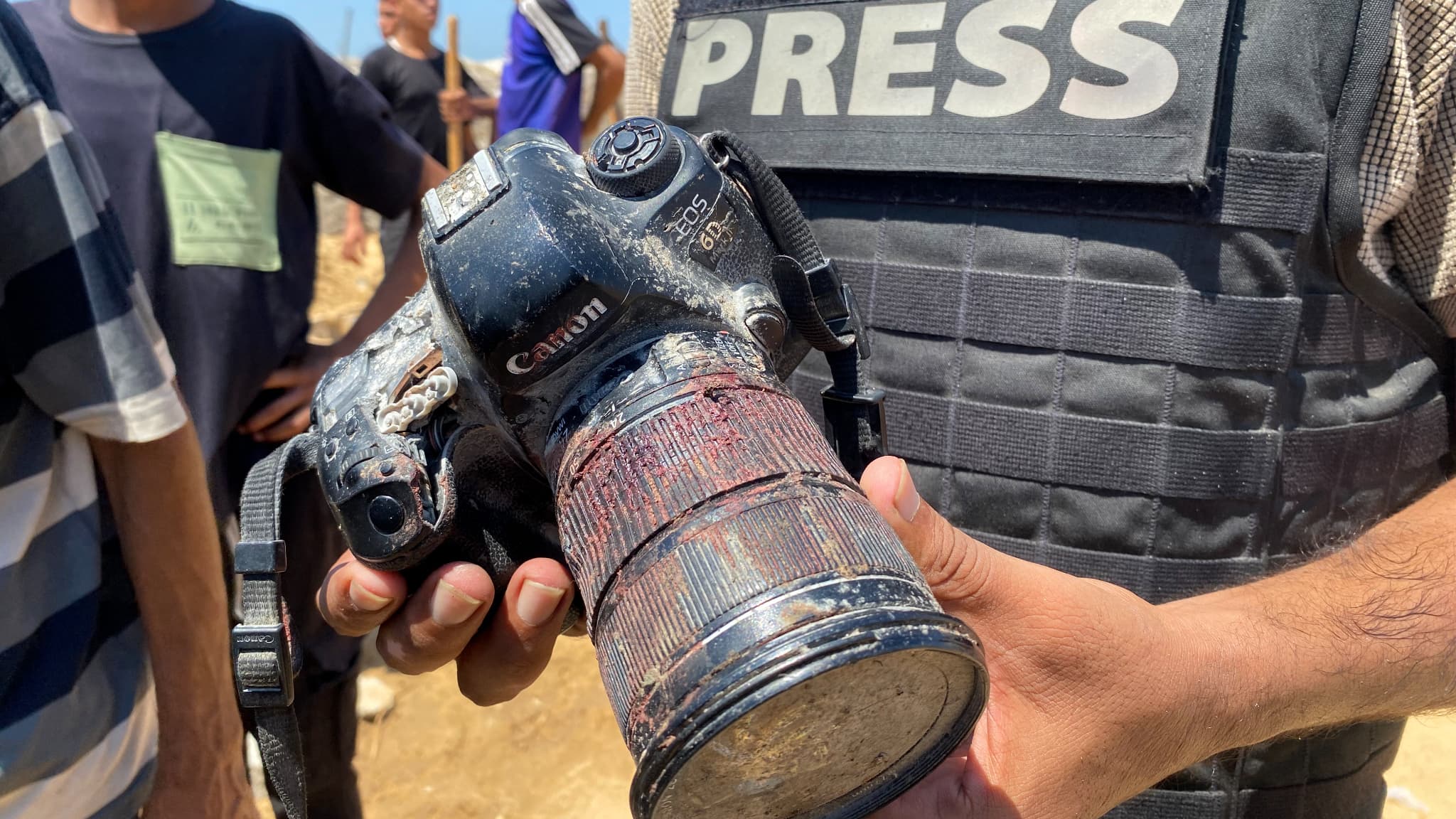
Reporting in Gaza is fraught with operational challenges. Without electricity since October 7, journalists rely on generators or solar panels to charge essential equipment like phones, laptops, and cameras. Internet connectivity is sporadic at best. “Because of the destruction, communication has generally been cut, but most of our work is done via the internet. To send footage, to go live, you need internet,” Rami explains, citing frequent “blackouts.” Fuel is scarce and exorbitantly priced—over $100 for a liter of gasoline—forcing reporters to walk or rely on animal-drawn carts. Furthermore, press vests and helmets, intended as protection, are paradoxically foregone. “Bulletproof vests or helmets, marked with the press insignia, ‘turn journalists into targets’,” observed Jonathan Dagher of RSF.
This perceived targeting has fostered a climate of fear among the civilian population, making their work even more isolating. Rami recounted an incident where a resident, passing the same street he walked daily to his office, jokingly warned him, “Next time, don’t pass this way because you are threatened.” Rami stopped using that path, unwilling to cause fear. “We, journalists, in general, are all condemned to death. They don’t want witnesses to their crimes,” he lamented, adding, “To silence us, they kill us.”
Journalists, like the wider population, are subject to relentless displacement. Rami first fled Gaza City in November 2023 when his neighborhood was encircled. “The army told us to evacuate, to leave with white flags from a specific location. We did, but they shot at us; one of our neighbors was killed,” he recalled. He sought refuge in Rafah, then moved twice more before returning to Gaza City during a brief winter ceasefire, only for Israeli forces to again call for evacuation amidst a new major offensive. Hamed and his family have been displaced six times since October 7, finally finding space in a refugee camp in the south, a stark contrast to his “beautiful house” in the now-destroyed Al-Shuja’iyya neighborhood. Despite these conditions, Hamed continues to film the congested exodus of Gazans heading south, many on carts due to the exorbitant cost of fuel.
Jonathan Dagher of RSF describes the situation as an “unprecedented media blockade.” RSF has filed four complaints with the International Criminal Court, condemning the deliberate “defamation” of Palestinian journalists, who are often accused by Israel of being Hamas supporters. “They are often accused, before or after their death, of being terrorists, whereas for many, they resisted the oppression led by Hamas before the start of the war,” Dagher argued. This tactic, he explained, aims “to question their integrity and thus the information they cover.” He concluded, “When we see the atrocious images coming out of the Gaza Strip, we can clearly see why the Israeli army has an interest in muzzling the press.”