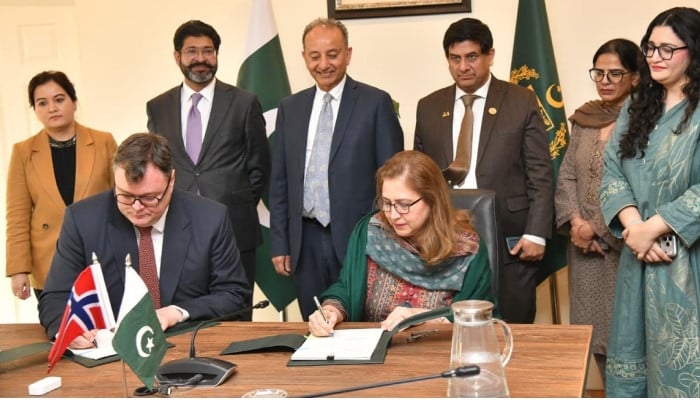
Pakistan has entered a historic phase in its climate strategy by signing its first bilateral carbon market agreement with Norway. The deal, formalized under the Paris Agreement’s Article 6.2, is designed to unlock international climate finance and support Pakistan’s transition to a low-carbon economy.
A Shift from Preparation to Implementation
Federal Minister for Climate Change and Environmental Coordination, Musadik Malik, hailed the Memorandum of Understanding (MoU) as a “historic milestone.” He stated that it marks Pakistan’s crucial shift from carbon market preparedness to active implementation. “This is Pakistan’s first bilateral agreement under Article 6.2 and an important step towards implementation,” Malik said, emphasizing that it creates a pathway for international cooperation and investment in climate-related sectors.
The agreement enables Pakistan to develop carbon credit projects in key areas such as:
- Renewable energy
- Agriculture
- Transport
- Waste management
The resulting carbon credits, known as Internationally Transferred Mitigation Outcomes (ITMOs), can be transferred to Norway.
Financing Climate Resilience and Development
Officials highlighted that the pact arrives as Pakistan faces escalating climate risks, including devastating floods and extreme heatwaves. The carbon market mechanism is seen as a vital tool to mobilize much-needed international finance. Minister Malik stressed that such markets must deliver tangible benefits. “They must help countries like Pakistan finance transition pathways, create jobs, attract technology and deliver real benefits to communities,” he asserted.
Pakistan has been laying the groundwork for this move, having approved national policy guidelines for carbon trading in January 2025. The government is now focused on establishing the necessary regulatory and reporting systems to fully operationalize the domestic carbon market.
Norway’s Commitment to Climate Neutrality
At the signing ceremony in Islamabad, Norway’s Ambassador to Pakistan, Per Albert Ilsaas, described the agreement as inaugurating a new phase in bilateral environmental cooperation. “Pakistan is among the countries most affected by climate change, and we believe this partnership can deliver both measurable emission reductions and real development benefits,” the ambassador stated.
He clarified that Norway, which aims for climate neutrality by 2030, is seeking to purchase ITMOs to go beyond its formal Nationally Determined Contribution (NDC) targets, not to meet them. This effort will be supported by Norway’s Global Emission Reduction Initiative, launched in 2024 with a $1.5 billion budget, designed to channel carbon finance to partner countries.
Ambassador Ilsaas expressed Norway’s interest in fostering large-scale cooperation across entire sectors like renewable energy, industry, and agriculture, rather than focusing on isolated projects.
A Pathway for Green Investment
Officials from both nations agree that this agreement enhances Pakistan’s access to climate finance and private investment. It is expected to support the country’s efforts to achieve low-carbon growth and fulfill its commitments under the Paris Agreement, turning climate challenges into opportunities for sustainable development.