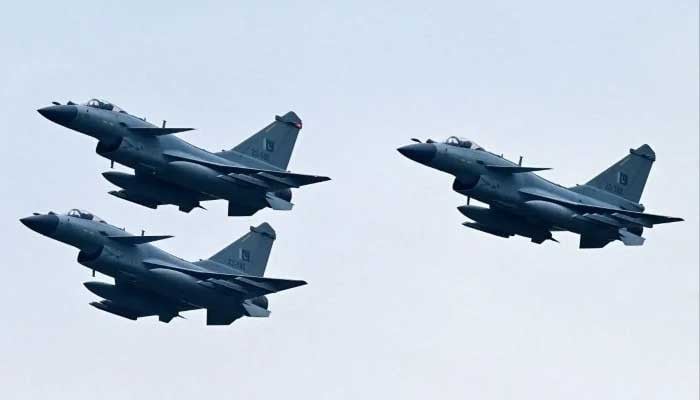
In an unprecedented security move, the Pakistan Air Force (PAF) deployed a fleet of advanced fighter jets to escort a high-level Iranian delegation home from inconclusive peace talks in Islamabad last weekend. The operation was launched amid specific fears that Israel might attempt to target the Iranian officials, according to three sources who spoke to Reuters.
A “Massive Operational Mission”
Two Pakistani security sources with direct knowledge of the operation stated that approximately two dozen PAF jets, supported by an Airborne Warning and Control System (AWACS) for aerial surveillance, were mobilized to ensure the delegation’s safe passage back to Iran. One source described the mission as “massive” from an operational standpoint, emphasizing the responsibility of providing air cover with “potent fighters” to counter any potential threat.
“We dropped them all the way to Tehran. Their security was our responsibility even beyond their time here,” a source involved in the talks confirmed.
Escort Triggered by Security Concerns
The extraordinary security measures, which go well beyond standard diplomatic protocol, were initiated after Iranian delegates raised concerns about their safety during travel. A regional diplomat briefed by Tehran indicated that while the Iranians presented the threat as a “hypothetical” possibility, it prompted Pakistan to insist on providing the armed escort.
“When the talks failed, the Iranians were wary that things had not gone right. It was their suspicion that they might be targeted,” one security source explained. The delegation was led by Foreign Minister Abbas Araqchi and Parliament Speaker Mohammad Baqer Qalibaf.
Top-Tier Aircraft and Ongoing Security
The escort mission utilized the PAF’s top-tier fighter, the Chinese-made J-10C, highlighting the operation’s significance. Sources indicated that similar protective measures would be arranged for future negotiation rounds if requested by Iran. Preparations are already underway for an expected follow-up meeting as soon as this weekend.
“Otherwise, Pakistani aircraft would receive them in Pakistan airspace,” a source noted regarding future visits.
Background of Threats and High-Stakes Diplomacy
The context for the fears involves a reported Israeli “strike list” that previously included the Iranian officials. Sources stated that Pakistan had asked Washington to intervene to have the names removed to preserve a channel for dialogue concerning the ongoing conflict launched by the US and Israel on February 28.
Israeli Prime Minister Benjamin Netanyahu recently declined to guarantee the safety of Iranian leaders, stating, “I wouldn’t issue life insurance policies on any of the leaders…”
The talks in Islamabad, described as the highest-level engagement between Iran and Pakistan since 1979, ended without a deal. However, dialogue is reportedly still active, with former US President Donald Trump suggesting the war “should be ending pretty soon” and that negotiations could resume in Islamabad.
Requests for comment from the Israeli prime minister’s office, Iran’s mission in Geneva, the Pakistan Air Force, and the US embassy in Islamabad were not immediately returned.