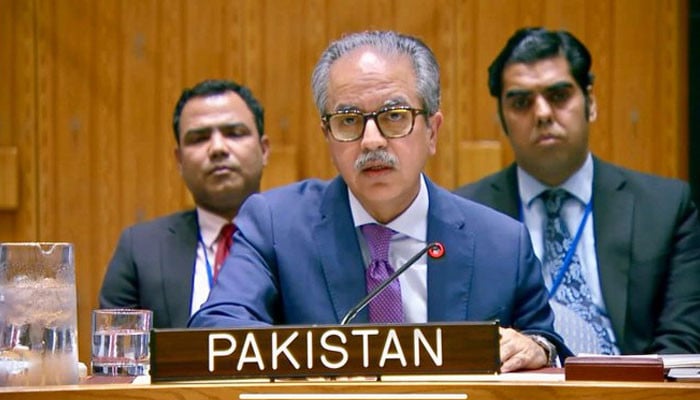
Global maritime security and escalating risks to critical sea lanes dominated a UN Security Council debate on Tuesday, where Pakistan warned that disruptions to international waterways are increasingly threatening global trade, energy flows, and economic stability.
Pakistan’s Permanent Representative to the United Nations, Ambassador Asim Iftikhar Ahmad, delivered the country’s position during the High-Level Open Debate on “The Safety and Protection of Waterways in the Maritime Domain,” held at UN headquarters on April 27.
Ahmad underscored the strategic importance of maritime security for international and development, while highlighting the severe consequences of the ongoing crisis in the Strait of Hormuz.
Developing Countries Most Vulnerable to Crisis Fallout
The ambassador warned that a prolonged closure of the Strait of Hormuz would trigger cascading economic shocks, with developing nations bearing the heaviest burden.
“If the crisis persists, the first order impacts related to the procurement of oil and gas, and essential commodities such as fertilisers and their pricing trends, will increasingly translate into second and third order impacts on inflation, growth, current account and balance of payment issues,” Ahmad told the council.
“No doubt, developing countries will be most affected,” he added.
Ahmad cited the Hormuz crisis as a stark example of how disruptions to routine maritime traffic can destabilize the global economy and threaten international peace and security.
Pakistan’s Diplomatic Role and Regional Stability Efforts
The ambassador highlighted Pakistan’s proactive diplomatic engagement in efforts to de-escalate tensions between the United States and Iran, which have contributed to the current crisis.
“Pakistan, supported by brotherly countries including China, Saudi Arabia, Türkiye and Egypt, has spearheaded constructive diplomatic efforts for de-escalation and the broader pursuit of stability between the United States and Iran,” Ahmad said.
He reaffirmed Pakistan’s commitment to diplomacy and dialogue as the primary tools for resolving the crisis.
“Pakistan remains firm in its faith in diplomacy and dialogue, and will continue to resolutely undertake all possible measures towards that end,” he stated.
Maritime Security Beyond Trade and Piracy
Ahmad expanded the scope of maritime security concerns beyond traditional issues like trade route protection and piracy, emphasizing a broader set of challenges facing the international community.
“In today’s interconnected world, the imperative of safety of maritime spaces extends well beyond securing trade routes and combating piracy; it encompasses a plethora of challenges, including climate change and environmental preservation, protection of critical coastal and underwater digital infrastructure, and safeguarding human rights at sea,” he said.
The ambassador called for collective and coordinated action anchored in international law, dialogue, and diplomacy to confront these multifaceted challenges.
Pakistan’s Operational Contributions to Maritime Security
Ahmad outlined Pakistan’s operational commitments to maintaining global maritime security, noting the country’s recent leadership roles in multinational task forces.
“Earlier this year, Pakistan assumed the of Combined Task Force 150 (CTF 150) for conducting Maritime Security Operations outside the Arabian Gulf to protect commercial shipping,” he said.
“Last year, Pakistan also commanded CTF-151 tasked to suppress piracy and to ensure free flow of maritime trade,” he added.
Pakistan has also launched its own Regional Maritime Security Patrols (RMSP) to ensure a safe and secure environment in regional seas, the ambassador noted.
Warnings on Erosion of Rules-Based Order
Ahmad expressed concern that the global governance system is under increasing strain, with even international waterways facing the consequences of geopolitical contestation.
“The rules and norms that we had collectively and painstakingly put in place to precisely avoid such contestations and confrontations, are being challenged or set aside,” he warned.
“This is an untenable situation whose prolongation would only further undermine international peace and security, and development, to the detriment of us all,” he said.
“Most consequentially, it will erode trust in the rules-based order,” he added.
Call for Collective Responsibility
The ambassador concluded with a call for sustained diplomatic engagement and collective responsibility to preserve the hard-won gains of international maritime cooperation.
“As a maritime state with unwavering faith in international law and diplomacy, Pakistan would continue to engage with the Secretary General, the Security Council and with all like-minded countries for preserving the hard-won gains — both in the gentle tides of peace and amity, and amid the rising storms of conflict and conflagration,” Ahmad said.
“This is a sacred trust that history has placed upon us, and we cannot afford to fail. We must succeed, together,” he added.