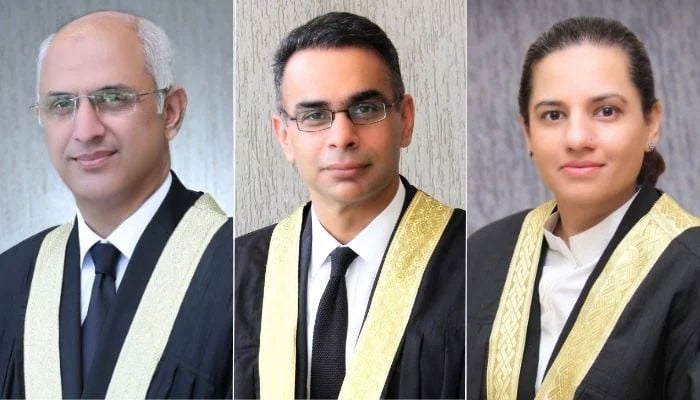
The Ministry of Law and Justice officially notified on Wednesday the transfer of three judges from the Islamabad High Court (IHC) to other high courts across the country, a move approved by the President on the recommendation of the Judicial Commission of Pakistan (JCP).
The transfers, carried out under Article 200 of the Constitution, relocate Justice Mohsin Akhtar Kayani to the Lahore High Court (LHC), Justice Babar Sattar to the Peshawar High Court (PHC), and Justice Saman Rafat Imtiaz to the Sindh High Court (SHC), according to the official notification.
JCP Decision Follows Contentious Meeting
The development comes one day after the JCP, chaired by Chief Justice of Pakistan (CJP) Yahya Afridi, approved the transfers. The commission’s meeting was convened under the powers conferred by clause (22) of Article 175A of the Constitution.
Attendees included senior judges Justice Aminuddin Khan, Justice Munib Akhtar, Justice Aamer Farooq, and Justice Syed Hassan Azhar Rizvi, alongside Law Minister Azam Nazir Tarar, Attorney General Mansoor Usman Awan, and representatives from the Pakistan Bar Council and other legal bodies.
Withdrawn Proposals and New Policy
The JCP noted that members who had initially requested the transfer of Justice Arbab M. Tahir to the Balochistan High Court and Justice Khadim Hussain Soomro to the Sindh High Court withdrew their respective proposals during the meeting.
In a significant policy decision, the commission ruled by majority that any vacancy arising a judge’s transfer shall be filled exclusively through another transfer, and shall not be treated as a vacancy for initial appointment, according to a press release.
Government Defends Judicial Transfers
Minister of State for Law Barrister Aqeel Malik defended the JCP’s decision, stating that all actions were taken in accordance with the Constitution and law. Speaking on Geo News, Malik emphasized that no member of the commission is subordinate to another.
“The authority to transfer judges rests with the JCP, not the executive,” Malik said, adding that bar councils had previously demanded the rotation of judges. He noted that while Justice Babar Sattar’s written position was placed before the commission, the Constitution does not mandate a hearing for the judge concerned.
Malik rejected claims that judicial transfers constitute punishment, arguing that the Constitution provides for such measures to strengthen the federal system. He cited Articles 200 and 175A, noting that the commission comprises seven senior judges, including two chief justices, with decisions taken by majority vote.