
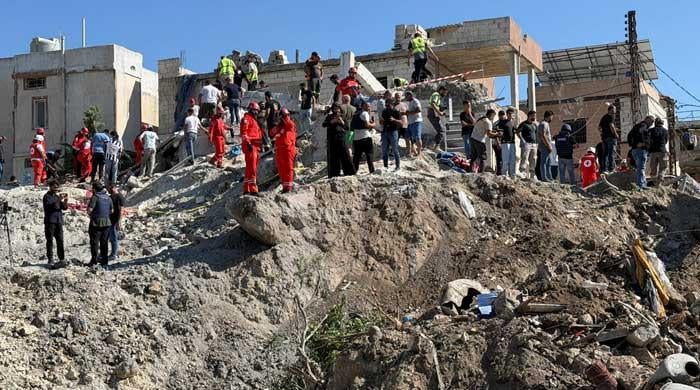
A volatile mixture of diplomacy and confrontation is redefining the landscape across the Middle East, as a shaky truce between the United States and Iran confronts fresh violence on strategic waterways and a parallel push to stabilize the Israel-Lebanon border. Within a single 24-hour window, a drone strike on a cargo ship, a landmark framework agreement for southern Lebanon, and renewed demands for rigorous nuclear inspections have underscored the extreme fragility of the current pause in hostilities.
Trump Threatens Response After Drone Strike on Merchant Vessel
President Donald Trump issued a stark warning on Friday after confirming that Iran had launched at least four one-way attack drones at ships transiting the Strait of Hormuz. One of the drones struck the upper deck of a ship, causing damage, though the vessel was able to continue its journey. US forces intercepted three other drones.
“Obviously, this is a foolish violation of our Ceasefire Agreement,” Trump wrote on his Truth Social platform. When by reporters on whether Tehran would face direct consequences, the president a cryptic reply: “You’ll find out.”
Almost simultaneously, Iranian media reported the sound of an explosion near the southern town of Sirik, though the source remained unclear. The incident immediately heightened fears that the unofficial truce, which halted the large-scale US-Israeli military operation against Iran that began on February 28, could be unraveling.
Adding to the friction, Iran’s Islamic Revolutionary Guard Corps (IRGC) categorically denied the existence of any direct communication line with Washington regarding the strategic Strait of Hormuz. An IRGC spokesperson described such claims as “a complete lie” and insisted the waterway is Iranian territory with “nothing to do with the US.” The denial came despite intense international pressure to maintain freedom of navigation through the chokepoint, a concern stressed by the UAE Foreign Minister in a call with his Iranian counterpart. Beyond the immediate military flashpoints, the head of the International Atomic Energy Agency (IAEA) insisted that any lasting resolution must include extraordinarily robust monitoring of Iran’s nuclear program. The IAEA chief confirmed that a US-Iran deal grants access to nuclear sites, but emphasized that “very strong” verification needed following the war to ensure compliance. In a related development, Russia’s Rosatom announced plans to return staff to the Bushehr nuclear power plant in the coming weeks, provided the security situation remains stable, after having evacuated hundreds of workers at the onset of the conflict. While tensions simmered in the Gulf, US Secretary of State Marco Rubio announced a significant diplomatic breakthrough in Washington. Following extended trilateral talks, Israel and Lebanon reached a framework agreement designed to restore Lebanese sovereignty and systematically disarm Hezbollah. “This agreement establishes a clear to dismantle Hezbollah’s infrastructure and enables Israel to return to its borders once the threat to its citizens is removed,” Rubio stated. The deal creates a trilateral Military Coordination Group for Lebanon, facilitated the United States, and outlines the handover of areas in southern Lebanon currently occupied by the Israeli army to the Lebanese armed forces. The announcement was met with immediate skepticism from Hezbollah, which dismissed the Memorandum of Understanding as an official declaration of US-Israel defeat. The human cost of the conflict remains staggering; Lebanon’s Ministry of Health reported that Israeli attacks since March 2 have killed 4,243 people and wounded 12,186. Despite the framework agreement, Israeli officials maintain they will not immediately withdraw, setting up a potential clash with the terms of the broader US-Iran ceasefire that also covers Lebanon. The easing of immediate large-scale conflict has begun to produce tangible economic shifts. India lifted curbs on commercial gas as the threat to Middle Eastern energy shipments receded, signaling a cautious return to normalcy for global energy markets. In a smaller humanitarian note, 22 Iranian sailors from a vessel interdicted by US forces arrived in Karachi for repatriation, according to Pakistani officials. As the weekend began, the international community was left parsing mixed signals: a diplomatic framework for one warzone, a drone strike in another, and an atomic watchdog demanding access. The path from truce to lasting talks remains perilously narrow.IAEA Chief Demands ‘Very Strong’ Nuclear Verification
Rubio Hails Israel-Lebanon Framework as Hezbollah Disarmament Path