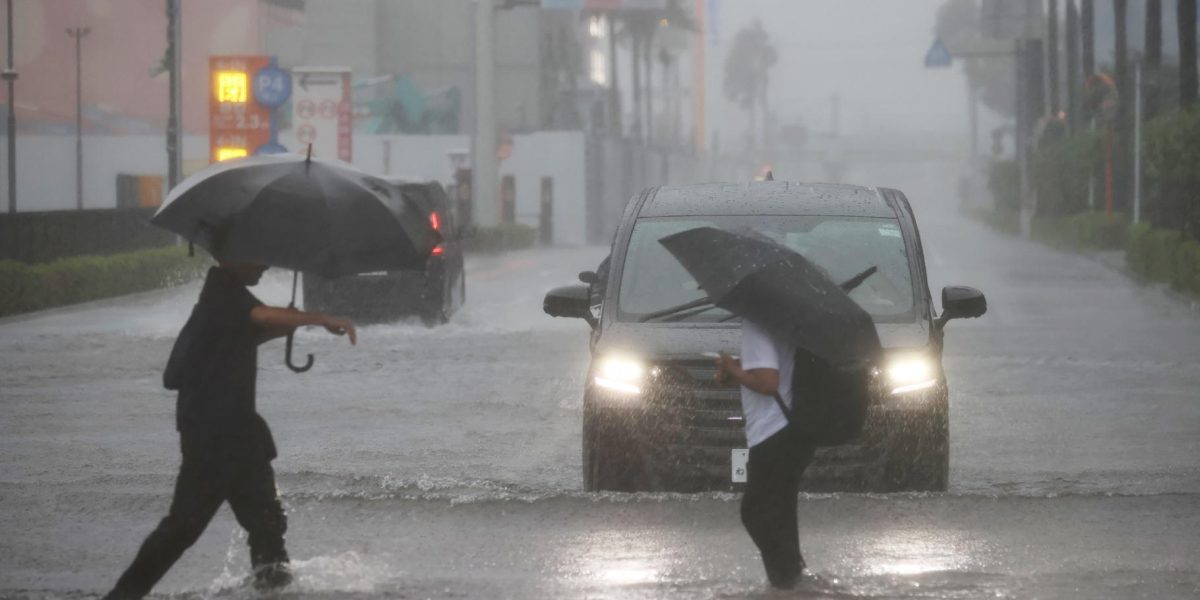
At least four people have died and six remain missing after Typhoon Dujuan battered the Tokyo region with record-breaking rainfall, prompting Japanese authorities to order the evacuation of nearly 1.6 million residents ahead of the storm’s arrival.
The Fire and Disaster Management Agency confirmed that three fatalities occurred in Chiba prefecture, east of Tokyo, while a fourth person died in Kanagawa prefecture, which also borders the capital. Search operations are continuing for six people missing after landslides, and 22 others have been injured.
Widespread Damage and Power Outages
More than 460 homes have been damaged in the Chiba district, according to officials. Tepco, the regional power supplier, reported that 45,000 households remained without electricity as of Tuesday, September 22.
Social media footage showed extensive flooding overwhelming roads around Tokyo, with buildings severely damaged by the storm’s passage. Authorities have also reported multiple landslides across the affected region.
Record-Breaking Precipitation
Oshima island, administratively part of Tokyo, recorded 832 millimeters of rain in 48 hours — more than twice the average for the entire month of September, according to NHK. In Edogawa, near the capital, 282.5 millimeters fell in just 24 hours, also an unprecedented figure.
The typhoon brought sustained winds of 130 kilometers per hour, with gusts reaching up to 194 kilometers per hour.
Warnings Eased as Storm Moves North
The worst appears to have passed. Japan’s meteorological agency has lifted or downgraded most of its heavy rain and landslide warnings as Dujuan continues moving away from the Japanese coast toward the northeast.
Authorities had initially warned of an “imminent threat to life” as the storm approached, leading to the large-scale evacuation order.
Japan’s 25th Typhoon of the Year
Typhoons — tropical cyclones — frequently strike Japan in late summer and early autumn. Dujuan is already the 25th typhoon to cross the country since the start of the year, though this one was particularly intense.
Scientists say climate change driven by human activity is making extreme weather events more frequent, more deadly and more destructive.
Earlier in September, heavy rainfall forced hundreds of athletes competing in the Asian Games hosted by Japan to briefly evacuate their accommodation in the central city of Nagoya.