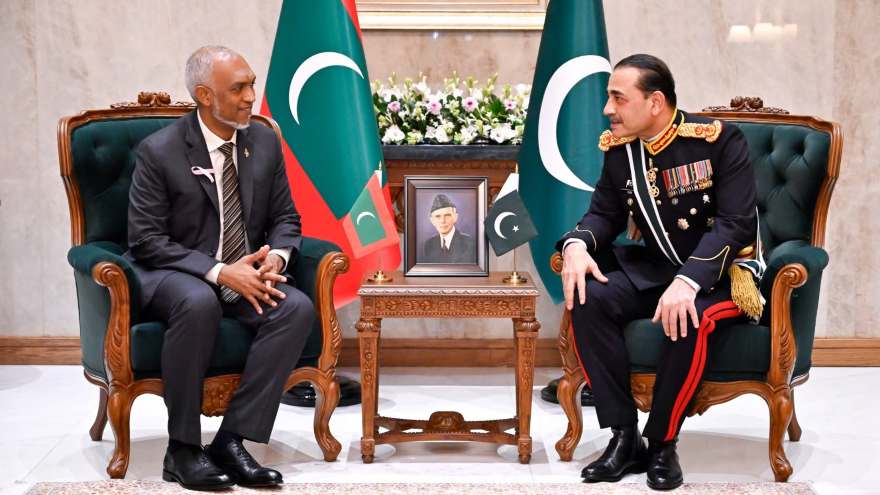
Pakistan’s top military commander and the President of the Maldives held talks in Islamabad on Wednesday, agreeing to strengthen defence cooperation through closer institutional links and professional exchanges, according to officials.
Field Marshal Syed Asim Munir, Pakistan’s Chief of Army Staff and Chief of Defence Forces, received Maldivian President Dr Mohamed Muizzu for a meeting that covered bilateral relations, the regional security environment and avenues for expanding military-to-military engagement.
Defence Cooperation at the Centre of Talks
Both sides underscored the importance of enhancing defence ties between the two countries, with discussions focusing on building stronger institutional linkages and expanding professional exchanges between their armed forces.
The talks reflected a shared interest in maintaining close engagement on defence-related matters and in building on an existing relationship that both governments describe as longstanding and cordial.
Regional Security Dominates Agenda
The prevailing regional security situation featured prominently in the discussions, with peace and stability emerging as key themes of the engagement. Both sides considered the broader security environment and opportunities to coordinate on matters of shared concern.
Field Marshal Munir reaffirmed Islamabad’s commitment to promoting regional peace, stability and security through constructive engagement, stressing the importance of continued dialogue and cooperation between countries.
Muizzu Praises Pakistan’s Armed Forces
President Muizzu commended the professionalism of Pakistan’s armed forces and expressed appreciation for the country’s continued efforts to promote peace and stability across the region, according to a statement carried by Radio Pakistan.
His remarks were seen as a positive assessment of Pakistan’s military capabilities and its regional engagement, as both sides reiterated the value of stronger cooperation.
What the Meeting Signals
The encounter between the Maldivian head of state and Pakistan’s senior military leadership points to a renewed push by both countries to formalise defence contacts and expand the scope of their bilateral relationship beyond traditional areas of cooperation.
Both governments indicated that further engagement on defence-related matters is expected, with institutional connections and professional interaction identified as priority areas for the coming period.