A slogan born from a viral Snapchat screenshot has become one of the most visible rallying cries of France’s student protests — and now Muslim activists are pushing back, with at least one reportedly taking direct action to tear the signs down.
The Origins of a Viral Slogan
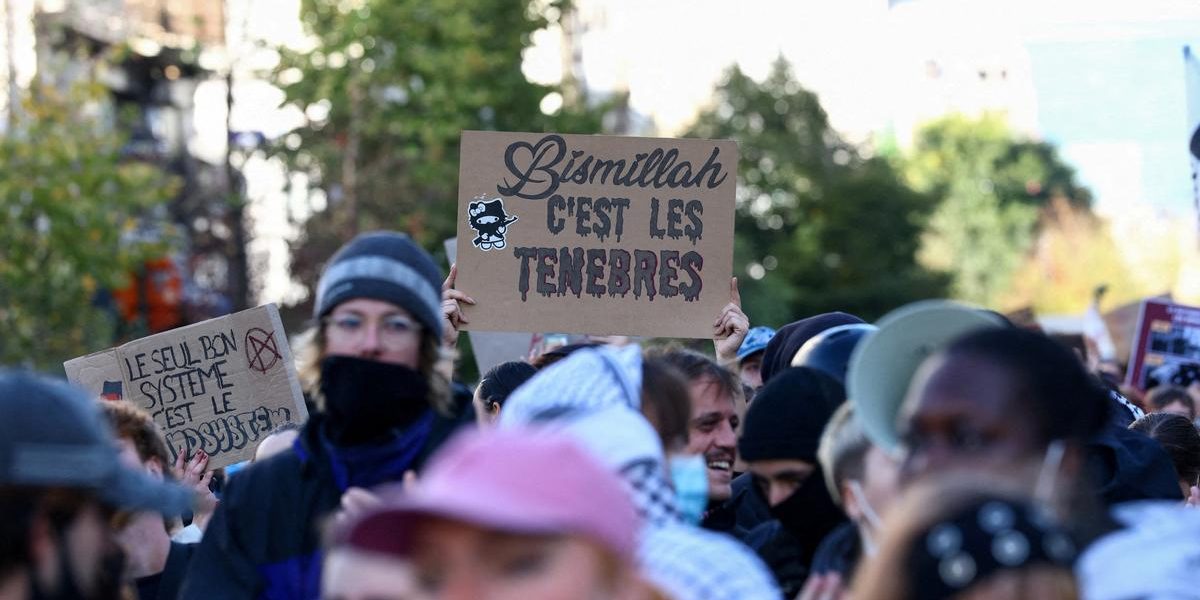
Since the start of the lycée mobilisations, the phrase “Bismillah c’est les ténèbres” — roughly, “Bismillah, it is the darkness” — has appeared on countless placards carried by protesting students. Its unlikely source was an unverified screenshot of a Snapchat conversation, widely shared on social media in early October.
The message, attributed to a certain “Mamadou,” read: “Hi! Bismillah it’s the darkness. It’s when’s the blockade, wallah my brother. We’re going to smash everything. Put me in the Aichek blockade group,” followed by two Algerian flag emojis.
The message was never authenticated. It quickly drew mockery online, with many users deriding the language used and suggesting the note had not been written by a Muslim student at all, but by a police officer seeking to infiltrate a group of mobilised students — a technique, critics noted, that is widely employed by police in their own operations.
Muslim Activists Respond
Whatever its provenance, the slogan has spread far beyond its origins, and Muslim activists have now denounced what they see as the misuse of the word “bismillah” — the invocation of God’s name that opens Islamic prayer and daily life — in protest settings.
At least one activist is reported to have acted on the calls, removing signs bearing the phrase from demonstrators. The episode has exposed tensions within the protest movement itself, pitting freedom of expression against concerns over the stigmatisation of religious language.
A Sign of “Extremism,” Says Islamologist
For one Islamologist quoted in French media, the affair is a telling marker of “extremism” — a signal that religious vocabulary is being drawn into political confrontation in ways that risk deepening communal divides.
The controversy also raises broader questions about how slogans circulate in the digital age: an unverified message, stripped of context, can within days become a fixture of mass mobilisation, and then a flashpoint in its own right.
What Comes Next
- The authenticity of the original Snapchat message remains unestablished.
- Muslim activists are demanding that the phrase be withdrawn from protest displays.
- The dispute has fuelled wider debate in France over the place of religious language in public protest and the boundaries of free expression.
With student mobilisations continuing, the row over four words on a placard shows little sign of fading — and may yet prove as divisive as the protests themselves.