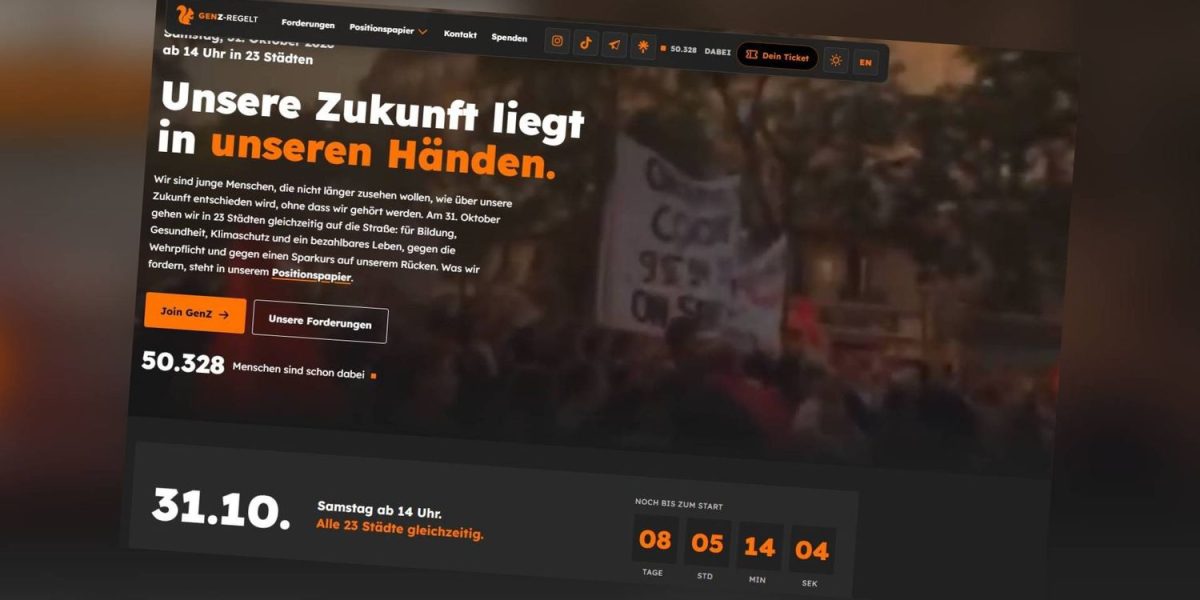
A German youth collective has called for a nationwide day of mobilization on Saturday, October 31, drawing direct inspiration from the protests that have swept France in recent weeks. The group, operating under the name “Gen Z regelt” — roughly translated as “Gen Z has got this” — has announced rallies in 21 German cities, including Berlin, Hamburg, Munich, Cologne, and Frankfurt.
More than 10,000 people had registered online by the morning of Friday, October 23, according to German magazine Der Spiegel, though the figure does not necessarily indicate the actual number of demonstrators who will take to the streets. The movement has adopted a red squirrel as its rallying symbol, the meaning of which remains unclear.
French Influence and Shared Grievances
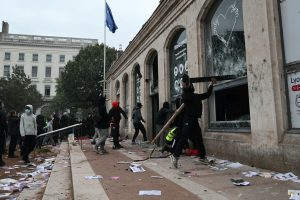
The movement openly acknowledges its French inspiration. On social media, supporters have circulated images from French protests and the violence that erupted during the weekend of October 17-18. One slogan making the rounds declares: “The French are setting the example, we are following it.”
The demands of young German protesters mirror those voiced in French marches: greater investment in education, better-maintained school buildings, and measures to make the cost of living more affordable. The collective is also calling for increased spending on healthcare and climate protection, as well as greater youth participation in political decision-making.
Initial mobilizations have already begun. On Tuesday, October 20, high school students demonstrated in Munich outside the university on Geschwister-Scholl-Platz, a square named after two iconic figures of German resistance to Nazism.
Opposition to Potential Return of Conscription
One of the defining features of the German protest movement is opposition to the possible reintroduction of mandatory military service, which was suspended in 2011. Against the backdrop of deteriorating security conditions in Europe — particularly since Russia’s invasion of Ukraine — the German government has initiated a reform of military recruitment.
Since January 1, 2026, all young Germans receive a questionnaire upon turning 18 regarding their health, aptitudes, and potential interest in serving in the Bundeswehr, the German armed forces. Men are required to respond, while participation remains voluntary for women. The reform also reinstates the obligation for men born from 2008 onward to undergo a military fitness examination.
At this stage, military engagement remains voluntary. However, the reform stipulates that in the event of insufficient recruitment or a deterioration in the security situation, the government may ask the Bundestag, Germany’s lower house of parliament, to vote on reinstating compulsory service. Berlin’s objective is to significantly strengthen its armed forces, aiming for more than 260,000 active-duty soldiers and 200,000 reservists — over 460,000 personnel in total — by 2035. For some young people, these new administrative obligations already represent a first step toward the return of conscription.
Authorities Concerned by Images of French Violence
Organizers of the October 31 mobilization insist they intend to protest peacefully. But some appeals circulating on social media have raised concerns among authorities. In Stuttgart, an Instagram account associated with the movement has published montages featuring scenes of clashes that occurred in France.
Speaking to regional public broadcaster SWR, Kolja, a student involved in the movement, acknowledged that such videos can appeal to young internet users, citing their catchy music, dramatic character, and popularity among Generation Z.
Germany’s Interior Ministry has warned against the risk of extremist groups co-opting the protests and potentially committing violence. Authorities nevertheless distinguish such militants from the high school and university students who wish to demonstrate peacefully. Police are preparing security arrangements accordingly. In Frankfurt, where a demonstration has already been registered, organizers expect 1,700 participants.
Another scheduling particularity is causing concern for law enforcement: October 31 coincides with Halloween. The celebrations already require significant police resources and have been marked in some years by incidents and property damage. The GdP police union fears that student gatherings combined with Halloween festivities could complicate maintaining public order.
It remains to be seen whether the German mobilization will reach the scale of those observed in France. For now, organizers are making their ambition clear: to give voice to a generation that believes decisions about its future are being made without it.