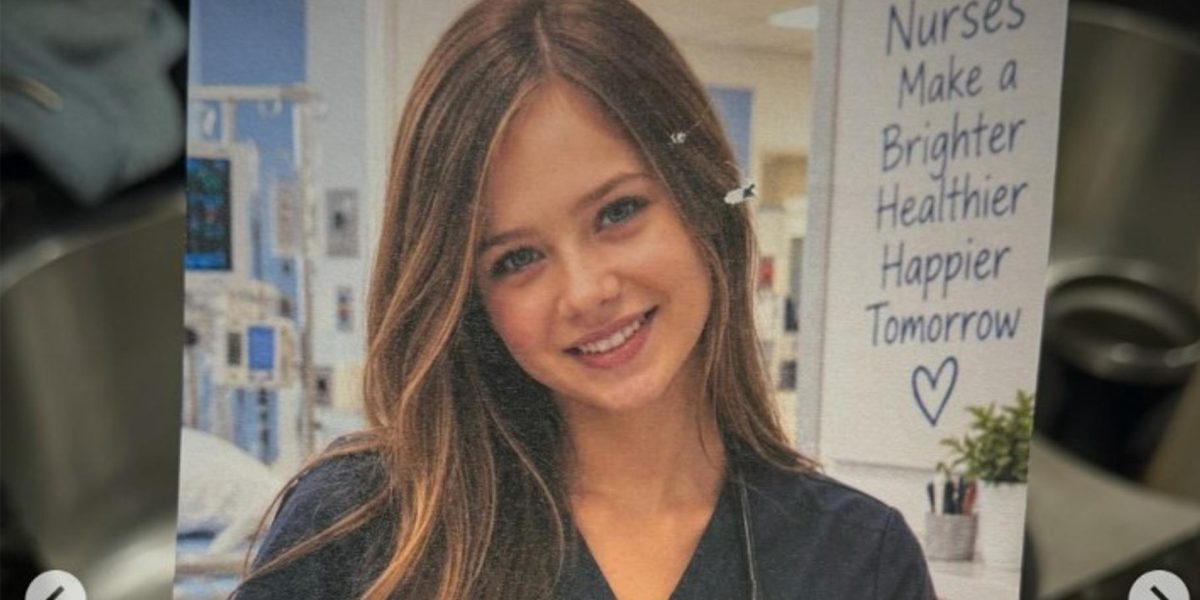
A South Carolina mother has publicly condemned her daughter’s elementary school for using artificial intelligence to generate an “adult version” of her six-year-old child without her knowledge or consent, igniting a wider debate about AI’s role in education and the protection of children’s privacy.
A Mother’s Disbelief
Nikki Anderson, 32, said she was left stunned when her daughter Harper brought home a computer-generated image depicting herself at age 25, dressed as a nurse—the profession the young girl hopes to pursue. In an Instagram post published on October 18 that has since gone viral, Anderson described her shock at seeing the fabricated, idealized image of her child, whose features appeared to conform to algorithmic beauty standards.
“Did a teacher really upload my daughter’s photo somewhere to do this, knowing what we know about AI?” Anderson told People magazine. “I was genuinely incredulous.”
Stifling Childhood Creativity
For Anderson, the image represents one of the core problems with AI in education: it curbs children’s imagination. To illustrate her point, she shared alongside the AI-generated picture a collage Harper had made herself using paper, scissors, and glue to depict herself as a nurse.
“Everything in that drawing was a decision she made,” Anderson wrote. “What does a nurse look like? What hospital does she work in? That’s childhood creativity, imagination, cognitive development.”
She argued that six-year-olds are already creative and capable of imagining futures adults could never predict. “Why outsource that?” she asked. “Harper is six, and she’s at that incredible age where the world is still full of possibilities. She doesn’t need a computer to tell her what she could become.”
Distorted Self-Image and Privacy Concerns
Anderson also worries the image may give her daughter a false sense of self and unrealistic expectations. “She said she loved the photo because she had straight and wavy hair, which is what she always wanted, and that she hoped she’d be as pretty when she grew up,” Anderson recounted. “I told her it was just a guess, that she might not look like that… She hopes she will.”
Beyond the psychological impact, Anderson raised concerns about data privacy. “What software was used? Was it an external platform? What happens to these photos afterward? These are questions every parent deserves answers to,” she insisted, adding that children “cannot give informed consent to this kind of use.”
Community Support and Calls for Safeguards
Anderson said she has asked her daughter’s school administration for answers but has not yet received a response. Her post has nonetheless resonated widely, with parents and teachers expressing alarm about AI use in schools.
“Your child’s imagination is wonderful and your desire to protect it is admirable and necessary,” one commenter wrote. Another said she would be “absolutely furious” if her child’s school generated AI photos of her child, calling it “beyond irresponsible, not to mention the ethical and environmental costs.”
Many teachers also voiced support, noting that the school had no legal right to use AI in this manner. Anderson thanked them while stressing that her criticism was not aimed at educators but at the need for safeguards. “Teachers are already asked to do an enormous amount with limited resources, and I don’t think the responsibility of navigating an entirely new technological environment should rest solely on them,” she concluded.