PARIS — On the eve of a new nationwide day of mobilization, students at the blockaded University of Paris Cité say they are more determined than ever, even as the government announces tougher security measures following last week’s violent clashes.
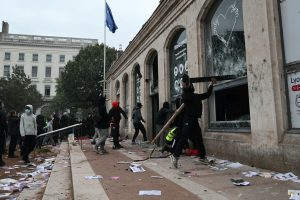
The youth intersyndicale has called for a new day of protest on Saturday, October 24, alongside the CGT union, Solidaires, and the coordination of the Yellow Vests. But after the October 17 demonstrations — which saw 3,000 shops looted and widespread violence on the margins of the processions — the mood on mobilized campuses has shifted.
A Movement Tested by Violence
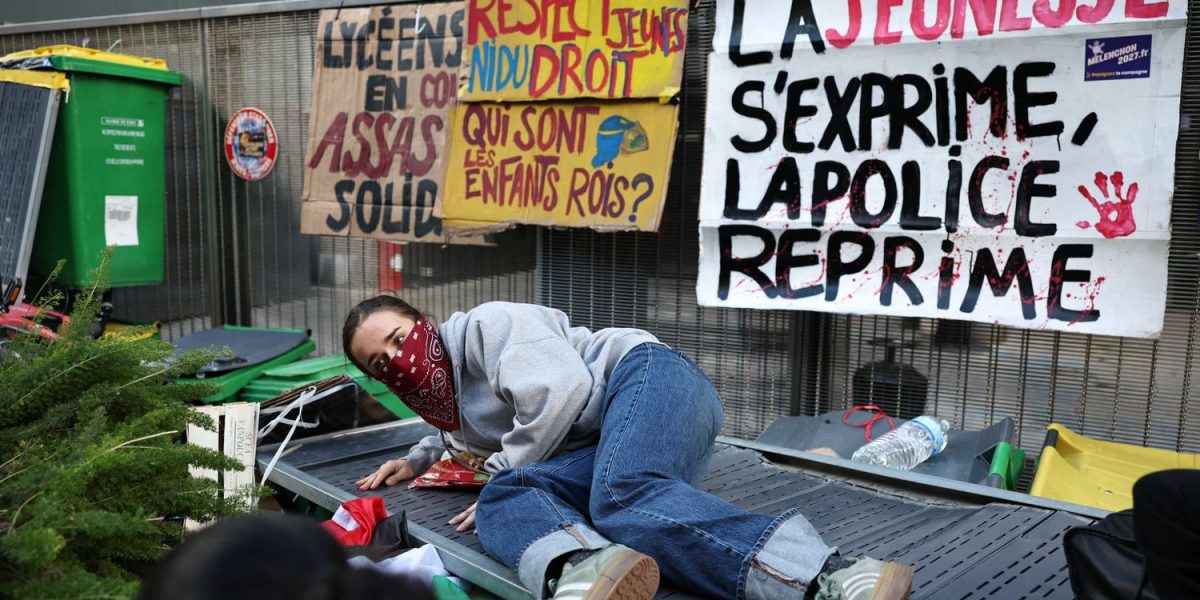
At Paris Cité, blocked for several weeks, the wind has scattered placards and the rain has dispersed the crowds. But inside, the blockade continues. Some students occupy the gymnasium; others attend an informal sociology class on conflict in an association room — a lesson that mirrors their daily reality.
Alba, Lila, and Ana, master’s students mobilized since the start of the movement, take a break. “There’s a need to see how far the government is willing to go. If we stop now, we’ve lost, they’ve won,” says Alba. “We want to see how far the repression can go. It only keeps deteriorating. Macron is just spitting in our faces, collectively! The more he reacts like this, the more he fuels the anger.”
“I don’t understand how anyone couldn’t want to demonstrate even more. It just makes me want to keep going,” adds her friend.
Fear and Resolve
The three friends witnessed some of last Saturday’s violence. They saw on television the images of the 3,000 looted shops. One says she was “shocked” by the “mess.”
“Of course, I’m against looting small businesses. I think it’s a real shame that everything revolved around that. I understand, things were broken, but people were broken too. People were beaten. Even within the system, the state breaks people, breaks lives,” says another.
“For me, it’s a sign of enormous despair. If we all had a secure living environment, resources, no one would loot. There would be no reason to do it,” adds a Parisian student.
The government has announced a larger law enforcement deployment for Saturday, including the possibility of extending custody for suspected rioters up to 72 hours. For Ana, the tone has changed — but it doesn’t deter her. On the contrary.
“Yes, mobilizing next Saturday won’t be the same as last Saturday. But it’s not because of the violence, it’s because of the repression and the risk of ending up in custody. It puts us in a position where you already feel like a criminal. Potentially, won’t this push people to say, ‘Well, doomed is doomed, I’ll do what you accuse me of. If I’m going to be flagged, I might as well be flagged for something I actually did and that actually had an impact’?” she says.
Alba nods but stares at the ground. Debating among students at university doesn’t erase her fear of returning to protest tomorrow. “I’m terrified by everything that’s happening, by the violence we see, and I don’t know how far I could go,” she admits.
The three friends attended very peaceful demonstrations until they felt tear gas. They didn’t understand why gas was deployed when children were nearby. “We’re all traumatized. Every loud noise, we think it’s a grenade,” Alba confides.
From Peaceful Protest to Radicalization
Two streets away, Alexis and Lucas block a university building. Their placard reads “Fuck the RN and long live math.” They are undergraduates in mathematics, physics, and computer science. They have always advocated peaceful protests. They are beginning to change their minds.
The two students denounce never having been heard even as violence takes center stage. “We’ve done peaceful protests. And what happened? All our demands were completely overshadowed,” says one.
Measures ‘Too Late’
Since the start of the movement, the government has promised announcements at the end of the month, and the agenda accelerated this week. A first series of decisions will be detailed Monday on staffing, substitute teachers, and Parcoursup, the national university admissions platform.
For Iryna, a literature student, it is “too late” and “no longer enough.”
“Everyone has their own demands — improving working conditions, living conditions, study conditions. Not looking at your bank account at the end of the month and having a knot in your stomach. There’s also the question of transport, food, inflation. There are many things to demand. And I think this movement is a kind of mixture that creates an explosive cocktail,” says Elsa, in her twenties.
She adds that France is now being watched by all of Europe, referring to recent protests in Italy, Belgium, Greece, and Albania. “I heard this phrase: when France sneezes, the world catches a cold. We’re not alone in our university, the world is listening to us,” she concludes with hope.
The support of European high schoolers plays heavily on the motivation of French students. “There’s a bit of ego, we have something to prove now, but also we feel heard. In Germany, we received videos of German high schoolers sending strength to French high schoolers. It’s motivating. That’s also what keeps me going personally. That and the revolt,” says Elsa. “The world is ours!”
Elsa has even planned to go to Bologna this weekend. She wants to exchange with Italian student unions and participate in the demonstrations planned tomorrow in the country.