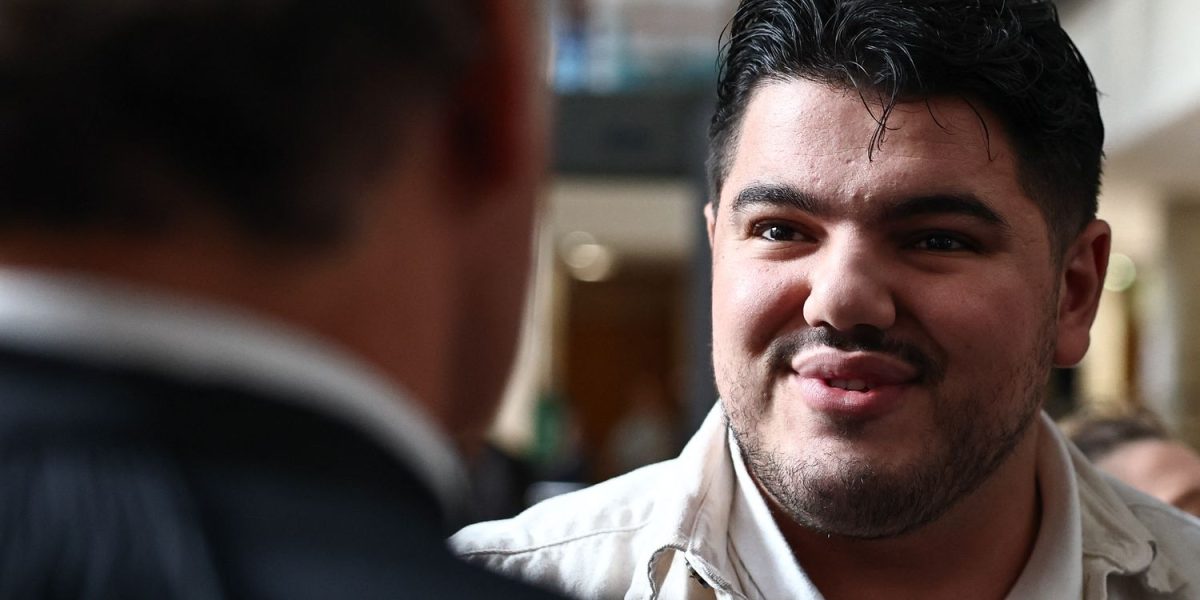
He describes himself as the second most protected public figure in France after President Emmanuel Macron. When he travels, it is in an armored vehicle, sometimes wearing a bulletproof vest, always surrounded by police officers who never leave his side. This is the daily reality for Amine Kessaci, the elected official who has become the face of Marseille’s battle against drug trafficking.
“Today, I am in a survival phase,” Kessaci said in a podcast interview with Brut. “I am regularly forced to change where I live, I am never in a fixed location, sometimes I can see my relatives, sometimes I cannot. Sometimes I am completely isolated, completely cut off from society in a bubble, on military bases. This is not a life. This is not a life to live like this.”
A Family Torn Apart by Drug Violence
The objective is clear: he must not end up like two of his brothers, both assassinated. The first was Brahim, his older brother who was involved in drug trafficking. In December 2020, at age 22, he was found burned inside the trunk of a car in Les Pennes-Mirabeau, near Marseille.
For more than a month, Amine Kessaci — then 17 years old and in his final year of high school — stopped attending classes. He stayed in his bedroom, curtains drawn. His mother, who works as a cleaner, convinced him to resume the fight.
Even then, the teenager was already an activist. At school, he was class representative and involved in every cause. He was also president of an association he had founded months earlier called Conscience Écologique, which organized cleanups of the streets in Frais-Vallon, the housing project in Marseille’s northern neighborhoods where he grew up.
After Brahim’s death, Conscience Écologique was renamed simply Conscience. Its mission: to support families victimized by drug traffickers, providing psychologists, lawyers, financial assistance for funerals, and help with administrative paperwork. All done with audacity.
Confronting the President
In September 2021, Emmanuel Macron traveled to Marseille to present his “Marseille en Grand” urban renewal plan. At a meeting where he sat near the president, Amine Kessaci challenged the head of state directly. The scene was captured by the television program Envoyé Spécial.
“What I want to tell you is that there is no point in coming with a plan that was made on a plane or I don’t know where,” he said. “This plan needs to be built with us — with local elected officials, with associations, with families of victims — because we also have testimony to provide, because we also have a lived experience, a story that is very important.”
Two years later, in a podcast called Ces Voix Qu’il Faut Entendre, Kessaci — then a law student — was even more incensed.
“Over two years, nearly 55 families have been broken, 55 families in mourning. Over two years, I have gone to see these 55 mothers and offered them my condolences. It has become a habit; I no longer even feel emotion when I go to see them,” he said. “The police who come, the CRS 8 riot squad, that is not what we need. They fine people for lack of insurance and bald tires, and that is all they do with their day. So stop! Let the Interior Ministry stop saying they are waging a war on drug trafficking, because their war is cute, their war is all pretty. For me, war is not that.”
A Second Brother Lost
In November 2023, Mehdi, his younger brother — who had nothing to do with drug trafficking — was shot dead at age 20 in broad daylight on a Marseille street.
Was Amine Kessaci intimidated? Would he give up? “I will not be silent,” he said. “And I will never stop repeating that. I will not be silent.”
Born for Politics
Amine Kessaci recalls a night from his childhood when his mother took him in the car late at night. She was going to retrieve Brahim, his older brother, who was stationed at a drug dealing spot. From the back seat, he watched.
“She came face to face with a network boss, a big figure from the neighborhood where we had gone to find my brother,” he remembered. “She had planted her feet on the ground, she stood facing him, head held high as she knows how to do. The man threatened her with a weapon, and she showed absolute courage — she stayed standing in front of him saying she would not leave without Brahim, and after a few minutes, she came back with my brother.”
Amine Kessaci’s unwavering commitment may have been born that night. Since then, he has become the face of the fight against drug trafficking in Marseille and now serves as deputy to Benoît Payan, the city’s left-leaning mayor. One of his former high school teachers confided: “He is made for politics.” Indeed, Amine recalls that as a child — and his mother confirms it — he preferred watching Public Sénat, the parliamentary channel, rather than cartoons.
A Trial and a Reckoning
The trial of the alleged killers of his older brother opened Monday in Aix-en-Provence. In the dock are five accused, including the man suspected of leading the DZ Mafia cartel. Amine Kessaci attended the proceedings, seeking what he has described as “justice,” not “vengeance.”
His presence in the courtroom is yet another chapter in a life defined by loss and resilience — a life that has made him one of the most recognizable and protected figures in France, and a relentless voice demanding that the state do more to confront the violence consuming Marseille’s neighborhoods.