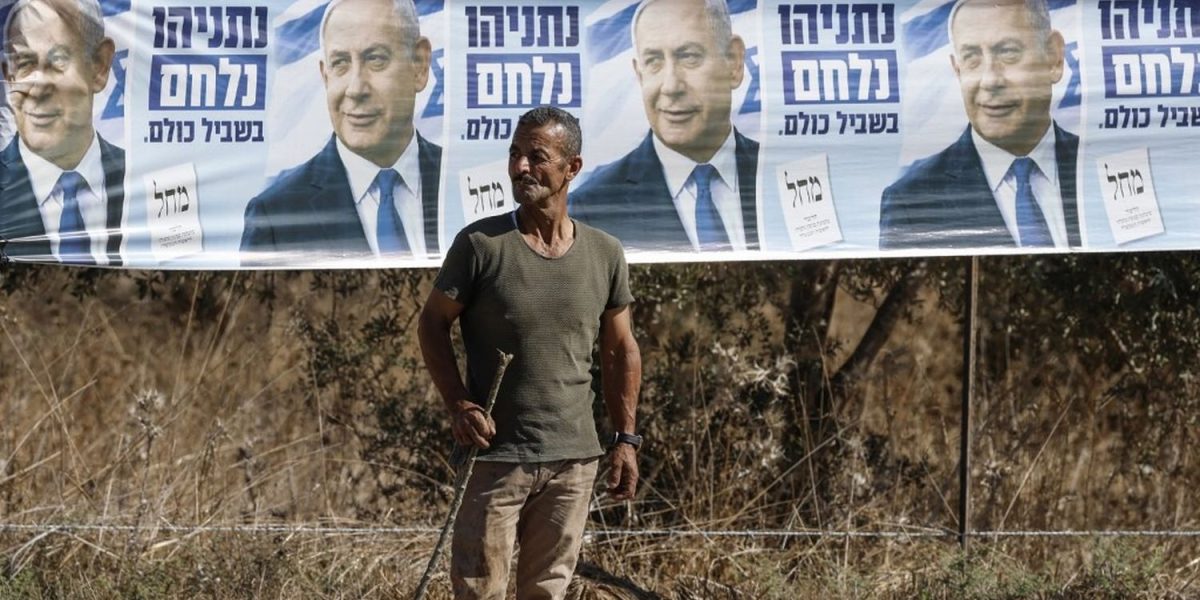
As Israelis prepare to vote in legislative elections on Tuesday, the question of who will lead the government is dominating headlines. But beyond the leadership contest between Prime Minister Benjamin Netanyahu and his rivals, the vote carries profound implications for the future of Gaza and the occupied West Bank — territories whose fate is being largely overlooked on the campaign trail.
According to analysts, the Palestinian question has been “largely marginalized” in a campaign defined instead by security concerns and accountability for the October 7 attacks. “Israeli politics can never detach itself from the Palestinian question, which has consequences for both domestic and foreign policy,” said Hugh Lovatt, a researcher at the European Council on Foreign Relations (ECFR). Yet despite the conflict’s importance to Israel’s daily life and future, the fate of Gaza and the occupied West Bank remains a subject “largely marginalized” in the campaign, the specialist noted.
A Diplomatic Solution Now ‘Almost Unthinkable’
“Ten or twenty years ago, some parties still raised the prospect of economic peace, or even the two-state solution,” recalled Ksenia Svetlova, an associate researcher at Chatham House and former Knesset member between 2015 and 2019. But since the October 7 attacks, during which more than 1,200 people were killed by Hamas terrorists, “there is little appetite for any initiative centered on peace,” she analyzed.
“In this campaign, the main issue is security and Israel’s defense. More broadly, the stakes of the election are about who will hold power, how it will be used, and against whom,” Svetlova told franceinfo.
With the trauma left by October 7, Israeli society has become “radicalized,” added Lovatt. “Anti-Palestinian ideology and opposition to a Palestinian state, which already existed before, have been legitimized and amplified” since the Hamas attacks, the researcher continued.
In this context, two priorities have emerged in a vote that resembles above all a referendum for or against Netanyahu: establishing responsibility for the failures that led to October 7 — as several media outlets report the Prime Minister had received warnings about imminent attacks — and guaranteeing the security of the Jewish state.
On the eve of the election, few parties are putting forward a diplomatic solution to achieve that second objective. “The idea of negotiations is almost unthinkable in the current climate,” Svetlova said. Netanyahu, leading a coalition of right-wing and far-right parties, is firmly opposed to the creation of a Palestinian state. He continues to defend his plan for “total victory” over Hamas in Gaza, but has no “clear plan” to achieve it, according to the Jerusalem Post.
For Svetlova, the Prime Minister has “slowed” the implementation of the US-brokered agreement to end the conflict in the enclave. His remaining in power would amount to a status quo, with “a situation that is neither open war nor peace” in Gaza, as well as a “de facto annexation of the occupied West Bank,” the researcher insisted.
Opposition ‘More Inclined to Restrict Settlement Expansion’
As Reuters noted, the Israeli Prime Minister’s project is partly influenced by his far-right allies, some of whom openly support the idea of annexing Palestinian territories. Under Netanyahu, Israeli settlements in the occupied West Bank — considered illegal under international law — have multiplied. So too has settler violence and intimidation against Palestinians, which has steadily increased as the election approaches: between October 1 and 9, the nonprofit organization Acled recorded nearly forty incidents daily, compared with about twenty per day in September.
The far right is advocating an even more radical agenda. Itamar Ben Gvir, leader of an ultranationalist party and current Minister of National Security, proposed in early September to empty the Gaza Strip of its two million inhabitants. A “transfer” he describes as “voluntary,” to be carried out over six years, the time needed to “encourage emigration” of a population already displaced multiple times during three years of war.
He is also targeting the rest of the Palestinian territories. “We must not wait for an October 7 to happen [in the occupied West Bank]. That is where the next war will break out,” he declared Friday, reacting to an attack that wounded five Israelis near Hebron. “The Palestinian Authority [which administers part of the territory] must be dismantled and demilitarized,” he added.
Would a change in governing coalition allow for a different approach? In the event of a victory by Netanyahu’s main rival, Gadi Eisenkot, the difference with the current Prime Minister would be minimal, Lovatt argued. The centrist, a former Israeli military chief of staff and political novice, also opposes the idea of a Palestinian state. He would, however, be “more inclined to restrict the expansion of unauthorized [by the Israeli government] settlements in the occupied West Bank, and to combat extremism among certain settlers,” Lovatt continued. In early October, Eisenkot described the surge in violence against Palestinians as “Jewish terrorism.”
An Election Watched by Palestinians
The former general, whose son was killed in the Gaza war, “does not mention a diplomatic solution” to resolve the conflict in the enclave, Svetlova noted. While he has criticized Netanyahu for his “resounding failure” in the war against Hamas, Eisenkot has also promised to defeat the Palestinian Islamist movement, even if it means launching new military operations. “We might see in the opposition a greater willingness to implement the second phase of the American peace plan,” which calls for the disarmament of the Palestinian Islamist movement, “but it would also have red lines,” Lovatt noted.
“Would the opposition [led by Eisenkot] accept the gradual withdrawal of the Israeli army from Gaza? I doubt it. Would they allow Palestinians to return to their land? I doubt it,” Lovatt said.
“The only one talking about stabilizing and rebuilding Gaza, about establishing new governance there, is Yair Golan,” said Svetlova, referring to the leader of the left-wing Democrats party. Without openly supporting the two-state solution, he advocates a diplomatic resolution to the Gaza conflict, condemns violence committed by Israeli settlers, and plans to end state-funded settlements, according to the Jerusalem Post. While Golan’s party “appears positioned to have about ten seats in the next Parliament, compared with four currently,” it “would represent only 10%” of the Knesset, the researcher cautioned.
According to polls, the future Israeli Parliament is expected to be highly fragmented. Arab parties, which represent about 20% of the Israeli population and are credited with about a dozen seats, could prove decisive in forming the next government. While the Unified List supports the creation of a Palestinian state, the Raam party “focuses on improving the daily lives of Palestinian citizens of Israel, fighting discrimination and the surge in crime,” Svetlova noted. But only Golan’s party has so far said it is ready to form a coalition with them.
Little Hope on the Palestinian Side
Across the border, in the Palestinian territories, observers are also watching the election outcome closely. “We want an Israeli prime minister who will recognize the suffering of the Palestinian people and the responsibility [of the Jewish state] for that suffering,” Mohammed Shtayyeh, former Prime Minister of the Palestinian Authority and a Fatah official, told Haaretz. According to the newspaper, Palestinians nonetheless hold little hope that their daily lives will improve.
“If the current coalition remains in power, the situation in Gaza and the occupied West Bank will continue to deteriorate,” Svetlova estimated. “That would be the worst-case scenario for the Palestinian territories, for Israel, and for the entire region.” Hamas leader Khalil al-Hayya was even more pessimistic in early October. In an interview with Qatari television Al Araby, he said: “Whoever comes to power, from this party or another… our people have suffered at the hands of all Israeli parties.”