Thousands of ID photographs and the names of school pupils are now in the hands of the police. In Brest, in the Finistère department of western France, the seizure of yearbooks from three lycées amid a wave of student protest has provoked outrage among teachers, parents and pupils — and raised a pointed legal question: are police entitled to use school documents to identify people suspected of involvement in incidents at demonstrations?
The answer is yes, but only under certain conditions. In the context of a criminal investigation, officers may request the transfer of documents useful to their inquiries, notably through a judicial requisition. But the collection of personal data must follow strict rules, and its proportionality can be challenged.
Plainclothes Officers at Kerichen School Complex
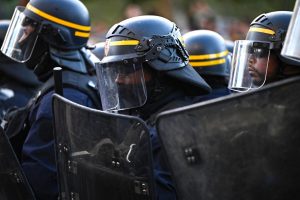
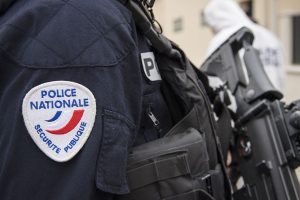
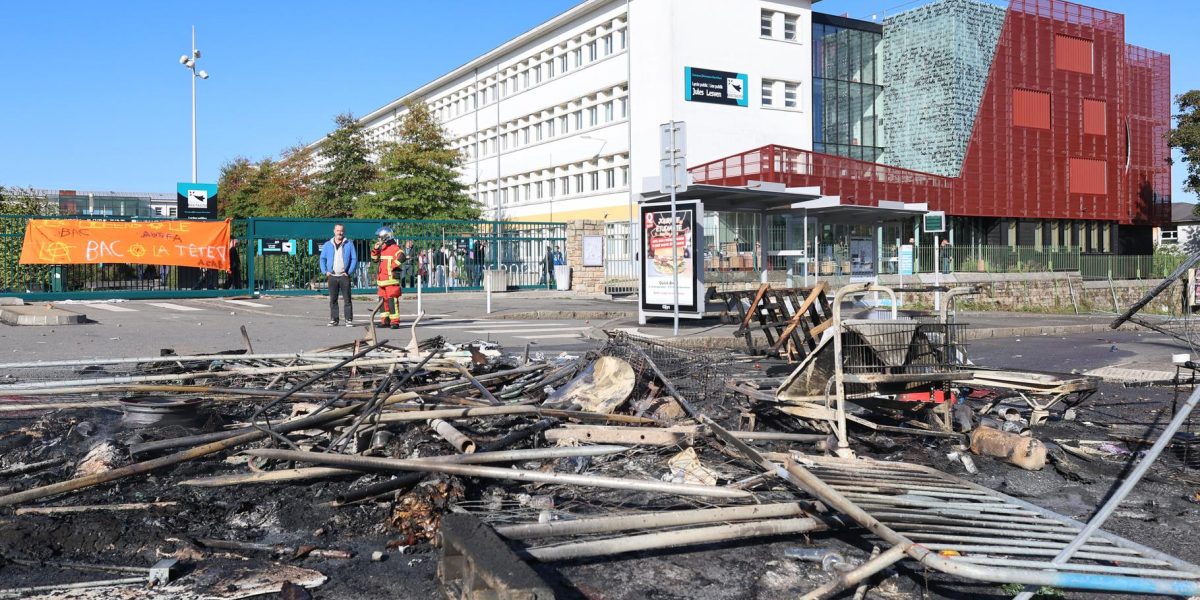
That is precisely the dispute unfolding in Brest. On Wednesday, November 4, two plainclothes police officers arrived at the Kerichen school complex, which brings together the Vauban, Lesven and La Pérouse-Kerichen lycées. The complex has been one of the main hubs of student mobilisation in the city for several weeks. Armed with a judicial requisition, the officers obtained the schools’ yearbooks, containing the names, first names and photographs of more than 4,000 pupils.
The Brest public prosecutor’s office confirmed that an investigation is under way. “A criminal investigation against persons unknown is in progress, giving rise to all investigations and verifications useful to establishing the truth, both for and against,” prosecutor Stéphane Kellenberger said, according to local outlet ICI Breizh Izel.
Schools Say Refusal Was Not an Option
The heads of the institutions concerned say they had no ability to oppose the police request — a position backed by the Rennes education authority, which oversees the schools. “This is a legal obligation. Refusing to comply would have constituted a criminal offence,” it told Mediapart.
In a message sent to families on Monday, November 9, the headteachers sought to reassure parents, describing the seizure as a “targeted and supervised measure.” One school head insisted that “this is in no way systematic profiling or a collection of data for purposes other than the investigation under way.”
But the explanation has done little to allay concerns, because while the requisition is provided for by law, the question remains whether collecting such a large number of photographs was genuinely necessary to the inquiry.
Concern Over the Fate of Sensitive Data
That is exactly the point raised by the Syndicat des avocats de France (SAF), which cites European and French rules governing the processing of personal data by judicial authorities.
“Under the European ‘Police-Justice’ directive as well as the French data protection law, these photos constitute sensitive personal data, and such a requisition can only be made in cases of ‘absolute necessity,'” Anna Blanchot-Giovannoni, co-president of the SAF’s Brest branch, told Mediapart. “Is that really the case here?”
Beyond the legality of the requisition, opponents of the seizure are also worried about what will become of the information obtained by investigators. “It is legal if there is an absolute necessity. That criterion can already be questioned, and above all the future of this sensitive personal data in the hands of the police and the prosecutor’s office. It is virtually impossible to have it deleted,” Blanchot-Giovannoni added.
Protest at the School Gates
On Monday, November 9, nearly 200 people gathered at the school complex to demand explanations. A banner made by pupils read: “What, how and why? Yearbooks: we want answers,” according to ICI Breizh Izel.
Among the pupils mobilised, Milos, a first-year student at Vauban, said he was not entirely surprised by the police intervention but questioned his school’s role in the affair, asking whether his institution was “complicit in this state of oppression.”
Anxiety is equally acute among parents. Erwan, a father, made no secret of his astonishment. “This is a first — for us it’s a shock. We thought our children’s important personal data was safe; clearly it wasn’t. We are deeply afraid of profiling.”
“For a handful of people who committed an act, do we need to take thousands of photos and identities? We contest the volume and the absence of any prior investigation,” said Julie Le Goïc, a literature and history teacher and municipal councillor for La France Insoumise in Brest, speaking to ICI Breizh Izel.
Several unions have announced their intention to refer the matter to the CNIL, France’s national data protection authority.
A Precedent in Gennevilliers
The Brest case is not the first to raise questions about police use of school yearbooks. On October 7, at the Galilée lycée in Gennevilliers, in the Hauts-de-Seine department, officers consulted pupils’ photographs to identify a young man suspected of firing mortar fireworks near the school during a mobilisation.
According to several teaching unions cited by actu.fr, the headteacher agreed to show the yearbooks to police, who wanted to compare them with photographs taken in the street. The identified pupil was subsequently arrested at his lycée and placed in police custody.
The Paris police prefecture confirmed the arrest at the school, with the management’s agreement, stating that it formed part of a flagrant-offence procedure.