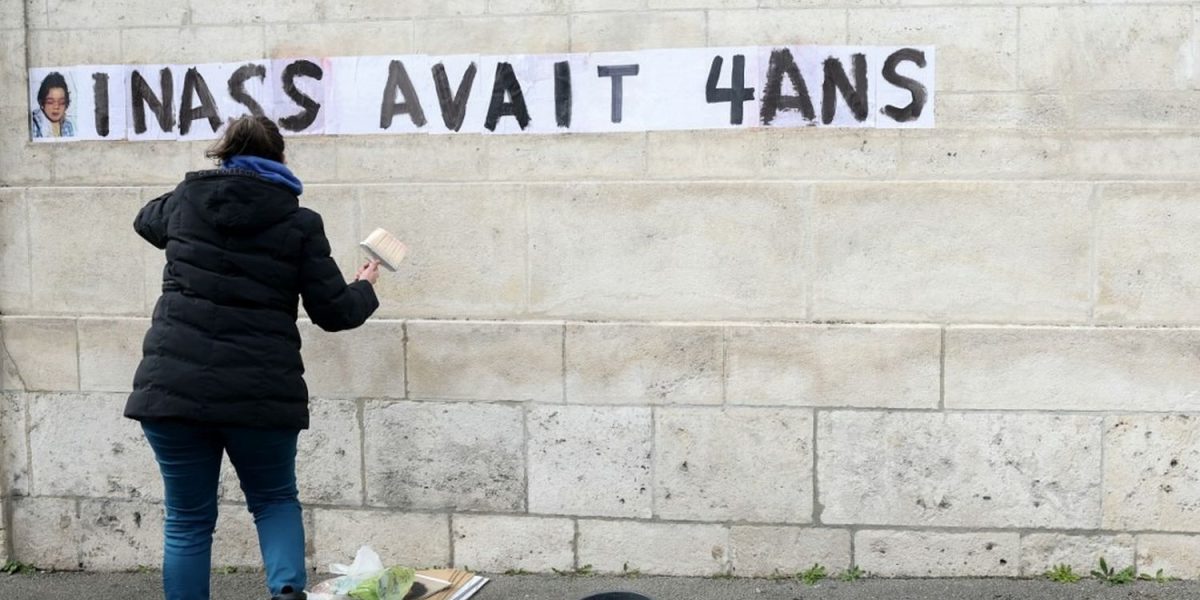
On the notice boards fixed to the railings of the Blois courthouse, passers-by have scrawled a name in black marker over each printed sheet: “Inass Touloub.” The public, visibly frustrated at seeing the little girl’s identity erased from the official notices for the “trial of the martyr of the A10,” wrote her name in by hand—a small act of restoration for a victim who remained anonymous for more than three decades.
Inside the courtroom, the child’s first name echoed through ten days of proceedings before the Loir-et-Cher criminal court, culminating Monday in the prosecution’s closing arguments. The state requested 20 years’ imprisonment for the girl’s mother and 14 years for her father. Before the verdict, expected Tuesday, November 17, the court was forced to confront the ordeal endured by the four-year-old through photographs of her tortured body projected at the hearing—and to hear, lesion by lesion, the nature of the injuries found on every inch of her skin.
A Childhood Reduced to Two Photographs
“I don’t remember,” Halima El Bakhti repeated each time she was asked to describe the chronic violence inflicted on her child. Her ex-husband, Ahmed Touloub, 74, often gave nebulous answers, citing memory problems. But beyond Inass’s suffering, each side sought to understand how she lived her short existence—from her birth in Casablanca on July 3, 1983, to her death in France on August 10, 1987. What was her daily life like? Did she ever play? What did her voice sound like?
When the trial opened on November 2, only one photograph of the girl alive had circulated publicly. On her missing-person notice—posted from 1988 in town halls, post offices, train stations and airports—the child appears with her eyes closed, seemingly asleep. Her swollen eye and bruised mouth had been retouched to avoid shocking the public. It was impossible to show the state in which she was discovered on August 11, 1987, along the expressway between Orléans and Blois.
On the third day, images of her remains, laid on the metal table of the medical examiner, were shown. The photographs were unbearable. Her injuries were listed one by one. Halima El Bakhti collapsed. The hearing was suspended.
But that same day, a photograph of Inass alive was also projected: the girl, about one year old, seated beside her maternal grandmother, whose arm is wrapped around the child. It was her grandmother who raised her during her first year in Morocco. The yellowed image was found tucked between the pages of a book on her mother’s bedside table.
On the fifth day, a second photograph emerged from the case file—part of an album seized by gendarmes at the mother’s home. Inass stands in a white dress, surrounded by adults and children from the family. She is about two. Her large, expressive eyes stare into the lens.
Fragments of Happiness in Morocco
“When she was there, with my mother and my brothers and sisters, she was fine,” Halima El Bakhti recalled from the stand. In her closing plea Monday, Agathe Morel, lawyer for the association Enfance et Partage, traced the child’s moments of joy in her native land: “We know she went out, that she went to parks in Casablanca. Perhaps she went to the beach, met her neighbors, the neighbors’ children. Perhaps she even laughed, Inass.”
In 1984, after a year apart from her parents and siblings, her mother decided to bring her back to France. But the little girl rejected her. Halima El Bakhti had become a stranger. The bond was broken—already frayed at birth, when Inass was taken from her for several days. Her mother caught only a glimpse of “her little feet, her little fingers” protruding from the crib. “That’s all I saw of my daughter,” she said, without explaining why.
“Because of the failure to bond with the little girl, Halima El Bakhti experienced emotional rejection from her,” psychiatrist Roland Coutanceau testified.
Inass then left Morocco and her grandmother’s arms, against her will, for the small family apartment in Vitry-sur-Seine, southeast of Paris, joining two older sisters and a younger brother born in spring 1984. Everything was new—including living with her father, whom she met for the first time. Ahmed Touloub had not been present at his wife’s delivery. His arrival appears to have been joyful; her eldest sister recalls a celebration.
‘She Doesn’t Want Anything. Absolutely Nothing.’
But Inass’s distress was evident. “She cries, she doesn’t want me to change her. When I feed her, she vomits. She doesn’t want anything. Absolutely nothing,” her mother said during questioning. The violence began—and became routine. Slaps, blows, burns, bites. Inass, soon covered in traces of the abuse, was hidden from the outside world. All that is known is that she occasionally played with dolls with her sisters, sometimes in the backyard of the family’s apartment in Puteaux.
Did she even speak? In the case file, her mother consistently described her as mute. “I never heard her speak,” she maintained. “Yes, she speaks,” Ahmed Touloub contradicted in court. “In what language?” the presiding judge asked. “In Arabic, because we speak Arabic at home.” She could say “papa, maman,” the 74-year-old added in his rasping voice.
Never enrolled in school, never vaccinated, she never saw a doctor—unlike her six siblings. “She stays in a corner watching the door,” Halima El Bakhti told the court. Everyone in the room pictured the girl huddled at home, alone from morning to night. “I didn’t really take care of her,” her mother eventually admitted under questioning.
“At no point did Inass come looking for comfort, whether with words or gestures?” lawyer Agathe Morel asked the father. “No. In our mountain culture, we don’t hold children in our arms,” said the Berber man from a modest Moroccan family.
Yet investigators in 2018 heard the eldest sibling describe moments of tenderness with her parents—a father “very gentle,” “easy to be around,” who took them “to the zoo during vacations,” and a mother she was “very close to” as a child, who cooked, helped with homework and took her “to the beach, on school outings.” But never in Inass’s presence. Her account helped illuminate the divide Halima El Bakhti drew between the girl, who became her scapegoat, and her other children.
‘The Silence That Seals the Secret’
The girl’s daily life emerges only in fragments. But shadowy areas remain—including the circumstances of her death. Her father has maintained since his first interrogation that he found her dead upon returning home on the evening of August 10, 1987. He says he saw his daughter’s body on the sofa. Her older sisters told him she had been pushed by their mother down the stairs to the cellar. Then panic, screams, tears—and the decision to drive to Morocco. His ex-wife swears she never pushed her and claims the child was still alive when they left, dying with her head resting on her mother’s lap in the vehicle.
The advocate general, Anaïs Allio, reached her own conclusion. “Her body was found bloodied at the bottom of the stairs, on a cold stone floor,” she said in her closing arguments.
“Inass was a child set aside, forgotten, denied—before becoming an erased child,” Allio said. “To the point that the accused did not even remember her date of birth at the time of his custody hearing.”
The girl was left at night along the A10 after roughly two hours’ drive. “It’s silent in the car. No one speaks. The crying, the screaming had stopped. And it is that silence that seals the secret,” said Eléonore Terrien-Freneau, lawyer for the siblings, in her plea. Inass was never mentioned in the family again. She ceased to exist entirely—removed from her parents’ passport in 1991, then dropped from social security records in 1997.
The rest is known: the girl was taken in by the village of Suèvres and its 1,300 inhabitants, who have tended her grave to this day. The daily presence of Raphaël Pilleboue, the town’s former mayor, in the front row of the trial attests to the village’s devotion to the child—prompting a grim observation from lawyer Patrice Reviron: “It is quite dizzying to realize that this child was more loved in death than in life.”