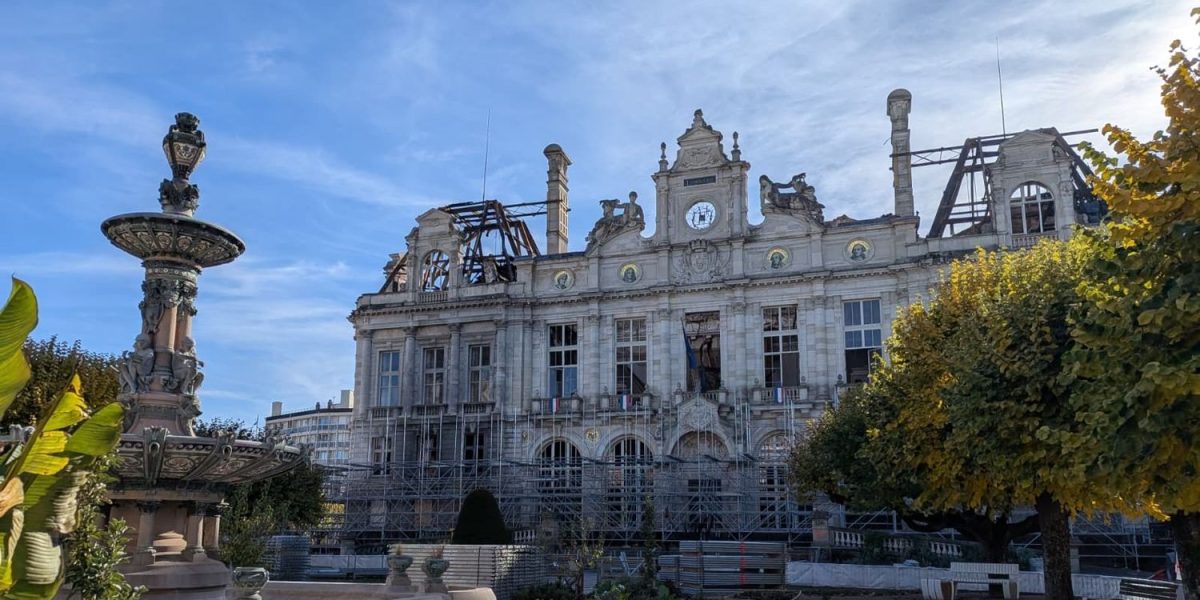
A month after rioters torched Limoges’ 19th-century city hall during nationwide protests against the high cost of living, the central French city is rebuilding its civic life from a makeshift barracks, a patchwork of temporary offices and plenty of sweets.
Two men were charged on October 23 with arson by an organized group and criminal association. As the investigation continues, the focus has shifted to reconstruction — and to keeping public services running.
A Race Against Time to Save the Building
The smell of smoke still hangs around the ruined monument, which has lost its windows and roof. On the facade, black scorch marks and a few anarchist graffiti remain at ground level, where the blaze began.
“It’s hard to see the city hall like this,” said Jennifer Alexandre, deputy director general for territorial planning and works coordination, hard hat on, as she oversees the site. Her office was in the right wing. On October 17 she was in Bordeaux; she drove back immediately. “On the road I tried to stay focused until that message: ‘That’s it, the campanile has fallen.’ Emotionally, that’s still hard.”
The campanile collapsed into the grand reception hall, along with the roof and its metal framework. Guillaume Ull, chief architect of historic monuments for Haute-Vienne, described steel beams “warped like chewing gum.”
“It’s a race against time to protect the building, which today has no roof. The rain keeps soaking the interior decorations,” he said, noting that the plaster and stucco ornamentation continues to deteriorate.
After shoring up the structure, crews will clear and decontaminate it before restoration begins. The huge project will likely cost tens of millions of euros, with completion scheduled for 2031.
Services Relocated to a Barracks
In the meantime, residents must travel about ten minutes by car to the Beaublanc barracks on Rue Edouard Michaud. The new site is not yet listed on maps, so users struggle to find it.
“You have to find it. But it’s true that we’re well received,” said Sophie, a local resident, in the parking lot.
Inside, among boxes of supplies, receptionist Caroline answers the phone with a smile. She tells 97-year-old Claudette that Christmas hampers are available at the CCAS, which did not burn. “I got bad information — maybe I didn’t understand either, that’s possible, because I’m 97,” Claudette said. “It’s our property,” sighed the woman, who was married in the burned city hall. “I hope I’m still here to see it repaired. Otherwise, it’s very sad.”
Chanel, who works 100 meters from the building, refuses to walk past it: “I don’t want to see it burned.”
Most services are nearly functional. Biometric stations were destroyed, so new ID cards cannot yet be issued locally, and weddings are now held in a small venue further north. “Overall it’s going well, we’re happy,” Caroline said.
Improvised Offices and Neon Corridors
The 250 staff are installed on the upper floors, along linoleum corridors lit by neon. The place has less character than the old city hall, and departments are indicated, for now, with felt-tip pen on A4 sheets.
In the protocol office, manager Marie-Noël Berger sits behind a laptop. “The basics, just the little screen,” she laughed. “We don’t have a phone yet, as you can see. We can’t call each other. But we’re happy to be together again. We’ve got the network back, so we can finally work.”
Much equipment survived, but the building is off-limits because of collapse and pollution risks. The bulk of the work involves IT: the fire destroyed the fiber network. “The hub of the fiber highway ran through the city hall,” said Wilfrid Faucher, the IT manager. “Many sites were connected to it — schools, gyms, cultural centers. We used detours, little back roads. We really worked flat out on Saturdays, Sundays and evenings.”
His colleague Lucas Vigier described the team as “headless chickens — running everywhere, but it has to be done.”
Keeping Spirits Up for the Long Haul
The forward-looking spirit shows in the smiles and the many bags of sweets in the offices. “There was a kind of craving for sugar among everyone. I think we’ve all put on five kilos since the fire,” said Sabine Freylone, deputy HR director. “We held on because we had to cope. But I think some staff may feel the backlash in a few weeks. That’s why we have two occupational psychologists — don’t hesitate to consult them.”
“We’re going to tell ourselves: ‘It’s not for six months, we’ll be here for several years,'” she added.
Services director Philippe Bombardier is proud of his teams: “For me, the lesson is that public service really means something to these staff.” His main concern is the budget. “At this stage we’ve exceeded 600,000 euros to reorganize the service. We had to arrange security, buy furniture. It adds up fast. The idea is that there’s no burden on the local authority. If there were, it would come at the expense of other things.”
The state is expected to reimburse part of the costs and pay for most of the works. The rest will be covered by insurance and donations to the Fondation du patrimoine, whose fundraising pot had reached 1.7 million euros by the evening of Monday, November 16.