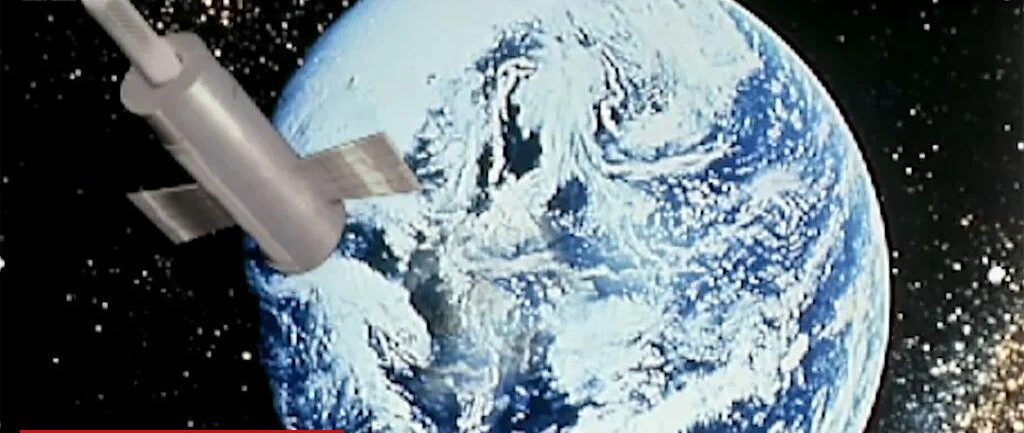
A costly dream of installing giant space mirrors in the sky to light up the Earth in Russia is slowly turning into a mirage. The project named “Znamya” was initiated by Russia’s space agency Roscosmos on February 4, 1993. The aim was to provide light to the Arctic cities of Siberia during winters, aiming to eliminate the darkness of night in those regions. This project was not part of any dangerous conspiracy, but rather a practical attempt to explore how using mirrors in space could illuminate dark parts of the Earth. This concept was initially introduced in 1923 by German rocket expert Hermann Oberth in his book “The Rocket into Planetary Space”, suggesting that mirrors in space could be used to reflect sunlight onto Earth.
During World War II, German scientists further developed this idea when they explored the concept of installing mirrors in space. The purpose of a weapon called “Sun Gun” developed at a Nazi research center aimed to use the sunlight to set cities on fire or boil water in lakes. Russian scientist Vladimir Syromyatnikov worked on the Znamya project, envisioning that large mirrors in space could reflect sunlight onto dark areas of Earth, especially during winter months when daylight is scarce. The first experiment of Znamya-2 was conducted in 1993, successfully reflecting light on Earth’s surface within an area of approximately three square miles, visible in various European countries. However, the experiment faced several challenges including the intensity of the mirror’s light falling below expectations and the difficulty of stabilizing it in space.
In order to further advance the project, Znamya-2.5 was prepared, but during its launch, a technical glitch led to the failure of the project. The mirror plummeted to Earth, destroying it, and ultimately ending the future of the project. Syromyatnikov’s dream of illuminating the Earth through space mirrors could not materialize, underscoring the fact that dreams of modern technology sometimes remain distant from reality. This incident serves as not only a lesson for the Russian space program but also a challenge for scientific research and technological advancement worldwide. Syromyatnikov’s efforts and his dream continue to inspire scientists to work on new ideas.
In conclusion, the Russian attempt to illuminate the Earth through space mirrors has garnered global attention, highlighting the complexities and challenges in turning innovative concepts into reality.