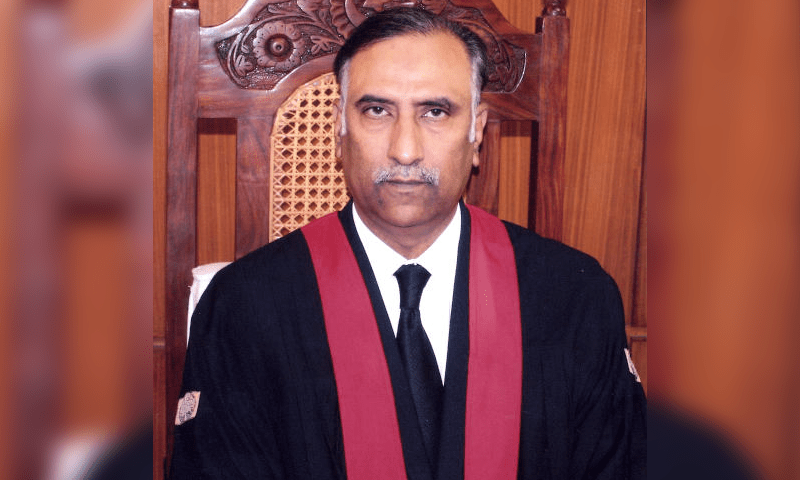
The Islamabad High Court has included Justice Sardar Mohammad Sarfraz Dogar in the list of nominated candidates for the vacant positions in the Supreme Court. Initially, the High Court had recommended the names of Chief Justice Aamer Farooq, Justice Mohsin Akhtar Kayani, and Justice Mian Gul Hasan Aurangzeb. However, now the administration has added Justice Dogar’s name to the list. The Judicial Commission of Pakistan (JCP) is set to meet today to finalize appointments to eight vacant Supreme Court positions.
Earlier this month, the Commission had sought nominations from all high courts, asking each to submit a list of five senior judges. Initially, the Islamabad High Court had only nominated three judges because the other two senior judges, Justice Tariq Mahmood Jahangiri and Justice Babar Sattar, did not meet the minimum requirement of five years of service.
During today’s meeting of the Judicial Commission, the list of judges will be finalized. However, in light of Justice Dogar’s recent inclusion, five judges from the Islamabad High Court had requested the reinstatement of their seniority with Chief Justice of Pakistan Yahiya Afridi and Chief Justice of the Islamabad High Court Aamer Farooq. They emphasized that any transferred judge should take a new oath under Article 194 of the Constitution, which would place them at the bottom of the seniority list in the Islamabad High Court.
These judges argued that failure to uphold this principle would immediately disqualify them for the position of Chief Justice of the Islamabad High Court, which goes against the rules of the Judicial Commission’s 2024 regulations. They clarified that their representation was solely related to seniority issues, not the judges’ transfers. Interestingly, four Supreme Court judges have also raised similar concerns and are requesting the postponement of the JCP meeting until a decision is reached on petitions against the 26th Amendment.
They expressed concerns that while the inclusion of judges benefiting from the 26th Amendment may damage public trust and complicate matters further. They also highlighted that recent transfers of judges from various high courts to the Islamabad High Court should not be permanent or for an indefinite period but rather temporary and time-bound. The judges questioned why a judge deemed unsuitable for a position in their high court would suddenly be considered eligible for the Supreme Court, pointing out that the current list of candidates is incomplete according to legal standards.
These developments not only highlight tensions among judges but also signal significant changes in the composition of the judiciary.