London, Canberra, and Ottawa formally recognised a Palestinian state on Sunday, marking a significant departure from decades of Western foreign policy and immediately drawing angry condemnation from Israel. Portugal also announced its intention to recognise Palestinian statehood later the same day, as Israel faces escalating international pressure over the conflict in Gaza, ignited nearly two years ago by the October 7, 2023, Hamas attack.
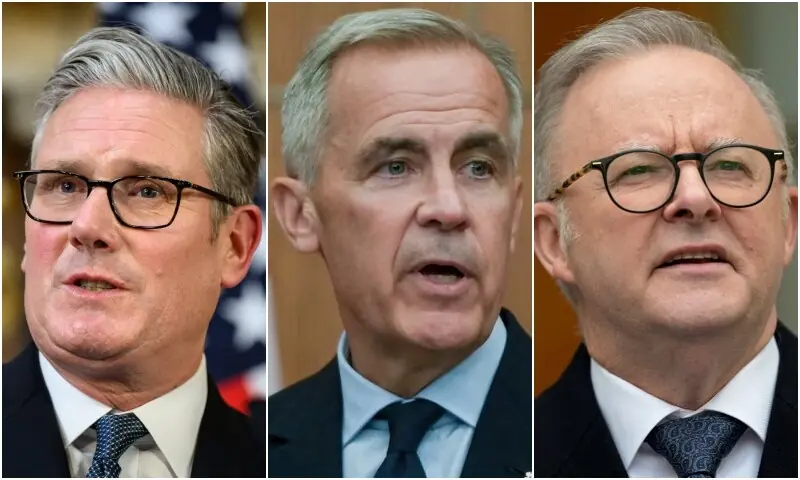
“Today, to revive the hope of peace for the Palestinians and Israelis, and a two-state solution, the United Kingdom formally recognises the State of Palestine,” UK Prime Minister Keir Starmer announced on X. Britain and Canada became the first G7 nations to take this step, with France and other countries anticipated to follow at the annual UN General Assembly, set to open on Monday in New York. Canadian Prime Minister Mark Carney echoed this sentiment, writing on X: “Canada recognises the State of Palestine and offers our partnership in building the promise of a peaceful future for both the State of Palestine and the State of Israel.”
Meanwhile, Australia declared its formal recognition of “the independent and sovereign State of Palestine,” according to a post on X by Prime Minister Anthony Albanese. In an accompanying statement, Mr. Albanese elaborated: “In doing so, Australia recognises the legitimate and long-held aspirations of the people of Palestine to a state of their own… Today’s act of recognition reflects Australia’s longstanding commitment to a two-state solution, which has always been the only path to enduring peace and security for the Israeli and the Palestinian peoples.”
This collective decision marks a watershed moment for Palestinians and their decades-long ambition for statehood. For years, the most powerful Western nations had maintained that Palestinian statehood should only emerge as part of a negotiated peace deal with Israel. Palestinian President Mahmud Abbas welcomed the move as “an important and necessary step toward achieving a just and lasting peace in accordance with international legitimacy,” according to a statement from his office.
Mr. Abbas further called for an immediate ceasefire in Gaza, humanitarian aid access, the release of all hostages and prisoners, complete Israeli withdrawal from the Gaza Strip, and a halt to settlement activity and settler violence. A senior Hamas official, Mahmud Mardawi, also hailed the recognitions, describing them as a victory for Palestinian rights. “These developments represent a victory for Palestinian rights and the justice of our cause, and send a clear message: no matter how far the occupation goes in its crimes, it will never be able to erase our national rights,” Mardawi told AFP.
However, the move puts these Western countries at odds with the United States and Israel. Israeli Prime Minister Benjamin Netanyahu reacted angrily, vowing to oppose the recognitions at the upcoming UN talks. He stated on Sunday that calls for a Palestinian state “would endanger our existence and serve as [an] absurd reward for terrorism.”
The shift in position by a growing number of Israel’s longtime allies comes as Israel has intensified its offensive in Gaza, aiming to eliminate Hamas. The Gaza Strip has suffered immense destruction, a soaring death toll, and a severe lack of food, leading to a major humanitarian crisis that has drawn widespread international outcry.
The UK government, in particular, has faced increasing public pressure to act, with thousands regularly protesting on the streets. A YouGov poll released last Friday indicated that two-thirds of young Britons aged 18-25 supported Palestinian statehood. Deputy Prime Minister David Lammy acknowledged in July that “Britain bears a special burden of responsibility to support the two-state solution,” a reference to the UK’s pivotal role in the 1917 Balfour Declaration, which laid groundwork for the creation of Israel.
Prime Minister Starmer had stated in July that his Labour government intended to recognise a Palestinian State unless Israel took “substantive” steps, including reaching a ceasefire in Gaza, increasing aid into the territory, and confirming it would not annex the West Bank. While Mr. Starmer has also repeatedly urged Hamas to release the remaining hostages from the 2023 attack, Deputy PM Lammy clarified on Sunday to the BBC that while recognition “won’t feed children” or “free hostages,” it was an attempt to “hold out for” a two-state solution, reflecting the Palestinian Authority’s long-standing calls. Palestinian foreign minister Varsen Aghabekian Shahin last week emphasized the non-symbolic nature of recognition, saying, “It sends a very clear message to the Israelis on their illusions on continuing their occupation forever.”
Over 140 of the 193 UN member states, representing three-quarters of the global body, already recognise Palestinian statehood. Portugal’s President Marcelo Rebelo de Sousa articulated his country’s decision by stating, “By acting now… we’re keeping alive the possibility of having two states.” The current conflict began with Hamas’s 2023 attack on southern Israel, which resulted in 1,219 deaths, mostly civilians. Israel’s subsequent retaliatory campaign has killed at least 65,208 people in Gaza, predominantly civilians, according to figures from the Gaza health ministry, which the United Nations considers reliable.