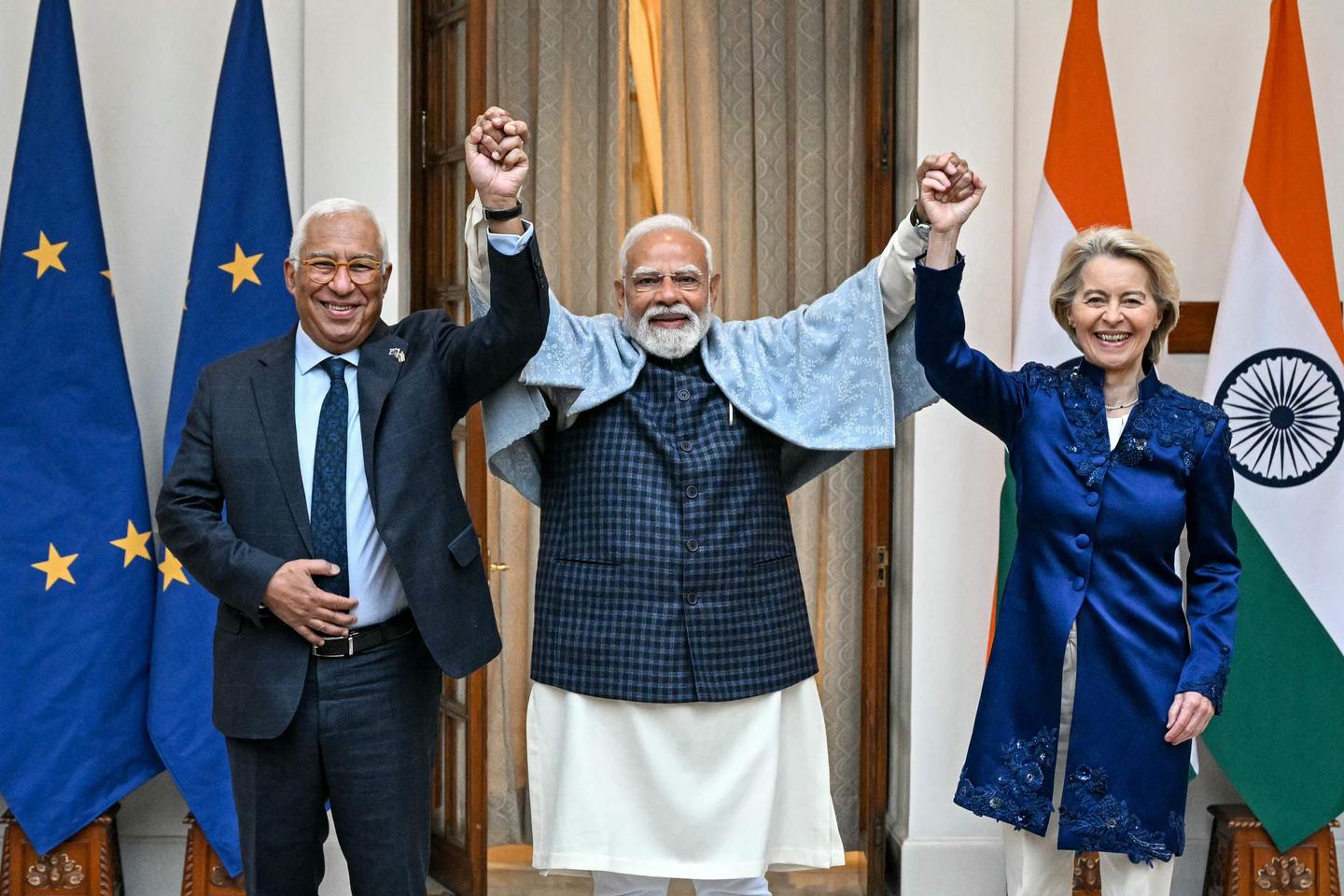
India and the European Union have finalized a landmark free trade agreement, concluding two decades of intermittent negotiations. The deal, announced on January 27, 2026, by Indian Prime Minister Narendra Modi, establishes one of the world’s largest trading blocs as both sides seek to navigate more complex relations with the United States and counter Chinese competition.
A “Landmark Agreement” for a Fractured World
“Yesterday, a great agreement was signed between the European Union and India,” declared Prime Minister Modi. “This agreement will bring major opportunities” for Indian and European citizens. European Commission President Ursula von der Leyen hailed the pact as “the agreement of all agreements,” creating a free trade zone for 2 billion people. “Europe and India made history today,” she stated.
Economic Scale and Strategic Imperatives
The agreement covers approximately 25% of global GDP and one-third of world trade. Finalized in New Delhi with EU leaders Antonio Costa and von der Leyen, the pact is seen as a strategic move in an uncertain geopolitical climate. It aims to shield both economies from the effects of U.S. tariff wars and provide a counterweight to China’s economic influence.
In 2024, bilateral trade in goods reached €120 billion—a 90% increase over ten years—with services trade at €60 billion. The EU expects the deal to double its exports to India.
Substantial Tariff Reductions and Market Access
The deal mandates drastic cuts to Indian tariffs on nearly all European imports. Key reductions include:
- Automobile tariffs slashed from 110% to 10%.
- Wine duties reduced from 150% to 20%.
- Full elimination of tariffs on products like pasta and chocolate, currently at 50%.
Brussels estimates these cuts will save European exporters €4 billion annually. The EU gains unprecedented access to India’s vast, protected market of 1.5 billion people, whose economy grew 8.2% year-on-year last quarter and is projected to become the world’s fourth-largest this year.
Broader Cooperation and a “Competitive Edge”
Beyond trade, the partners are signing agreements on seasonal worker mobility, student exchanges, and a security and defense pact. India seeks European technology and investment to modernize and create jobs, while the EU aims for a “significant competitive advantage” in key industrial and agri-food sectors.
Von der Leyen emphasized the strategic choice: “India and Europe have made a clear choice. That of strategic partnership, dialogue, and openness… We show a fractured world that another path is possible.” This sentiment extends to defense, where India is diversifying away from Russian equipment and Europe seeks to reduce dependency on the U.S.
The agreement marks a profound shift in global economic alliances, positioning the India-EU corridor as a central pillar in a reconfigured world order.