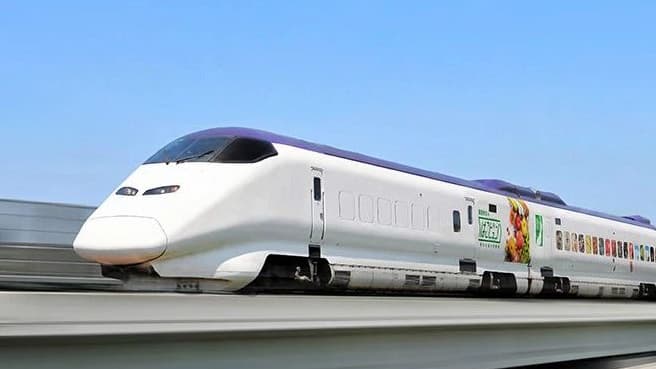
Japan is revolutionizing freight logistics by launching the world’s first dedicated high-speed cargo Shinkansen. Starting in March, a full bullet train will operate regular cargo services between Tokyo and Morioka, carrying up to 1,000 packages at speeds of 300 km/h.
From Passenger Carriages to Cargo Hold
The train, originally designed for passengers, has undergone a complete transformation. Workers removed all 394 seats from its seven carriages and installed non-slip flooring and cargo securing systems. This new configuration is tailored for perishable and sensitive goods, with a primary focus on seafood, medical supplies, and ornamental fish. Loading and unloading operations will be conducted at rail depots near stations to ensure efficiency.
A Pandemic-Era Experiment Goes Mainstream
Japan Rail (JR) began testing this concept during the COVID-19 pandemic, placing parcels in passenger carriages when ridership plummeted. The experiment proved successful, with transported volumes steadily increasing, prompting the company to commit a full train to the service.
JR plans to go further by building a brand-new cargo-specific Shinkansen and expanding the number of routes. The company cites several driving factors:
- A severe shortage of truck drivers
- Growing demand for rapid perishable goods delivery
- Intense pressure to reduce carbon emissions
Integrating Rail and Air Freight Networks
A key goal is to seamlessly connect rail and air freight systems. Earlier this year, Japan Airlines Cargo and JR officially launched an integrated logistics solution. This service links the eastern Japan Shinkansen network with Japan Airlines’ international cargo flights, transporting goods from regional cities to Tokyo’s Haneda Airport. There, shipments are loaded directly onto international flights bound for destinations like Singapore, Hong Kong, Kuala Lumpur, and Taiwan, saving critical hours in the supply chain.
High-Speed Freight: A Global Trend
France, another high-speed rail pioneer, is also exploring parcel delivery via TGV, albeit alongside passengers. Last year, Amazon announced a partnership with SNCF to transport packages in a sealed compartment within the locomotive on Paris-Lyon routes. This space, previously underutilized, can hold about a thousand parcels.
Amazon France reported that since the May announcement, it has gradually increased frequency beyond the initial 11 weekly trains, with over half a million packages transported between Lyon and Paris by TGV in 2025. Encouraged by the results, Amazon is actively studying expansion to other routes.
This initiative echoes France’s past use of dedicated yellow TGV postal trains, which operated from 1984 until 2015. Those services were ultimately discontinued as internet usage surged and the trains were no longer deemed cost-effective.