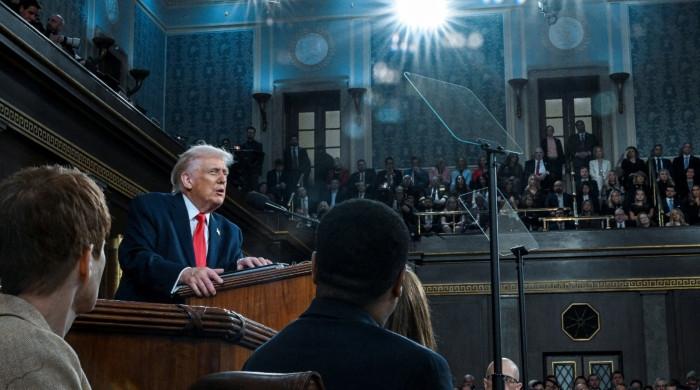
WASHINGTON — In a historic and combative State of the Union address, President Donald Trump presented his case for a potential military confrontation with Iran, framing it as a necessary step to prevent a terrorist state from obtaining nuclear weapons. The speech, delivered to a deeply divided Congress, also served as a platform for Trump to champion his economic record amid sagging approval ratings ahead of the November midterm elections.
The Iran Ultimatum
Against the backdrop of a significant U.S. military buildup in the Middle East, President Trump accused the Iranian regime of spreading “terrorism and death and hate.” He pointed to Tehran’s support for militant proxies, its domestic crackdown on protesters, and its advancing missile and nuclear programs as direct threats.
“My preference is to solve this problem through diplomacy,” Trump stated. “But one thing is certain, I will never allow the world’s No. 1 sponsor of terror, which they are by far, to have a nuclear weapon.”
The president offered no new specifics on his plans but reiterated frustration with stalled negotiations, suggesting Iran had not provided sufficient guarantees to halt its nuclear ambitions. The address provided little clarity to an American public that polls show is largely wary of new foreign entanglements.
Economic Boasts Amid Political Headwinds
Seeking to reset his political narrative, Trump devoted the first hour of his speech to the economy, declaring a “golden age” and claiming credit for curbing inflation, driving stock market records, and enacting tax cuts.
“Our nation is back — bigger, better, richer and stronger than ever before,” he proclaimed to cheers from Republican lawmakers.
However, this optimistic portrayal clashes with economic data showing persistent high costs for essentials and a recent slowdown in growth. With only 36% of Americans approving of his economic handling, according to a Reuters/Ipsos poll, the speech was a critical attempt to sway public opinion before the midterms.
A Record-Length, Heated Delivery
The speech, lasting one hour and 47 minutes, set a new record for the longest presidential address to Congress. While Trump initially stuck to his script, avoiding his characteristic digressions, the tone turned contentious during discussions on immigration.
The president engaged in shouted exchanges with Democratic lawmakers, repeating claims about migrant crime that are not supported by studies. Representative Ilhan Omar (D-Minn.) shouted, “You have killed Americans!” in response to Trump’s praise of his immigration enforcement, referencing recent fatal shootings by federal agents.
Protests were visible throughout the chamber. Representative Al Green (D-Texas) was removed for waving a sign referencing a controversial social media video posted by Trump. Many Democratic women wore pins demanding the release of files related to convicted sex offender Jeffrey Epstein.
Foreign Policy and Omissions
Despite Trump’s focus on Iran, other major global issues received scant attention. He made only a passing mention of the Russia-Ukraine war on its fourth anniversary and repeated an exaggerated claim that he had “ended” eight wars.
Notably, he refrained from attacking the Supreme Court justices in attendance, despite a recent ruling against his tariff policies, calling the decision merely “unfortunate.”
As the 2026 midterms approach, the address underscored a presidency at a crossroads: projecting strength and economic success while navigating the perilous path toward a potential new war and intense domestic political friction.