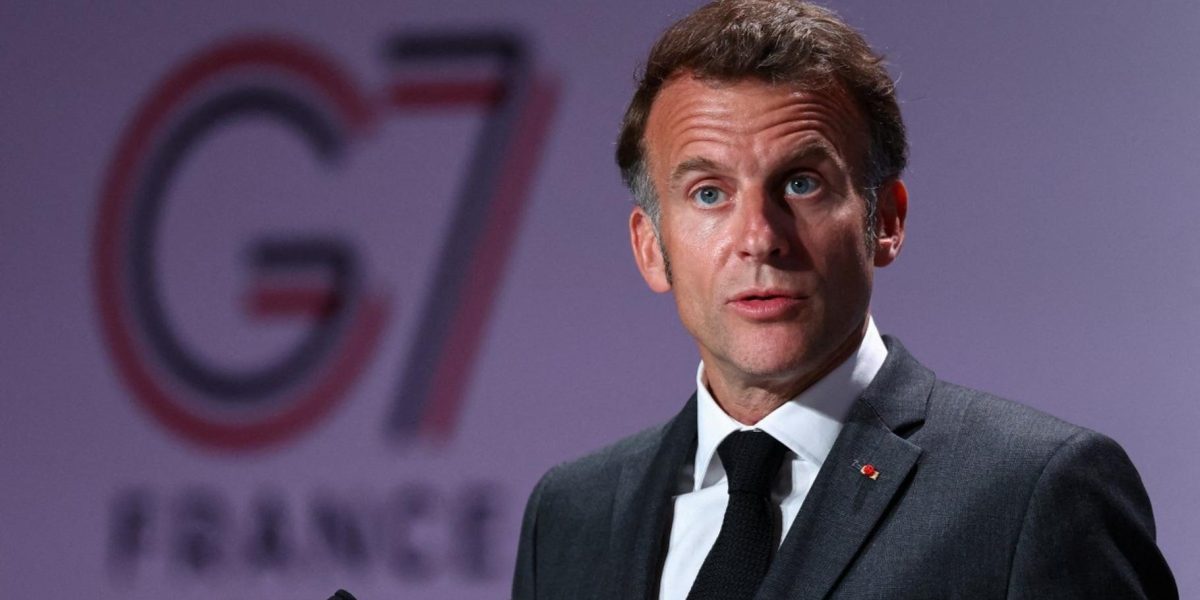
Emmanuel Macron is taking his final bow on the grand stage. Starting this Monday, June 15, the French president hosts his last G7 summit in Evian before his term at the Élysée Palace concludes. The event could serve as the capstone to a decade of forceful international declarations and posturing, yet it crystallizes a mixed legacy—one defined by undeniable theoretical successes that have struggled to materialize into concrete results.
This gathering of powerful nations on French soil marks the first transatlantic meeting between U.S. President Donald Trump and the other G7 members—France, Germany, Canada, Italy, Japan, and the United Kingdom—since the outbreak of war in Iran in late February. That international crisis is formally on the discussion agenda, alongside the war in Ukraine, with President Volodymyr Zelensky in attendance. However, the Élysée Palace is also placing “structural” international issues on the table, starting with the reduction of macroeconomic imbalances.
Pre-Summit Satisfaction on “Structural” Issues
On this last point, a sense of satisfaction prevails even before the meeting begins. The French presidency is pleased with a “shared observation” on the dangers of import, export, and production imbalances, while simultaneously evoking a “consensus” to “act together for a sustainable growth agenda.” Similar contentment applies to topics concerning “economic sovereignty,” a text for “accelerating cancer research,” online child protection, investment in “more fragile countries.” “On these substantive issues, this G7 is already a success,” the Élysée boasts.
A “Conceptual Victory” That Isn’t Everything
With his mandate nearing its end, Emmanuel Macron can also claim to have been right before everyone else with his concept of a “Europe puissance” (European power), detailed as early as his 2017 Sorbonne speech. The head of state long preached in the wilderness, until the coronavirus pandemic, the outbreak of war in Ukraine, and especially Donald Trump’s return to the White House jolted European partners awake. “It’s true that we are witnessing a conceptual victory for Macron,” Michel Duclos, an expert at the Institut Montaigne, told AFP. But the former ambassador offered a crucial nuance: “In diplomacy, being right is sometimes less important than having operational results.” That is where the problem lies.
Consider the idea of a European nuclear deterrent, raised by the head of state as early as 2020. It was applauded by numerous allies but triggered an outcry within parts of the French opposition forcing the government, and then Macron himself, to intervene in the debate to try to defuse it. These domestic reservations did not kill the project—a European nuclear deterrent is now under construction—but the head of state, poorly supported in his own country, especially after a failed dissolution of parliament, has also weakened on the international stage. The strong criticism expressed by the far-right Rassemblement National is hardly reassuring to allies about the future, as the party leads voting intentions eleven months before the presidential election. More recently, the failure of the FCAS, the Franco-German combat aircraft project, further illustrated the limits of his sovereign European defense and cooperation approach.
Climate Goals Relegated, Crises Unresolved
In a completely different domain, Macron has also had to revise his ambitions downward: on climate. The French president who, in the wake of the U.S. withdrawal from the Paris Agreement, presented himself as a climate champion with his “Make Our Planet Great Again” slogan, collided with Donald Trump’s return and his climate skepticism six years later. On the eve of a G7 where the climate issue is relegated to the background, the Élysée is forced to acknowledge that “the objectives are no longer consensual within the G7.” This is highly diplomatic language to avoid speaking of “failure,” but it does not prevent the stark assessment: “It didn’t work.”
The G7 also risks confronting the head of state with his powerlessness on two major subjects: the ongoing crises in Iran and Ukraine. Contrary to its optimism on other themes, the Élysée is extremely cautious about the outcome of these discussions. Two objectives are set for Ukraine: to “converge on the necessity” of maintaining European and, above all, American support, however reduced it may now be, and to on the “conditions (under which) G7 partners can encourage negotiation” with Russia. On the situation in the Middle East, the terms are even less precise. “We expect this session to address ways to exit the crisis today in the Gulf” by unblocking the Strait of Hormuz, “but also to tackle” the issue of Iranian nuclear and ballistic programs “and its regional policy,” the Élysée indicated cautiously.
The Shadow of Trump and a Final Push
If the French presidency is not venturing toward more precise objectives, it is precisely because it knows its capacity to act concretely is limited—partly due to the omnipresence of the highly unpredictable Donald Trump. Just hours before the G7 began, the announcement of a deal between Iran and the United States disrupted the planned discussion schedule in Evian. The French head of state seized the opportunity to put his proposal for a “maritime coalition” back on the table, stating that “the means are in place and ready to be engaged.”
Will this initiative, led jointly with the United Kingdom, be taken up by other powers? To date, the head of state’s other proposals to influence conflict resolution—a “coalition of the willing” for post-war Ukraine or for Gaza after October 7—have barely moved beyond the proposal stage. Emmanuel Macron still has eleven months to make them a reality. Success would allow him to leave at least this one concrete mark on the international stage Failure would add another line to the list of his initiatives that have fallen into oblivion.