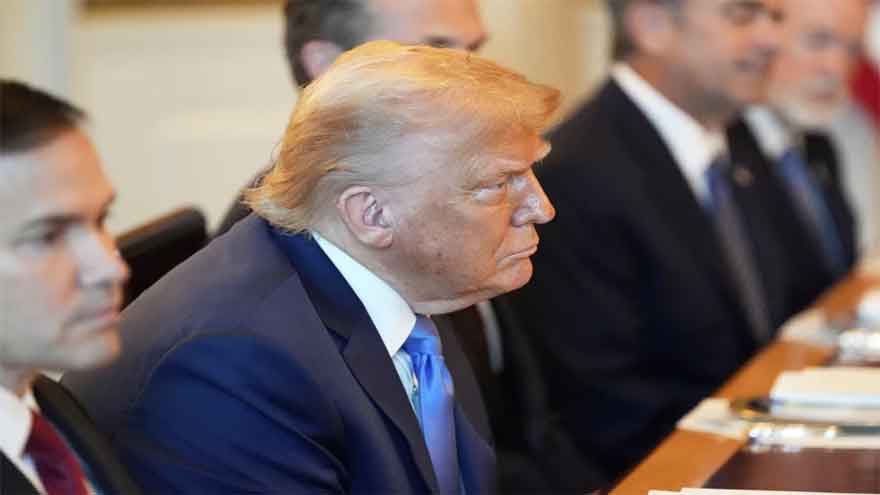
WASHINGTON — To reach a deal with Iran that reopens the economically vital Strait of Hormuz, President Donald Trump may need to do something profoundly out of character: compromise. Any concession would be a bitter pill for the Republican president, who has categorically denied the reality of his sagging poll numbers, a sluggish economy, and the U.S. military’s dwindling stockpiles of key weapons following the Iran war he launched with Israel more than five months ago.
“He divides the world into winners and losers, and this would make him a loser,” said Eliot, who served as counselor of the State Department in the George W. Bush administration. “And the image of being a loser, I think, would be intolerable for him.”
2>The Strategic Chokehold
The central sticking point remains control over the Strait of Hormuz, the narrow waterway through which 20% of the world’s oil flows. While both sides signal a deal is close, the Trump administration has ruled out any arrangement that would cement Iran’s grip over the Persian Gulf passage, including Tehran charging fees. Iran, however, insists on a measure of control, declaring the strait will not revert to the open international waterway it was before the conflict. Despite thousands of U.S. strikes, Iran retains the capability to fire drones and missiles at vessels, maintaining a strategic chokehold over commercial shipping.
Cohen argues that yielding ground to Iran would be politically devastating for the president, even if the ongoing conflict keeps gasoline prices elevated and poses significant problems for Republicans in November’s midterm elections Yet, the calculus may be shifting. David Schenker, a former State Department official in the first Trump administration suggests that mounting economic pressure could force the president’s hand, even with profound implications for global trade.“There will be a lot of spin both ways, but my guess is that the has tipped his hand as to the urgency for him of resolving the crisis,” said Schenker, now a fellow at the Washington Institute for Near East Policy. “This a concession he may very well be willing to make.”
Depleted Arsenals and Political Denials
Trump has so far conceded little about the war’s toll. He posted on social media Thursday that the U.S. still has “massive amounts” of weapons and that large quantities are being manufactured, jail time for alleged “leakers” information on the nation’s weapons stockpiles. The statement was a direct response to a Washington Post story detailing his frustration with Defense Secretary Pete Hegseth over shrinking inventories of advanced munitions during a Cabinet gathering at Camp David.
A senior administration official, speaking on condition of anonymity to discuss internal deliberations, described a “robust and healthy” on Iran but denied a “knock-down, drag-out fight.” However, experts say shortages are real. The Center for Strategic and International Studies has released reports documenting declining inventories of advanced missile interceptors, which have been critical in defending American troops from Iranian attacks.
When pressed later, Trump told reporters that “we need more all the time,” claiming some munitions are in “virtually unlimited supply” others are “a little bit tighter.” He insisted, “We’re in great shape., with that being said, we always want more. We have to have more.”
A War Without a Goal
Sen. Mark Kelly, an Arizona Democrat and former Navy pilot, directly linked the weapons shortfall to a war that lacked a well-defined objective beyond striking more than 14,000 targets.
“My contention on this is, if you knew what the goal is, maybe the target list would have been 500 targets. Maybe it would been 200 targets,” Kelly said, adding that the Pentagon now wants “billions and billions of dollars to fix their self-inflicted problem.”
The political backdrop is equally grim for the administration. A late July poll from The Associated Press-NORC Center for Public Affairs Research found that about two-thirds of U.S. adults believe the war with Iran has not been worthwhile. This sentiment includes the vast majority of Democrats and independents, alongside roughly 37% of Republicans.
A Fragile Waterway
Despite Trump’s claim that the Strait of Hormuz is “sort of open right now,” the reality on the water is tense and volatile. At least two ships were hit in the strait in the past week, while several others reported near misses or warnings from entities claiming to represent Iran’s Revolutionary Guard, according to maritime data company Lloyd’s List Intelligence. While vessel traffic has increased to 84 transits last week from 45 the week prior, it remains a fraction of the more than 700 weekly transits typical before the crisis.
The Associated Press reported Wednesday that a potential deal is being framed as a temporary solution, allowing ships to enter the Persian Gulf through an Iranian-controlled route and exit through an Omani-controlled route. A U.S. official, not authorized to comment publicly, confirmed Thursday that any temporary routes would not include tolls, charges, or other impediments. The official maintained that Trump’s preferred choice is diplomacy and that he “holds all the cards” in dealing with Iran.