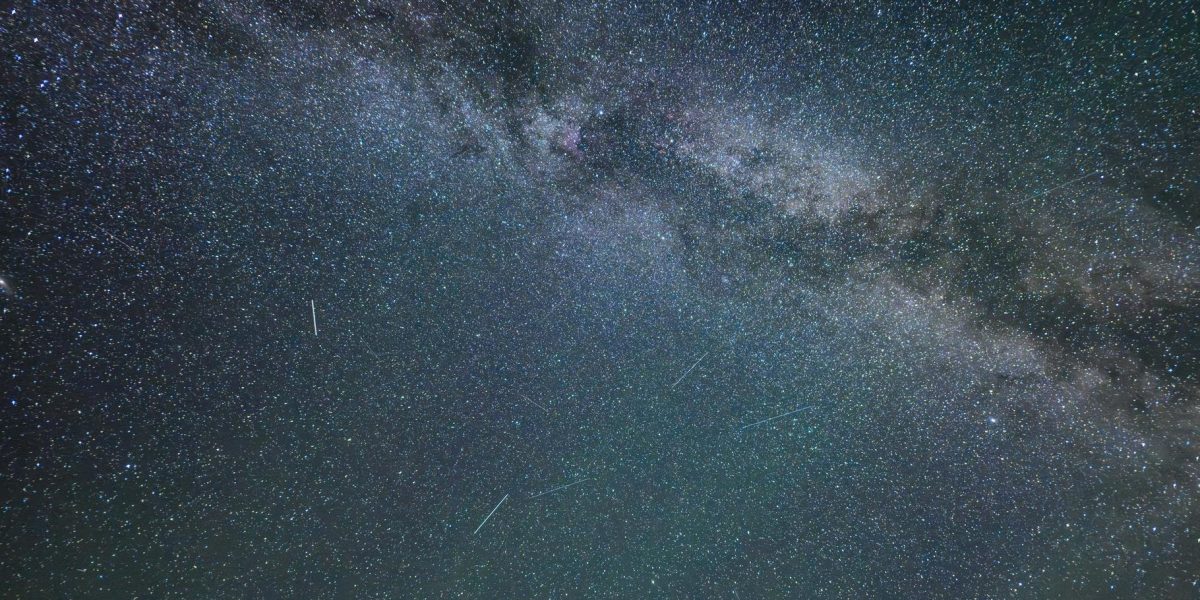
The highly anticipated solar eclipse on Wednesday, August 12, is not the only phenomenon demanding attention in the sky this evening. The peak of the Perseid meteor shower is also expected during the night from Wednesday to Thursday. And with a peak comes the promise of a beautiful spectacle. “This date corresponds to the expected maximum for this famous meteor shower,” the Astronomical Society of France noted on its website.
The phenomenon, which began in mid-July, is well worth observing because the Perseids are renowned for the sheer number of meteors they produce. It is “the most beautiful meteor shower of the year,” summarized La Chaîne Météo.
Perfect Viewing Conditions After the Eclipse
“The peak of the 2026 Perseids is forecast for August 13 between 4 a.m. and 6 a.m. metropolitan French time,” the Cité de l’Espace indicated on its site. “Keep in mind this is an estimate with some uncertainty, and the peak may therefore begin earlier or later. While the nights around the peak can also offer some fine shooting stars, prioritize the night of August 12 to 13,” it added.
Observation conditions for the peak are particularly favorable this year, thanks to the solar eclipse on Wednesday. “With the Moon requisitioned for the eclipse… the skies will be very dark,” the Astronomical Society of France highlighted. These conditions are complemented by a clear sky. “Observation conditions are expected to be good or even excellent in many regions,” La Chaîne Météo reported.
How to Watch the Perseids
The only downside: “the peak might not be the ZHR (Zenithal Hourly Rate) of 100 often promoted, but lower, around 40,” the Cité de l’Espace signaled. This rate determines the number of visible meteors per hour. “It remains a fine peak of activity that is worth trying your luck and being patient for,” the science center nonetheless estimated.
According to the Astronomical Society of France, “nearly one Perseid per minute on average should be observable” on the night from Wednesday to Thursday. “Although several minutes can pass without any meteor, before they arrive in bursts of two to four in a few tens of seconds!”
To admire this peak, you can take off your solar eclipse glasses. “Regarding equipment, your eyes are the ideal instrument. No need for binoculars or telescopes,” the Cité de l’Espace reminded. “Choose a location far from urban lighting and settle in to take in the entire celestial vault with your gaze,” it advised.
It is also important not to create your own light pollution and to avoid checking your mobile phone. “Don’t forget that it takes about 15 minutes for your vision to adapt to nighttime conditions,” the Cité de l’Espace specified. Finally, if you miss your chance tonight, specialist sites emphasize not to neglect the following nights, as “meteoric activity will be slightly more sustained than usual.”