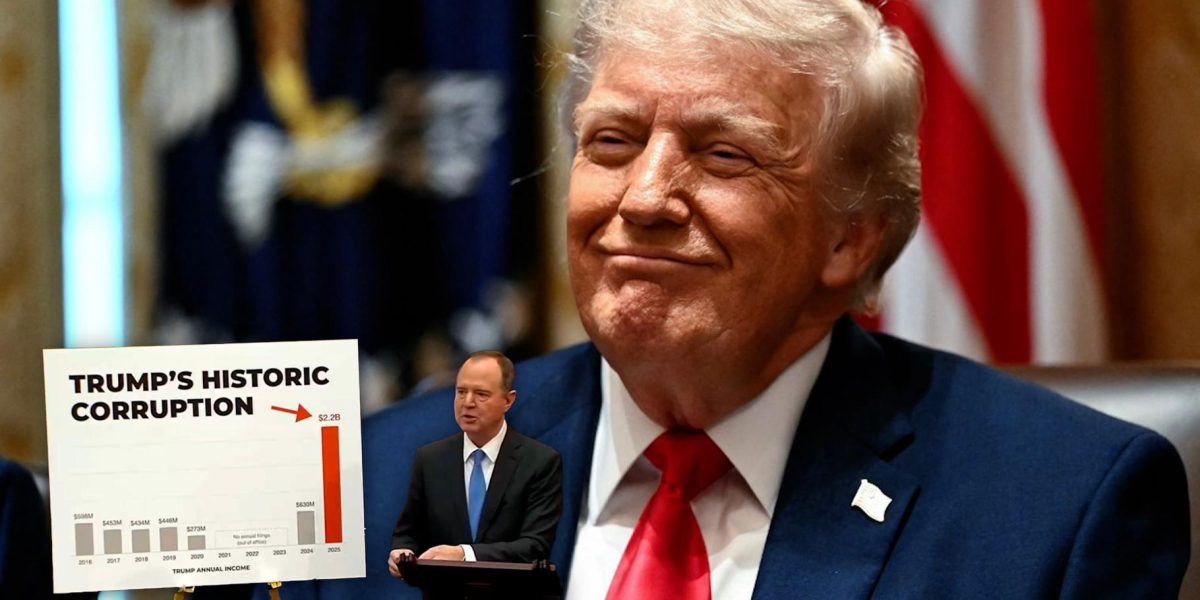
Donald Trump has added $5.3 billion to his personal fortune since returning to the White House, according to a Bloomberg estimate, making him the wealthiest sitting U.S. president in history. His net worth now stands at $7.6 billion, up from $2.3 billion in late 2024, driven by aggressive ventures in cryptocurrency, real estate, and brand licensing.
The surge is detailed in a 927-page financial disclosure released by the U.S. Office of Government Ethics, which reveals how the president has monetized his name, his social media platform, and his policy influence. The document has drawn sharp criticism from Democratic lawmakers, who are demanding investigations into potential conflicts of interest.
Crypto Ventures Yield $1.4 Billion in 2025
Hours before his inauguration on January 17, 2025, Trump launched a meme cryptocurrency called $TRUMP, issuing one billion tokens and pocketing $635 million. The move underscored his embrace of digital assets, a sector he has vowed to make “the world capital of cryptocurrency” from the Oval Office.
As of June 29, Trump held $288 million in cryptocurrencies, including $150 million in Ethereum and $33 million in Bitcoin. But his most lucrative vehicle is World Liberty Financial, a company he founded in 2024 with his sons Eric and Donald Jr., along with Zach and Alex Witkoff, sons of his close ally Steve Witkoff.
The company launched its own token, WLFI, which raised $550 million at launch. Under a financial arrangement, 75% of that sum—over $410 million—flowed to DT Marks DeFi LLC, a firm wholly owned by the Trump family. In total, Trump earned roughly $1.4 billion from virtual currencies in 2025.
However, many retail investors who bought into Trump-linked tokens have suffered steep losses. Reuters reported that WLFI investors lost approximately $674 million, while $TRUMP holders lost $3.8 billion across more than one million people.
Real Estate and Brand Deals Remain Lucrative
Trump’s original business—real estate—continues to generate substantial income. According to the Wall Street Journal, his properties brought in more than $575 million. His private Mar-a-Lago club in Florida earned $77.5 million, his Miami golf course $122 million, and a New Jersey golf property over $35 million. Golf-related revenues across his clubs totaled nearly $250 million.
The Trump name also remains a valuable commodity. He collected $5 million for licensing a hotel in Abu Dhabi, another $5 million in Bucharest, and $10 million in Dubai. Merchandise sales—including watches, books, and even Bibles—added $8.5 million.
In July, Trump monetized his own words by launching a paid tier on his Truth Social platform. Subscribers paying between $60,000 and $100,000 per month gain early access to his announcements, allowing investors to anticipate market movements and trade ahead of policy news.
A Family Business in the White House
Trump has said he does not involve himself in his personal finances and allows his children to “do what they want.” Yet his family has benefited conspicuously from his presidency.
First Lady Melania Trump earned $10.7 million for the rights to a documentary about her life, produced and distributed by Amazon. Eric and Donald Trump Jr., who run the Trump Organization, have profited from their father’s policy decisions—for instance, when the administration considered up to $1.6 billion in funding for a mining project in Kazakhstan, the Trump sons were among the investors poised to benefit.
Jared Kushner, Trump’s son-in-law, has an estimated fortune exceeding $1 billion. He has blended diplomacy with private dealings, including a $55 billion acquisition of video game publisher Electronic Arts with Saudi Arabia’s public investment fund—a country central to Gaza negotiations and eager to invest heavily in the United States.
Democrats Demand Investigations
In January, Trump told the New York Times that “everyone stopped caring” about his finances. Democratic lawmakers strongly disagree.
On June 3, Senator Elizabeth Warren highlighted a suspicious sequence: on January 6, Trump bought $1 million in Nvidia stock. One week later, his administration relaxed export controls, allowing Nvidia to sell chips to China. Nvidia’s stock price subsequently soared.
On August 12, Warren and Representative Robert Garcia sent a 17-page letter demanding Trump disclose the names of the financial managers overseeing his investments. They cited “risks of insider trading, market manipulation, and policy decisions favorable to the president’s finances” and set a deadline for answers by the end of August.
The lawmakers’ findings are intended to support a bill that would prohibit sitting presidents from holding individual stocks—a practice currently permitted but subject to disclosure requirements.