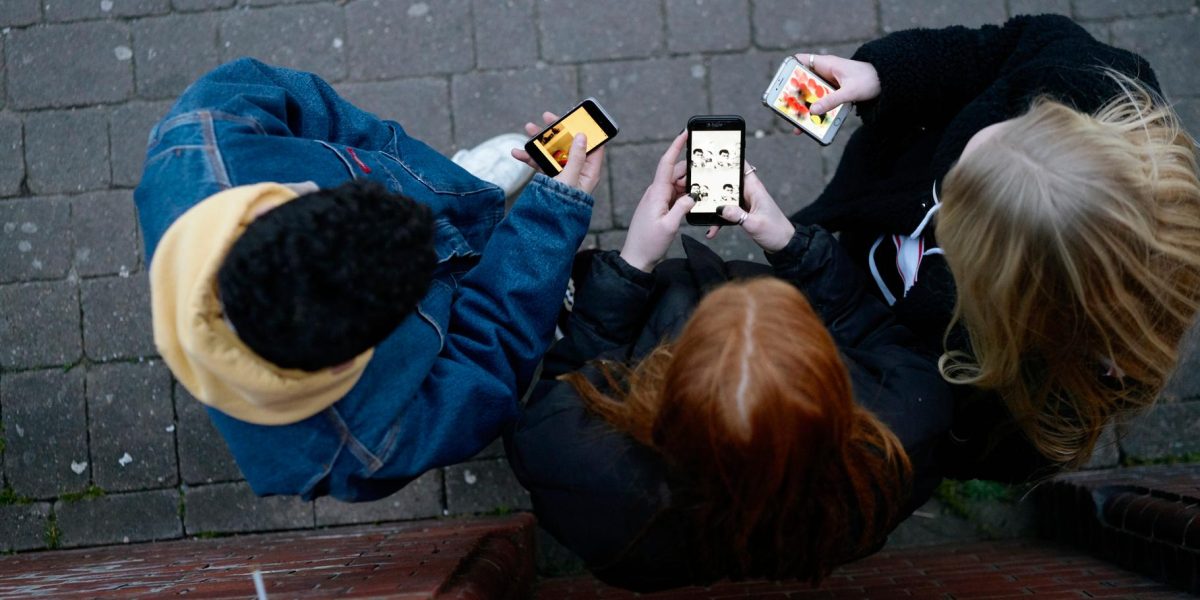
With just seven days before the start of the school year, the French government has confirmed that mobile phones will be “banned” in high schools starting this year. The announcement was made on Monday, August 24, by government spokesperson Maud Bregeon following the back-to-school council of ministers. However, education union leaders are warning that the practical implementation of this policy is far more complex than the official statement suggests.
A Late Announcement Leaves Schools Scrambling
The ban has been under discussion since a proposed law aimed at protecting minors from the risks of social media use was introduced. Now, the responsibility for enforcing the ban falls to individual schools through their internal regulations. But according to Audrey Chanonat, national education and pedagogy secretary for the SNPDEN union, and Sophie Vénétitay, general secretary of the SNES-FSU, this is easier said than done.
Chanonat explained that her union had been waiting for months for a text to “clarify” the implementation, particularly regarding the legal framework. “We needed a text that came out early enough for us to implement it at the start of the school year,” she said. However, the circular was only issued on July 2, 2026, just two months before classes resume. This timeline, she argues, is insufficient for such a significant change.
“To change an internal regulation, you have to prepare it with the student life council, the pedagogical council, and pass it through the board of directors… It’s not because a text comes out in early July that we can apply it from the start of the school year,” Chanonat stated.
Government Accused of ‘Political Communication’ Over Practical Reality
Sophie Vénétitay was even more critical of the timing. She said that an announcement so close to the start of term “only confirms what we already knew: the government is doing political communication, tinkering, which ignores the realities on the ground.” The teacher anticipates a chaotic start to the school year, where students could exploit the absence of updated internal regulations to continue using their phones.
A significant complication arises from the fact that high schools in France educate both minors and adults. “We cannot apply the law in exactly the same way for those under 18 and those over 18. This is one of the problems we raised that has not been resolved,” Chanonat affirmed. She added, “There is the announcement and then there is the implementation. The means we allocate, the application on the ground, the challenges, the surveillance, the modification of the internal regulation… It’s not enough to say it for it to be done.”
Echoes of the Failed ‘Digital Pause’ Initiative
The skepticism from unions is rooted in recent history. At the start of the 2025 school year, the government announced the generalization of the “Pause numérique” (Digital Pause) system to prevent phone use in middle schools, where phones have technically been banned since 2018. The rollout was largely unsuccessful.
“It is difficult to have exact figures, but a large part of the establishments—perhaps the majority—did not buy the anti-wave pouches recommended by the government due to a lack of resources,” Chanonat reported. The question now is whether the high school ban will suffer the same fate.
Logistical Nightmares: From Notifications to Lunch Lines
In practice, few schools are considering confiscating smartphones at the entrance. The daily reality of high school life makes a blanket ban difficult to enforce. “In high school, some things go through Pronote, students sometimes receive notifications related to a room change or an absent teacher. There are students who badge with their phone to go to the cafeteria… We are not talking about the same thing with sixth graders as with final year students,” Vénétitay detailed.
So what might the ban actually look like? “We are far from the uniform speeches held by the government. It will depend on the configurations, the discussions between the teams,” Vénétitay suggested. Chanonat noted that many colleagues favor a ban in pedagogical spaces but allow use in very specific zones. Some establishments are even considering jammers in certain areas, but, as she points out, “you need the means.”
A September Implementation ‘Unlikely’ and ‘Illusory’
Ultimately, the full application of the ban in all high schools by September seems “very unlikely,” even “illusory,” according to Chanonat. Vénétitay agrees, lamenting that the government might “trumpet in September that we offer a phone-free education from kindergarten to high school when that is false; there will be phones in high schools.”
Despite their criticism, both union representatives acknowledge the value of addressing screen use among young people. “We do not deny the interest of the measure. Announcing is good, but giving us time to work to do something sensible is better,” Chanonat said. Vénétitay concluded with a pointed remark about the political motivation behind the timing: “A whole pedagogical reflection could have been carried out; there is an important issue with screens. But not in this way, just so Emmanuel Macron can say that ‘for his last back-to-school, there will be no phones in high schools.'”