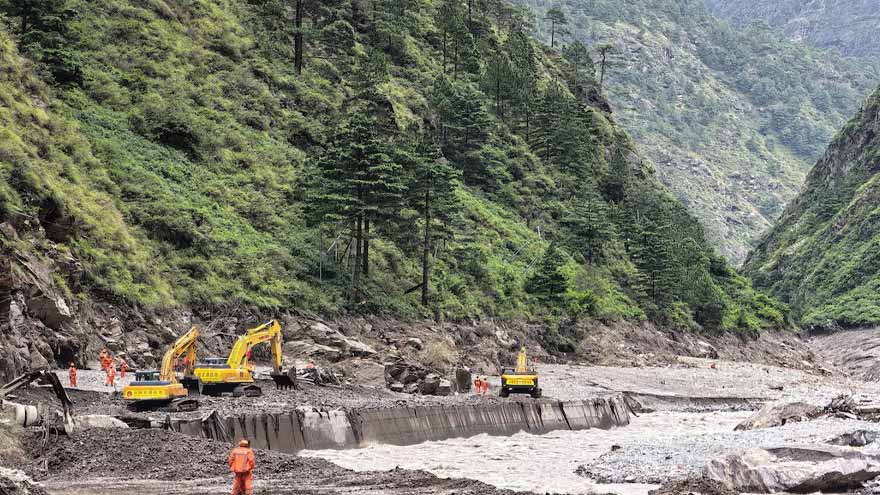
BEIJING — Chinese authorities are scrambling to prevent a catastrophic barrier lake burst that could unleash fresh flooding across the already devastated Tibet-Nepal border region, where this week’s glacial collapse and flash floods have killed hundreds and left nearly 1,000 people missing.
Both Nepal and China issued urgent warnings on Thursday about two unstable lakes that have formed on either side of their shared Himalayan border. The bodies of water, created when landslides and debris dammed river valleys, now threaten to collapse and send torrents of water downstream into communities still reeling from Wednesday’s disaster.
Engineers Deploy Aerial Surveys and 3D Modeling
An eight-member Chinese engineering team has been mobilized to conduct aerial surveys and build three-dimensional models of the most dangerous barrier lake, located near the Gyirong border port in Tibet, according to state broadcaster CCTV on Friday.
Chen Hanxiao, one of the engineers, described the formidable challenges facing the team.
“After the glacier collapse created the lake, many isolated cliffs and steep cliffs appeared along it,” Chen told CCTV on Thursday evening. He explained that the standard approach to reducing the threat involves excavating a drainage channel at a lower point of the dam, but that the precise width and depth of such a channel require complex calculations based on water flow rates and how quickly the lake is filling.
Lake Holds Up to 2 Million Cubic Meters of Water
Initial survey data revealed that the barrier lake is approximately 150 meters long and 40 to 50 meters deep, with a reservoir holding between 1.5 and 2 million cubic meters of water. The engineering team’s immediate tasks include continuous monitoring of the lake, collecting data from the lake floor, and tracking weather patterns in the coming days.
The situation is being compounded by ongoing rainfall. The Gyirong border port area has experienced light to moderate rain, which has loosened and destabilized soil and rock surrounding the precarious zone upstream. Forecasts indicate that rain will continue over the coming week, further elevating the risk of a breach.
Peak Flow Expected Around September 1
Chinese officials warned on Thursday that an estimated 3 million cubic meters of water — the equivalent of about 1,200 Olympic swimming pools — are expected to flow into the still-dammed lake over the next three days. This influx creates a high risk of a breach, with peak flow anticipated around September 1.
Aerial footage captured by a Chinese rescue team and broadcast by state media outlet CGTN showed masses of brown water accumulating in a basin with no visible outlet. The footage revealed that the rising water had already submerged bushes and trees and appeared to be pushing against a barrier of debris and stones.
Nearly 1,000 Missing, Including 540 Foreigners
The new flood threat compounds an already dire humanitarian situation. Officials report that nearly 1,000 people remain missing on both sides of the border, including as many as 540 foreigners from 31 countries. The initial disaster, triggered by a glacial collapse, sent walls of water and debris crashing through mountain valleys, destroying homes, bridges, and infrastructure.
Rescue and recovery operations continue amid challenging terrain and unstable conditions. The potential failure of the barrier lake could severely hamper those efforts and put additional lives at risk in communities downstream.
Chinese authorities have not specified a timeline for completing the drainage channel excavation, but the urgency of the operation is clear as water levels continue to rise and the September 1 peak flow date approaches.