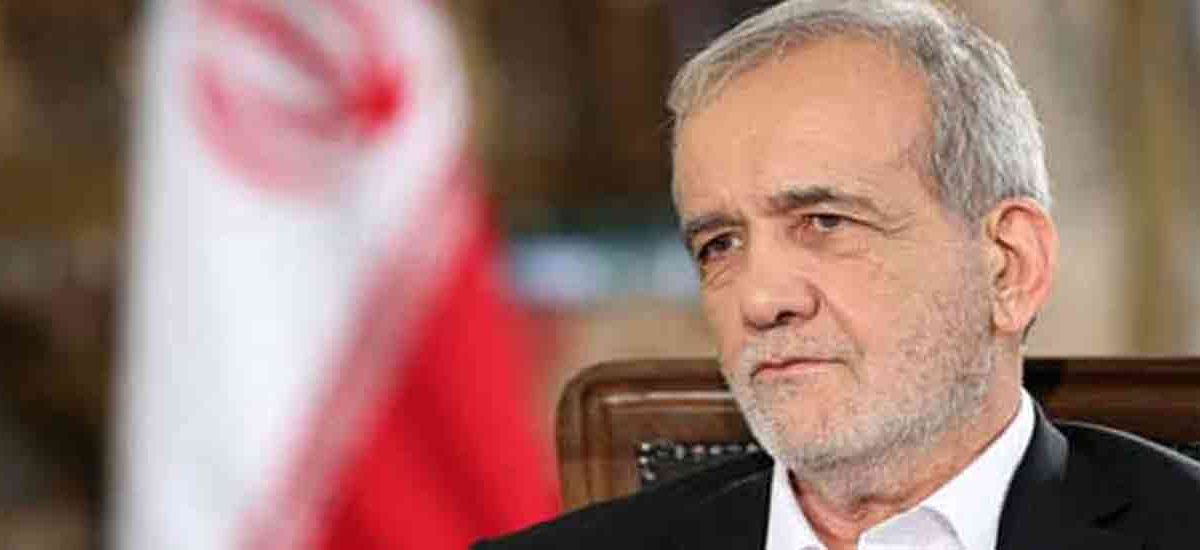
Iranian President Masoud Pezeshkian declared on Monday that Tehran is not seeking war but will “never sit still in the face of any aggression,” following a weekend U.S. attack on Larak Island that has reignited fears of a wider regional conflagration. The comments came as oil prices surged and shipping through the Strait of Hormuz collapsed to a trickle, marking a dangerous new phase in a conflict now entering its sixth month.
US Strikes and Iranian Retaliation
U.S. Central Command confirmed that American forces struck two rocket launchers belonging to Iran’s Islamic Revolutionary Guard Corps on Larak Island on Sunday. CENTCOM said the action targeted an “imminent threat” to the Strait of Hormuz, claiming IRGC forces were preparing to launch rockets carrying sea mines into the vital waterway. “Iran created the threat and the U.S. military eliminated it,” CENTCOM stated.
Iran’s Revolutionary Guards responded swiftly, launching a combined ballistic missile and drone attack on two U.S. air bases in Jordan early Monday. The IRGC claimed the strikes targeted Muwaffaq Salti Air Base and King Hussein Air Base, causing “heavy damage.” Jordan’s armed forces reported intercepting eight missiles that entered the country’s airspace. A U.S. source told Fox News that nearly all missiles fired by Iran had been intercepted.
Iranian state media reported that the IRGC also shot down a U.S. MQ-9 Reaper drone over the Strait of Hormuz, and a Telegram channel linked to the Guards claimed cruise missiles were launched at U.S. warships in the strait. U.S. officials have not commented on those specific claims.
Economic Fallout and Global Shipping Crisis
The renewed violence has sent shockwaves through global energy markets. Brent crude futures climbed more than 2.8% to $90.61 a barrel, while U.S. West Texas Intermediate crude rose 2.55% to $85.53. The Strait of Hormuz, through which 20% of the world’s oil and natural gas passed before the war began on February 28, has become a no-go zone for most commercial shipping.
Shipping data showed the number of visible commodity vessels transiting the strait dropped to just five per day over the weekend, down from dozens in peacetime. Iranian media reported a supertanker was struck by mines in the strait, though details remain unverified. Some vessels have switched off their automatic identification systems to evade attack, meaning the actual number of transits could be slightly higher.
U.S. President Donald Trump claimed on social media that Kharg Island, which handles 90% of Iran’s oil exports, is “being blown to smithereens,” but provided no evidence. The CEO of Iran’s National Iranian Oil Company, Hamid Bovard, dismissed the claim as “laughable,” insisting conditions on the island are “calm and appropriate” and that oil operations have not stopped.
Economic Warfare Intensifies
U.S. Treasury Secretary Scott Bessent signaled a dramatic escalation in economic pressure on Tehran, telling Reuters that the Treasury Department is likely to unveil weekly new secondary sanctions aimed at cutting Iran off from the global financial system. The initial focus will be on banks, with the possibility of cutting institutions entirely from dollar-based transactions.
“You’re going to see a lot more of these every week,” Bessent said ahead of a G20 finance leaders meeting. “We’re starting with the banks, and we’re telling the banks it’s not okay to have Iranian money and to aid the regime.”
The Treasury imposed penalties on the UAE branches of Egypt’s Banque Misr on Friday over alleged financial links to Iran, a move that drew sharp criticism from Tehran and its allies.
Regional Powers Weigh In
UAE presidential adviser Anwar Gargash said Iran’s policy of targeting Gulf Arab states and Jordan has failed, calling for de-escalation and the restoration of normal shipping through the Strait of Hormuz. “A state of neither war nor peace cannot be a sustainable solution,” Gargash wrote on X.
The UAE’s Ministry of Defense also reported that its air force dealt with a drone coming from Iranian waters over Emirati territory. Iran’s army separately claimed it attacked the UAE’s Al Minhad Air Base with drones, saying the strike targeted locations where U.S. forces and helicopters were stationed.
Israeli Energy Minister Eli Cohen warned that Israel would strike Iran again if Tehran attempts to rebuild its nuclear or ballistic missile programs, even if an agreement is reached with Washington. “If Iran makes the mistake and tries to renew its nuclear programme or ballistic missile programme, even if there is an agreement with the United States, we will be there to attack,” Cohen told Ynet.
Iran’s Defiant Stance
Speaking before departing for an international summit in Kyrgyzstan, President Pezeshkian said Iran would respond firmly to any further attacks. “Instability and unrest in the region are not in the interest of any country and will challenge everyone,” he said.
Iranian state broadcaster IRIB reported that solid-fuel Kheibar Shekan ballistic missiles were used in the latest attack on U.S. bases, alongside slower liquid-fuel missiles and drones. The IRGC warned that attacks would be met with increasingly forceful responses and said the strikes would not weaken Iran’s control over the Strait of Hormuz.
IRGC spokesperson Hossein Mohebi called the U.S. attack on Larak Island a “strategic and fatal mistake” and warned Washington would face consequences “in both the economic and military arenas.” The IRGC Intelligence Organization also accused the “enemy” of waging psychological warfare to undermine national stability.
Six Months of War
The conflict began on February 28 when the United States and Israel launched coordinated strikes on Iran. Supreme Leader Ayatollah Ali Khamenei was killed in the initial assault, and his son Mojtaba succeeded him in March. A two-week ceasefire was agreed on April 8, followed by face-to-face talks between U.S. and Iranian officials in Pakistan later that month. A preliminary agreement was reached in June, but renewed fighting and disputes over the Strait of Hormuz have continued through July and into August.
With no end in sight, the war has now entered its sixth month, with the Strait of Hormuz remaining at the center of the crisis. The collapse of shipping through the waterway threatens to trigger a global energy shock, while the escalating tit-for-tat strikes raise the specter of a direct military confrontation between the United States and Iran.