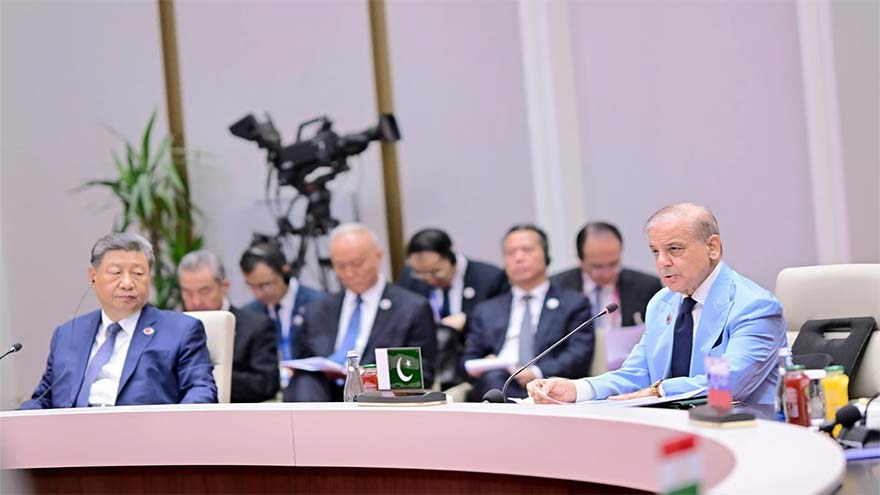
Pakistan has formally proposed the creation of a sovereign artificial intelligence infrastructure and a dedicated governance framework for the Shanghai Cooperation Organization, marking a significant digital pivot as Islamabad assumed the rotating chairmanship of the Eurasian political and security bloc for 2026-27.
Prime Minister Shehbaz Sharif unveiled the initiative during an SCO summit in Bishkek on Tuesday. The proposal anchors an ambitious action plan that will prioritize information technology and AI, alongside energy development, poverty reduction, disaster management, health, culture, and sports throughout Pakistan’s tenure at the helm.
A Digital Shield for Over 3 Billion People
The push for collective AI sovereignty arrives at a critical juncture for the SCO, a region Sharif noted encompasses more than 3 billion people. Member states are simultaneously navigating rapid technological disruption, persistent geopolitical tensions, energy supply shocks, and an urgent demand for deeper regional connectivity.
“In IT and AI, we propose to establish an SCO sovereign AI infrastructure and governance framework to promote responsible and inclusive AI development and also ensure that no member state is left behind,” Sharif told assembled leaders.
The proposal signals Islamabad’s intent to position the SCO as a coordinated bloc in the global race for AI capability, rather than a collection of nations pursuing divergent digital paths. A shared governance framework would aim to set common standards for ethical AI deployment while pooling resources to bridge the technological divide between larger and smaller member economies.
Connectivity as a Strategic Imperative
Sharif framed Pakistan’s chairmanship under the theme “Turning Vision into Action, Connectivity, Innovation and Shared Prosperity,” placing physical and digital infrastructure at the core of the bloc’s future agenda.
“Today, connectivity is no longer a choice. It is a strategic imperative,” he said.
The prime minister pointed to recent instability in the Middle East as a stark reminder of the vulnerabilities inherent in concentrated trade routes. “The recent crisis has also proven that diversified transport networks, secure energy corridors, and resilient supply chains are indispensable to our collective security,” Sharif added.
Central to Pakistan’s connectivity vision is the multi-billion-dollar China-Pakistan Economic Corridor, which Sharif said would continue to serve as a gateway linking regional economies to the Arabian Sea. Islamabad will also back trans-regional railway, road, and energy projects designed to weave the SCO’s vast geography into a more integrated economic zone.
Financing the Bloc’s Long-Term Vision
Beyond infrastructure and AI, Sharif called for concrete institutional progress on financing. He described the establishment of an SCO Development Bank as a “critical step” toward implementing the bloc’s development strategy through 2035.
The proposed bank would provide a dedicated funding mechanism for cross-border projects, reducing reliance on external financial institutions and enabling faster execution of connectivity and energy initiatives. For Pakistan, the bank represents a pathway to unlock stalled regional projects and channel investment into priority sectors identified under its chairmanship.
As Islamabad steers the SCO through a period of global uncertainty, the dual focus on sovereign AI and hardened connectivity infrastructure reflects a broader strategic bet: that the bloc’s future influence will be measured not only in diplomatic alignment but in shared technological capability and resilient economic arteries.