A confidential Spanish police report has emerged, directly challenging the government’s insistence that Morocco bore no responsibility for the mass influx of migrants into the North African enclave of Ceuta in late July. The document, published by online outlet El Español and reviewed by AFP, describes a striking “permissiveness” among Moroccan security forces during the crisis.
Reduced Police Presence and Passive Response
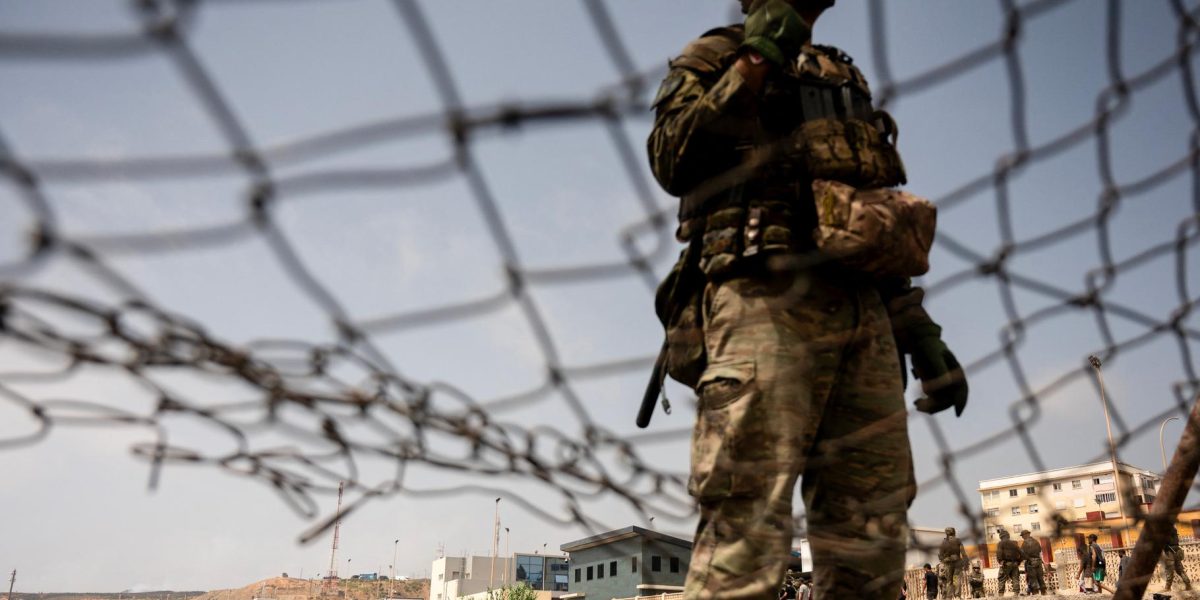
Investigators from Spain’s National Center for Immigration and Borders (CENIF) noted that despite the high-profile celebrations for Morocco’s Throne Day on July 30, which should have concentrated security assets near the border, the actual deployment was “sensibly more reduced than usual.” The report states that on July 30 and 31, the Moroccan police response to the mobilisation and mass entry of migrants was, “at minimum, one of total permissiveness, without any serious attempt being recorded to reduce, disperse, or move the mass of people away from the border perimeter.”
The report goes further, suggesting that the behaviour of Moroccan officers may have actively facilitated the crossings. “In the interviews conducted, migrants almost unanimously state that the police forces not only remained passive in the face of entry attempts but also indicated to them to pass through the sea in the area of the El Tarajal jetty and not through other access points,” the investigators wrote.
Madrid Maintains Its Position
The findings stand in sharp contrast to the narrative maintained by Spanish Prime Minister Pedro Sánchez, who has consistently absolved Morocco of any orchestration. Speaking before parliament on Thursday, Sánchez reiterated that his government had “no proof” of Moroccan involvement and insisted that no national or international body had provided “solid evidence that Morocco planned or orchestrated” the influx.
However, the Prime Minister did not shy away from criticising recent statements from two Moroccan ministers who claimed sovereignty over Ceuta and Melilla, the two Spanish enclaves on the North African coast. “For centuries, these two cities have been Spanish… And I assure you that, for the Spanish government, it will remain so until the end of time,” Sánchez declared from the podium.
A Geopolitical Message?
The police report supports a theory held by several analysts: that the migrant surge was a deliberate signal from Rabat to Madrid. The crisis unfolded shortly after Pedro Sánchez visited Algeria, a key rival of Morocco, in July. The timing has led experts to suggest the pressure on Ceuta was linked to the ongoing dispute over Western Sahara, a former Spanish colony largely controlled by Morocco but claimed by the Polisario Front, which is backed by Algeria.
The CENIF report notes that video footage and migrant testimonies show attitudes “compatible with a behaviour of facilitating irregular immigration, up to scenes that suggest surveillance and control of the entry/exit process.” This detailed account provides the strongest official challenge yet to the Spanish government’s position, intensifying the political debate over one of the most sensitive episodes in recent Spanish-Moroccan relations.