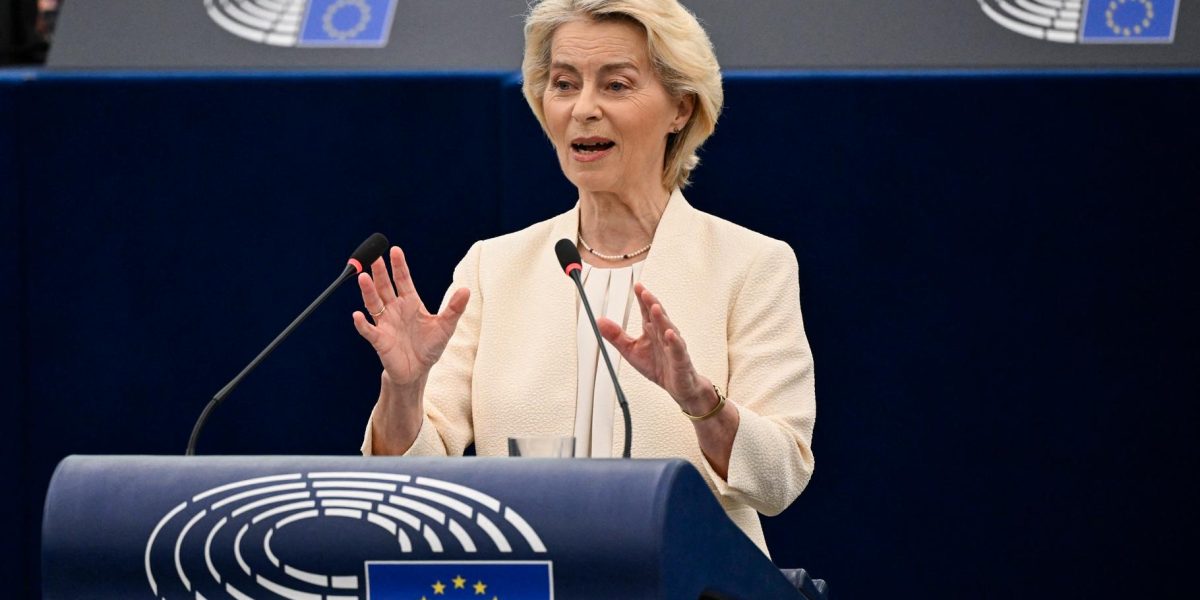
The long-running debate over protecting minors online has arrived at the heart of European policymaking. On Wednesday, September 16, European Commission President Ursula von der Leyen presented long-awaited proposals to safeguard children and adolescents across the bloc: a ban on social media for anyone under 13, and restricted “mini-accounts” for those under 15.
“No social media before the age of 13” and “no personal account before 15,” the Commission president declared in a speech before the European Parliament.
A Graduated Approach to Online Access
Under the plan, younger teenagers would not be shut out entirely but would face strict limits on how they use digital platforms.
“Children between 13 and 15 will only have mini-accounts, set up and monitored by their parents, with restricted features and limited screen time. And for those aged 15 to 18, platforms will be required to adopt safe-by-design standards,” von der Leyen added.
The measures, which will require approval from MEPs and the 27 EU member states, are to be detailed Thursday in a draft European law — the “EU Kids Act” — to be presented in Strasbourg by the European Commission.
Mounting Pressure Across Europe
Screen addiction, harassment, sleep deprivation, eating disorders and sexual solicitation are among the many risks minors face online. Existing European legislation, such as the Digital Services Act (DSA), is deemed insufficient, and political pressure has been building from all sides to better protect children and adolescents within the EU.
National initiatives have multiplied, with France leading the way. President Emmanuel Macron has pledged to secure a ban on social media for under-15s in France by the end of 2026. A bill to that effect was passed by parliament during the summer, but it was ultimately struck down by the Constitutional Council, which ruled it a “disproportionate infringement” on young people’s freedom of expression.
Derogations From Age 13
Von der Leyen has been working on the file for a year, drawing heavily on a July report by experts in child protection, scientists and child psychiatrists.
Her system is expected to be more flexible than the outright ban on social media for under-16s introduced in Australia last year, which has nonetheless been widely circumvented by teenagers.
The gradual access model envisioned by the EU closely mirrors France’s new draft law, announced by Macron on Monday. That text, submitted to Brussels to ensure compliance with European law, aims to ban social media for under-15s where platforms present harmful features, while providing derogations from age 13. The revised formula takes into account the Constitutional Council’s objections to a blanket ban.
Severe Fines for Non-Compliance
According to documents seen by AFP, the bill to be presented Thursday by the European Commission will apply to various categories of online platforms: social networks, artificial intelligence assistants and chatbots, and online games.
The bloc-wide age restrictions will be paired with new obligations for operators that wish to keep their services accessible to minors, with fines of up to 6 percent of global turnover for violations.
Among those obligations, platforms will be required to remove their most “addictive” features — such as infinite content scrolling and ultra-personalized recommendations — and to systematically verify the age of new users.