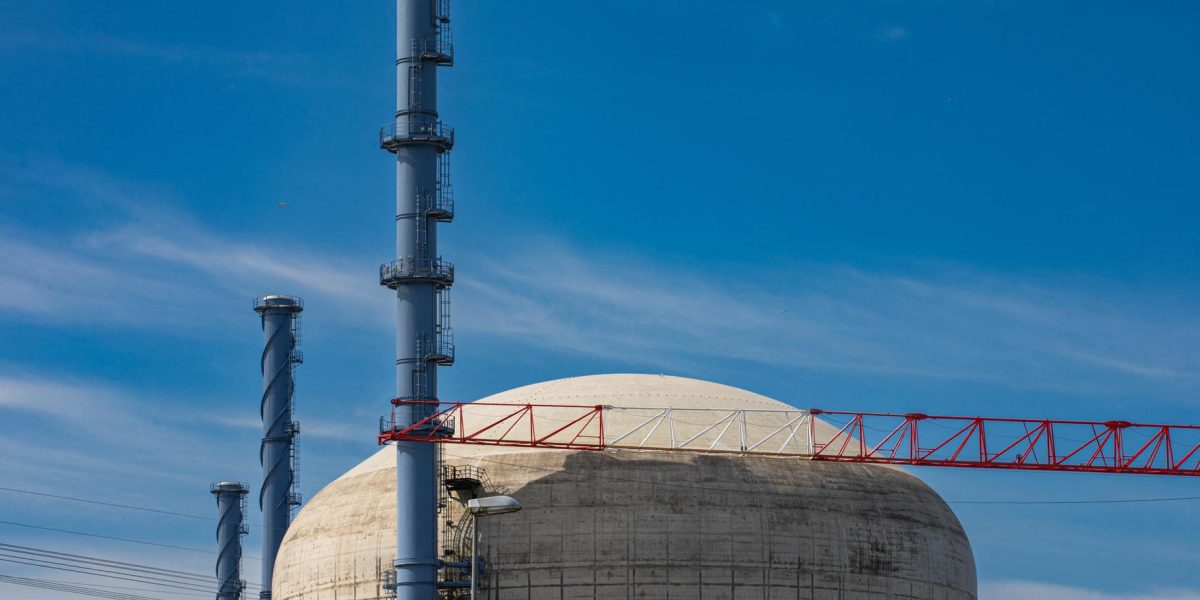
Less than a year after reaching full power, the EPR reactor at Flamanville in the Manche region of France will be taken offline for 350 days starting Saturday, September 26. The extended pause will allow operator EDF to carry out the reactor’s first complete inspection, involving thousands of operations, some of them major — most notably the replacement of the reactor vessel lid.
“We will carry out three major inspections” during this “complete visit number one,” said Renaud Crassous, deputy director of performance for EDF’s nuclear production division. He described it as “an in-depth inspection of the entire facility,” representing a cost of “several hundred million euros.”
A Regulatory Milestone Comparable to a Decennial Review
The 350-day shutdown is a regulatory requirement for all reactors in EDF’s fleet and had to be initiated within 30 months of the plant’s fuel loading on May 8, 2024.
“It is fairly comparable to a decennial visit as we conduct them today on reactors when they reach 30 or 40 years of age,” Crassous explained. The Flamanville inspection will nonetheless take longer than those at plants such as Chooz in the Ardennes or Civaux in the Vienne, which run 190 to 200 days, owing to “the volume of inspection activity” required, he said.
Vessel, Primary Circuit and Sealing Checks
The nuclear giant must inspect the vessel of France’s newest reactor, examine the primary circuit that captures the heat generated by the nuclear reaction, and verify the sealing of the hydraulic circuits.
Added to this is a large-scale operation: replacing the EPR’s vessel lid, which ensures the sealing of the primary circuit, at the request of the Nuclear Safety and Radiation Protection Authority (ASNR) due to long-known anomalies.
A 100-Tonne Component at the Heart of the Reactor
Manufactured by Framatome in Saint-Marcel, Saône-et-Loire, the lid is a key component of the reactor. It weighs nearly 100 tonnes and measures more than 5 meters in diameter. It also houses the control rod drive mechanisms that allow the nuclear reaction to be managed safely, according to EDF.
The old lid will be stored on site for two years before being transferred to the radioactive waste storage center operated by Andra, the national radioactive waste management agency, in the Aube region.
Other, smaller operations will involve modifying certain equipment, including cooling exchangers, the control system and the plant’s control room.
Altogether, the overhaul represents 20,000 activities, will mobilize “around 2,500 people” and 200 partner companies drawn from EDF’s industrial network, many of them local. All of it will follow a “reliable and robust schedule, sequenced so that activities are carried out in the right order and in complete safety,” Crassous assured.
Confirming the Plant’s Performance
According to the EDF official, this first phase of operation “confirmed the proper behavior of the facility” and made it possible “to identify all the improvements that could be made to certain equipment.”
The Flamanville EPR has produced 9.9 terawatt-hours (TWh) of electricity to date and reached 100 percent of its power on December 14, 2025. For the year 2026 alone, it has already exceeded its production target.
“Our goal was to produce seven TWh in 2026; we exceeded it as of September 3,” Crassous said. The reactor has a net electrical output — the power injected into the grid — of 1,600 megawatts.
A Long-Delayed Flagship Project
The first nuclear reactor to start up in France in 25 years, Flamanville 3 was connected to the grid in late 2024, 12 years behind schedule. Its costs ballooned from an initial estimate of 3.3 billion euros to roughly 23.7 billion euros at 2023 prices, according to the Court of Auditors. Built facing the English Channel alongside two older reactors, it is the most powerful unit in France’s nuclear fleet.