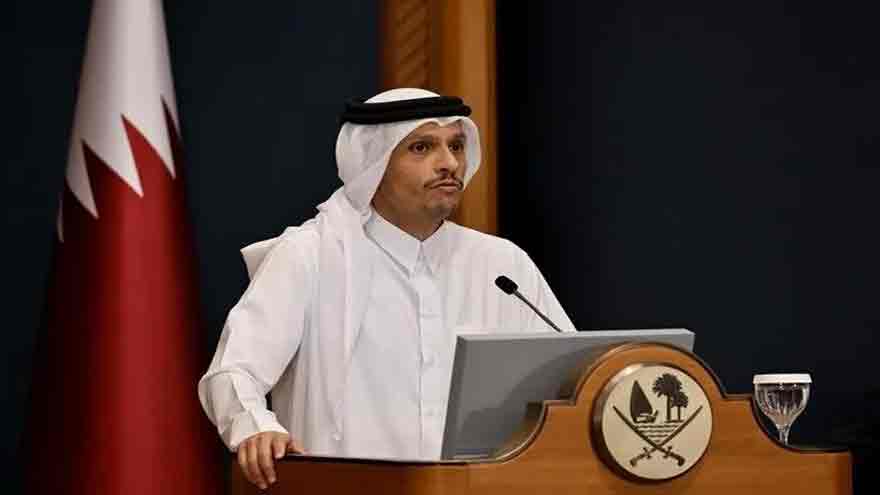
Qatar’s Prime Minister and Foreign Minister, Sheikh Mohammed bin Abdulrahman Al Thani, has publicly branded Israeli Prime Minister Benjamin Netanyahu a “war criminal,” accusing him of targeting Qatar politically to deflect scrutiny from his own conduct and that of his government.
In an interview with British journalist Piers Morgan, Sheikh Mohammed was asked directly whether he considered Netanyahu a war criminal. “Of course,” he replied. “What’s been committed in Gaza is war crimes, and whoever is responsible for this is a war criminal.”
He pointed to the scale of destruction in the enclave as evidence. “Hospitals have been targeted, schools have been targeted. Whatever the justifications and the arguments, nothing is justifying this,” he said.
Strike on Doha During Mediation
The Qatari premier renewed his condemnation of Israel’s September 9, 2025 strike on Doha, which targeted Hamas officials while Qatar was engaged in mediation efforts. The attack killed five Hamas members and a Qatari security officer.
“We were attacked by Israel while we were mediating,” Sheikh Mohammed said, describing the strike as an unprecedented assault on a mediator. “Netanyahu has crossed the line like he has crossed other lines before that.”
He framed the Israeli leader’s public criticism of Qatar as a political maneuver aimed at shifting attention away from his own record and that of his government.
Diplomacy to Continue Despite Tensions
Despite the heightened regional tensions, Sheikh Mohammed insisted that Qatar would keep prioritizing diplomacy, arguing that quiet, behind-the-scenes engagement remains the most effective path to progress.
“We are trying to do our best to give the best advice to the US government on how to reach a solution, as well as to the Iranians,” he said.
His remarks were reinforced earlier the same day by Qatari Foreign Ministry spokesman Majed Al-Ansari, who said Doha was continuing its mediation efforts and carrying messages between Washington and Tehran. Al-Ansari added that Qatar remained concerned about further military escalation and was pursuing a peaceful solution.
A Framework for Regional Security
Turning to the wider regional conflict, Sheikh Mohammed outlined three issues that must be addressed to defuse the war:
- Iran’s nuclear program and the associated sanctions
- Freedom of navigation through the Strait of Hormuz
- Regional security arrangements involving Iran and Gulf Cooperation Council states
He said any regional security framework should be built on dialogue, non-interference and non-aggression, alongside greater economic cooperation among the parties involved.
The Qatari position reflects the balancing act the Gulf state has maintained throughout the conflict: sustaining its role as a key intermediary while confronting Israel over an attack on its own territory. Sheikh Mohammed’s comments signal that Doha intends to press ahead with mediation even as it sharpens its rhetoric against the Israeli leadership.