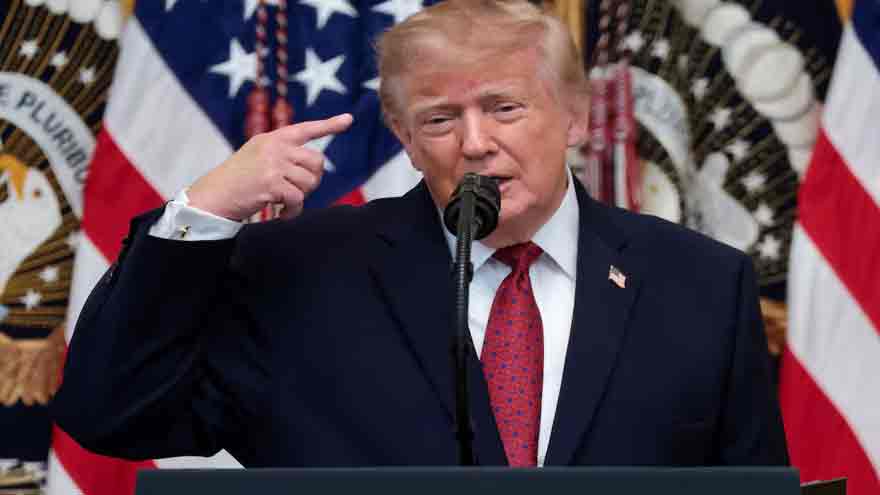
US President Donald Trump has moved to clarify controversial remarks in which he appeared to suggest Iran could “take out” California cities, insisting he was referring to the need for Americans to tolerate higher gasoline prices rather than threatening a nuclear attack on US soil.
Rally Comments Spark Backlash
Trump made the original remarks on Monday at a political rally in Nebraska, where he spoke about the economic sacrifices Americans have historically made during wartime. At the time, he framed the comments as a defense of elevated fuel costs tied to the conflict with Iran.
“Remember, with the war, it’s just artificial, it’s a little bit high, it’s a small price to pay,” he said then. “It’s a small price to pay for keeping the world safe, for keeping our country safe. They could take out a city. Let ’em take out Los Angeles, let ’em take out San Diego. This is a very small price to pay, and it’s going to be over with very soon.”
The comments drew swift condemnation from California’s Democratic leaders as well as from some fellow Republicans, who interpreted the president’s words as a cavalier dismissal of the threat to major American cities.
Trump Issues Clarification
In a post on Truth Social on Thursday, Trump said his meaning had been misconstrued.
“What I was talking about was that a temporary increase in the price of Gasoline is a small price to pay for Iran not having a Nuclear Weapon,” he wrote.
The president then turned the question back on his critics, arguing that the consequences of a nuclear-armed Iran would be far worse than any temporary spike at the pump.
“If you want to see a big price, can you imagine what it would be like if they bombed San Diego and/or Los Angeles?” he continued, adding that he loved both cities.
Pattern of Dismissing Cost Concerns
The episode marks the latest instance in which Trump has brushed aside cost-of-living concerns stemming from the Iran conflict. The president has consistently argued that economic discomfort at home is a worthwhile trade-off for preventing Tehran from acquiring nuclear weapons, a position he has returned to repeatedly as tensions with Iran persist.
The dispute also underscores the political sensitivity of gasoline prices in the United States, where fuel costs remain a persistent pocketbook issue for voters and a frequent flashpoint in national elections.