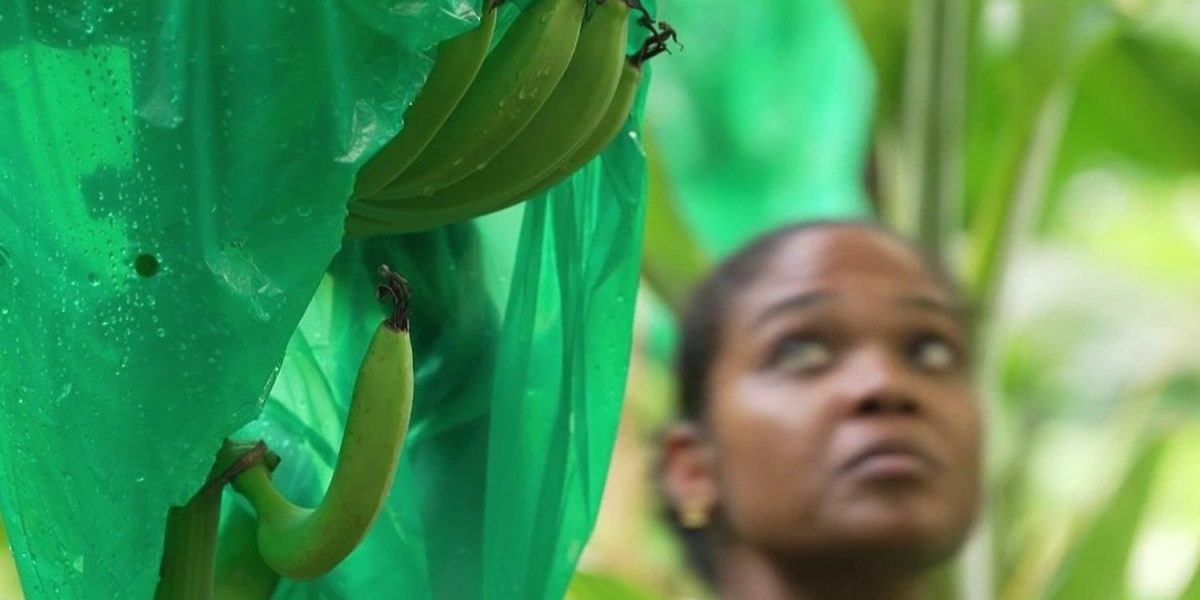
The French Caribbean banana industry is fighting an existential battle, squeezed between rising production costs, climate challenges, and fierce competition from South American and African producers who can sell their fruit at half the price.
A Family Tradition Under Pressure
In her native Guadeloupe, Célia Sinitambirivoutin has been carrying on her family’s banana farming tradition for seven years, working alongside her father and grandfather. On her six hectares of banana plants—which are technically giant herbs rather than trees—she cultivates 400,000 fruits annually.
“We ask ourselves questions sometimes,” admits Hector Sinitambirivoutin, Célia’s father. “I think to myself: ‘Why did she get into this?’ But it’s her choice. It’s difficult, it’s a very difficult profession.”
His concern is well-founded. Guadeloupe has lost half of its banana producers over the past 20 years, devastated by rising costs, drought, and recurring crop diseases.
The Economics of Survival
The numbers paint a stark picture. Each banana costs 27 centimes to produce, but producers receive only 14 centimes from buyers. With 9 centimes in public subsidies, they still fall 4 centimes short of breaking even.
To survive, producers like Célia must diversify their operations and reduce their own salaries. European subsidies have been frozen since 2007, though according to France Télévisions sources, they may increase next year.
“Without subsidies, the Caribbean could not sell its bananas on the European market,” explains Philippe Aliane, director general of the Guadeloupe Producers Group (LPG). “Today, a kilo of bananas in France sells for around 2 euros. If we had to sell our own banana without aid, it would need to be around 3 euros. It would be the death of the banana.”
Dominated by Foreign Competition
Every Saturday, 1,500 tonnes of bananas leave the port of Pointe-à-Pitre, enduring a nine-day crossing before reaching mainland France. In the Paris region, they spend four days in ripening chambers at 16°C—the ideal temperature for them to gradually turn yellow before reaching supermarket shelves.
But once there, Caribbean bananas must fight for space. They now represent only 21% of the French market, far behind South American bananas at 39% and African bananas at 40%. These competitors can sell at up to twice less, a price difference justified by lower labor costs and less stringent environmental requirements.
“Our bananas are, one could say, the cleanest in the world,” says Pierre Monteux, director of the Union of Banana Producer Groups (UGPBAN). “We use just a few kilos of fungicides to fight some fungal diseases, while our competitors use tens of kilos per year per hectare.”
Environmental Legacy and New Threats
The reduced pesticide use carries particular significance on an island marked by the chlordecone scandal—an ultra-toxic substance spread until 1993. Since then, phytosanitary products have been drastically reduced.
Yet new threats loom on the horizon, adding to the uncertainty facing an industry that produces France’s most consumed fruit but struggles to compete in an increasingly globalized market.