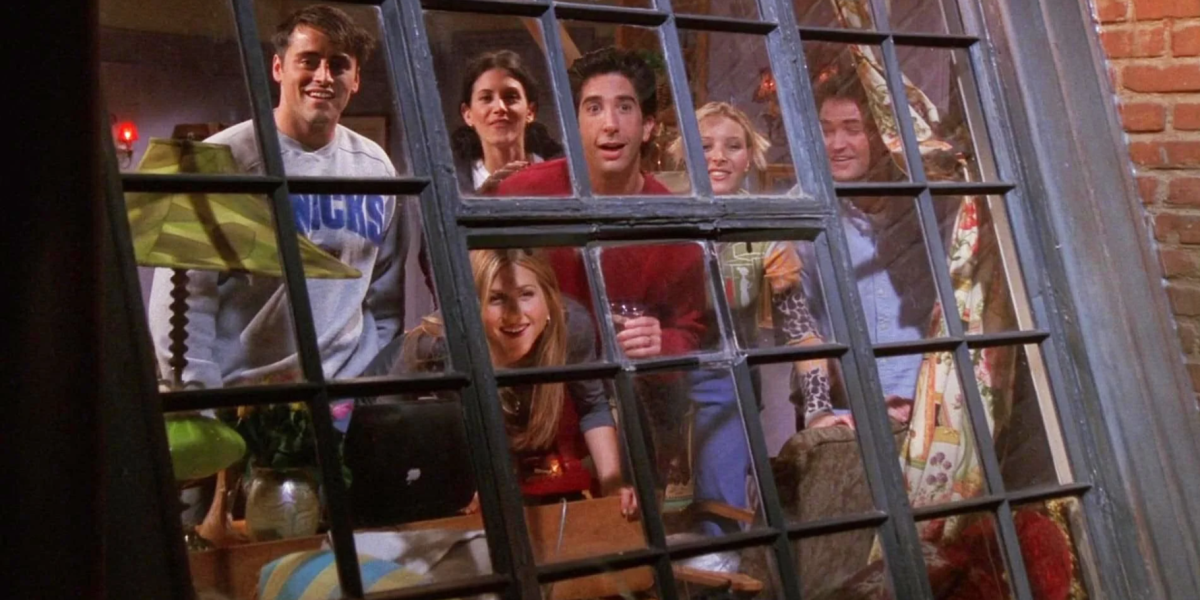
In ten seasons and 236 episodes, they became “our best friends” to viewers around the globe. In May 2004, Friends closed one of the most memorable chapters in television history with its finale, bringing an end to a cult series that redefined the sitcom genre entirely.
Two decades later, it is this “small miracle” that hinged on “so little” that Laurent Hopman set out to chronicle. In Nos meilleurs amis (Our Best Friends), available since Wednesday, October 7 from Deman Editions, the author repeats the brilliantly successful approach he employed in his Guerres de Lucas (Lucas Wars) series, which examined the genesis and production secrets of the original Star Wars trilogy.
A Story of Near-Disasters
Accompanied this time by Spanish illustrator Isaac Jadraque—selected after an extensive casting process for his ability to photorealistically render the faces of Rachel, Ross, and Monica while conveying genuine emotion—the entertainment industry enthusiast does not hide his deep attachment to the characters born from the minds of Marta Kauffman and David Crane.
“I’ve been a huge Friends fan from the beginning, and I want to write about subjects that I’m passionate about,” he told HuffPost, following years of painstaking work to “manage the mass of available information and construct a coherent narrative.”
Through exhaustive research into actor biographies, technical crew interviews, and talk show appearances by the key players, Hopman compiled hundreds of anecdotes—each more tantalizing than the last. These moments are scattered throughout the narrative as Friends evolves from a simple pitch to a phenomenon that captivated audiences “in a world without cell phones, thanks to deeply human storylines.”
Revelations and Struggles
Readers discover Matt LeBlanc filing down a tooth with a nail file before a photo shoot, Courteney Cox breaking taboos as the face of a Tampax commercial—speaking about menstruation on American television for the first time—and the male leads collectively nursing crushes on one of their co-stars.
- Endless hours in the writers’ room
- Personal struggles among cast members, both romantic and health-related
- Actors repeatedly considering quitting the show
- Jokes hastily rewritten when audiences remained stone-faced
These obstacles illuminate the enormous effort required for such success—including the emergence of an unlikely “villain”: Don Ohlmeyer, a reactionary, misogynistic, and homophobic NBC executive who consistently “put obstacles in the way” of David Crane and Marta Kauffman.
The Magic Formula
Yet the formula triumphed against all odds, summarized by the showrunner’s statement in the graphic novel: “Each episode will have three storylines of equal importance, and at least one of the three must have something moving because we attract people with humor, but it’s with the heart that we keep them.”
According to Hopman, this is the key to success: “It’s that intensity in the dramatic scenes that counterbalances the humor. Everyone tries to do it, but it’s extremely difficult.”
Humor appears regularly throughout Nos meilleurs amis—such as when Matthew Perry, asked to use his charm to convince Julia Roberts to join the cast for a special episode, found himself relying on the writers to compose the perfect invitation via fax. He ultimately satisfied the actress’s demand that he explain quantum physics to her as a precondition for her appearance.
As for emotion, few moments rival the writing of Ross and Rachel’s breakup—but that discovery awaits readers within the book’s pages.
A Bittersweet Reality
A “comfort show” if ever there was one, endlessly rewatched by millions of fans worldwide, Friends represents both a triumph and a tragedy.
“That’s the idea of this book: to show the bittersweet reality behind the scenes of this dream industry,” Hopman concludes. “It’s about showing the difficulties, the conflicts, the animosities, the harshness of this world, but also the love stories and the successes. It’s showing how difficult and cruel it can be, how you need rhino skin to withstand all the uncertainties. It’s telling fascinating stories that inspire readers, allowing them to see this series and its success in a more nuanced way.”
Mission accomplished.