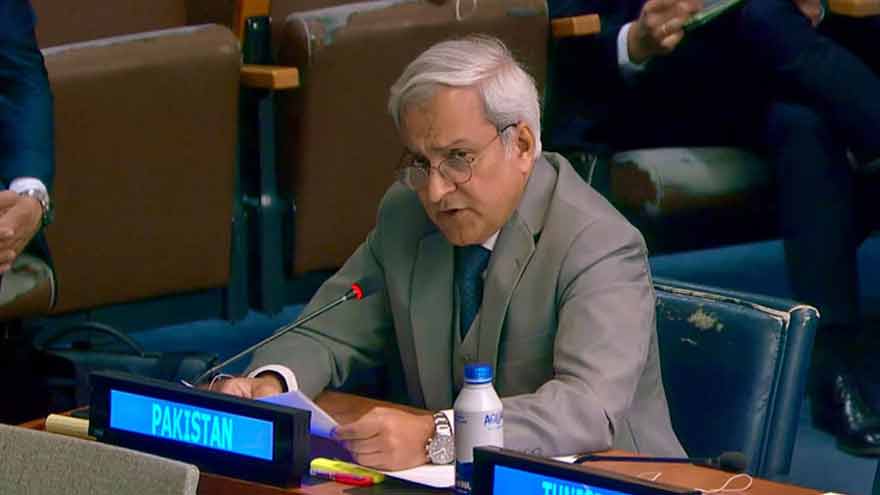
Pakistan has called on the United Nations to prevent an arms race in South Asia, warning that the region is being pushed toward instability by India’s large-scale military expansion, and urging negotiations on all outstanding disputes, including Indian-occupied Jammu and Kashmir.
Warning of a Widening Scope of Conflict
Addressing the United Nations General Assembly, Pakistan’s Permanent Representative Tahir Hussain Andrabi said the scope of wars around the world was expanding, international law was weakening, and restraint was increasingly being abandoned by states.
His remarks placed South Asia’s security tensions within a broader global pattern of eroding norms and rising militarisation.
Middle East De-escalation and Regional Diplomacy
The Pakistani envoy called for de-escalation in the Middle East, noting that mediation between Iran and the United States had produced a ceasefire and the Islamabad Memorandum of Understanding.
He also described the Mecca defence agreement between Pakistan, Saudi Arabia and Türkiye as defensive in nature and consistent with the United Nations Charter.
India’s Military Doctrine Blamed for Instability
Andrabi said South Asia was facing instability because of India’s aggressive military doctrine, while the region remained under pressure from India’s large-scale military expansion.
- Pakistan does not seek an arms race, the envoy said.
- Pakistan will maintain its defence capabilities according to its needs.
- The region is under sustained pressure from India’s military build-up.
Nuclear Risk and the Case for Negotiations
Andrabi cautioned against assuming that war could be kept under control in the presence of nuclear capabilities, a warning that underscored the stakes of any escalation between the two nuclear-armed neighbours.
Reiterating Pakistan’s position on regional disputes, the permanent representative said negotiations should be held on all outstanding issues, including Indian-occupied Jammu and Kashmir.
The appeal to the UN General Assembly reflects Pakistan’s continued push to internationalise the Kashmir dispute and to seek multilateral guardrails against a deepening regional arms competition.