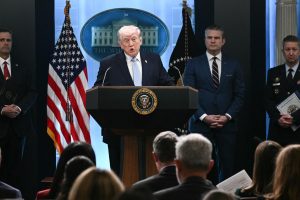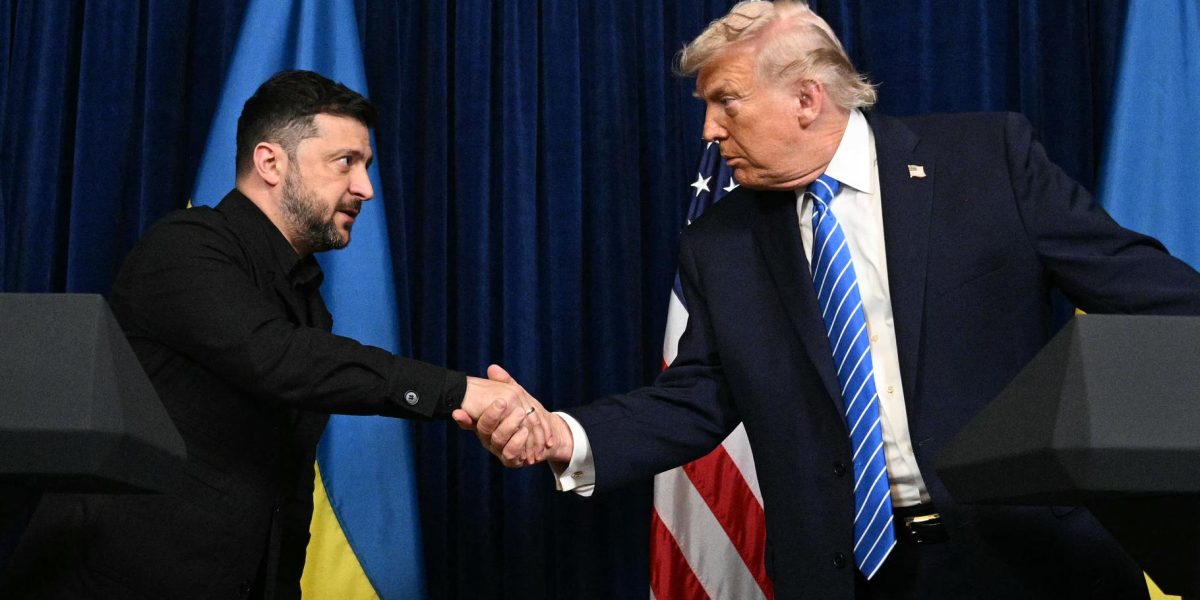
Seven years after trying to force Ukraine to help his reelection campaign, Donald Trump appears to be at it again. The U.S. president is pressing Kyiv to stop retaliating against Russia’s deadly nighttime attacks on civilians, hoping to boost Republicans ahead of the midterms.
“I think it’s time Ukraine had a new president,” the U.S. president said days ago, after chiding his counterpart, Volodymyr Zelensky, for striking Russian oil infrastructure. “Zelensky could have ended this war many times. Many, many times. But he chooses not to.”
A Pressure Campaign Tied to Pump Prices
That pressure campaign, combined with a deal Trump struck with Moscow to import Russian diesel, is meant to shore up Republican candidates wounded by soaring fuel prices. But this last-ditch political maneuver — which amounts to morally questionable support for Vladimir Putin — seems unlikely to meaningfully lower prices at the pump. The combination is drawing criticism even from within Republican ranks, including from some of the very lawmakers the president aims to help.
“We need to bring down the price of diesel, but I don’t think we need to strike a deal with Russia to do it,” Republican Ashley Hinson, an Iowa congresswoman running for the Senate in a traditionally GOP-leaning state where the race is tight, said Tuesday evening.
Far Beyond 2019
Trump’s moves against Ukraine are no longer limited to harsh rhetoric. On Wednesday, Zelensky told U.S. public radio NPR that Trump administration officials had warned Ukrainian military leaders that Washington would stop sharing intelligence with Kyiv if it did not halt strikes on Russian refineries. Also this week, the Starlink-based navigation system Ukraine used to shoot down Russian drones was abruptly deactivated, triggering a spat between Elon Musk and the Trump administration.
The White House did not respond to questions about Trump’s backing of Putin at a time when Russian forces continue to hit Ukrainian apartment buildings and other civilian targets, including power plants.
By demanding that Ukraine take steps that could jeopardize its very existence on the grounds that they would lower diesel prices, the U.S. president is going well beyond his 2019 request, when he conditioned congressionally approved military aid on Zelensky opening an investigation into Democratic presidential candidate Joe Biden. At the time, Russia was mounting smaller-scale attacks in eastern Ukraine’s Donbas, and Putin was still three years away from the full-scale invasion he launched in 2022.
“It’s the same use of government authority for purely political purposes,” said John Bolton, who served as Trump’s national security adviser during his first term and who, like several other critics of the president, has faced prosecution by the Justice Department under his second.
Robert Kagan, who worked at the State Department under Ronald Reagan and is now at the Brookings Institution, argues that Trump’s sudden pivot toward Putin and against Ukraine has consequences far beyond the conflict itself. “The United States no longer has a foreign policy. Today, the United States is a predatory criminal enterprise,” he said.
Little Relief Expected at the Pump
In recent days, Trump has repeatedly and wrongly blamed Zelensky for soaring diesel prices. In reality, experts say, the price — approaching $7 a gallon — stems from the war the U.S. president is waging against Iran. Despite that, Trump is demanding that Ukraine stop targeting Russian refineries and instead accept a “deal” that would benefit Putin in a war nearing its fifth anniversary.
“He wants to create problems for the world. He wants to create problems for our farmers, our ranchers, with, uh, diesel, because Russia supplies a lot of the world’s diesel,” Trump said Saturday of Zelensky.
In a social media post, the U.S. president announced another deal that would effectively lift sanctions on Russia to let it sell diesel to the United States. The announced agreement, which at first glance appears to violate a 2022 law banning such imports, has drawn criticism from members of Congress — including Republicans — as well as from European allies, who see it as a betrayal of Ukraine and a reckless embrace of a leader accused of spreading violence and waging a deadly war.
“The effects of this decision are uncertain, while the risks are obvious: legitimizing Moscow while its bombs keep falling on Ukrainian cities, financing its war and weakening sanctions,” Italian Prime Minister Giorgia Meloni said Wednesday before the Italian Senate.
In any case, oil industry specialists estimate that allowing Russia to sell diesel to Western countries would barely help consumers who depend on it. “Five cents less per gallon of diesel,” said Dan Eberhart, owner of oil services firm Canary LLC and a Republican donor. “Too little, too late.” Matt Randolph, who also has decades of experience in the sector, called even that five-cent estimate too optimistic. “Zero,” he said flatly. “It doesn’t add a drop of diesel to the global market. Moving diesel from one place to another doesn’t change its price. Only an increase in supply or a drop in demand can do that.”