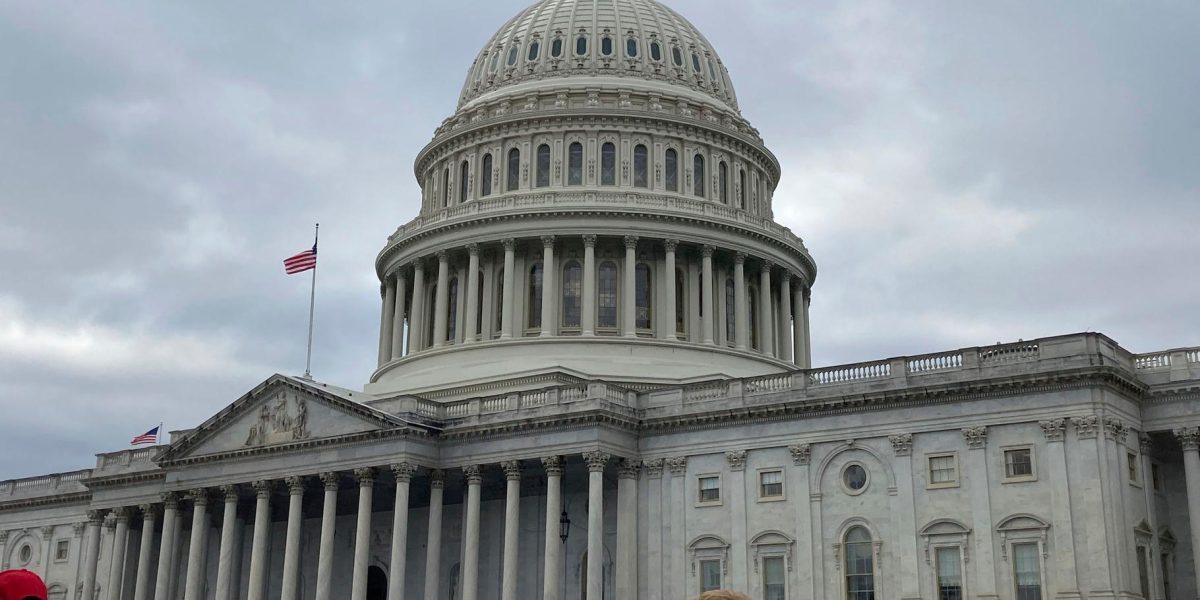
With just fifteen days remaining before Americans head to the polls, the political landscape is shifting. The midterm elections on Tuesday, November 3, will see the entire House of Representatives and a third of the Senate up for grabs. This is a crucial moment for Donald Trump, as a Democratic “blue wave” is already anticipated given the president’s growing unpopularity.
The House: Democrats Lie in Wait
The U.S. Congress is composed of the Senate and the House of Representatives. The latter, with its 435 members, is the equivalent of the National Assembly and is entirely renewed every two years. Currently, Republicans hold the majority with 219 seats against 214 for the Democrats. Two seats are vacant, previously held by one Democrat and one Republican. The president’s party therefore holds a razor-thin majority, as 218 seats are needed to control the chamber. Democrats need a net gain of just three seats to reclaim the majority.
To maintain their grip, Republicans have waged a long battle in recent months to redraw district lines. Will this be enough? Donald Trump’s ever-declining popularity casts doubt. According to the latest calculations from The Washington Post this Monday, October 19, 202 results are “solidly” or “very likely” Democratic. 187 are “solidly” or “very likely” Republican. This leaves 46 seats truly in play: 12 lean Democratic, 13 lean Republican. In the final 21, the race is so tight that it is impossible to predict the winner’s color.
Renowned statistician Nate Silver estimates that Democrats have a 94% chance of winning the House, according to his figures from October 7. The website Decision Desk HQ gives them a 75% chance. However, polling experts, as well as some cautious elected officials, remain wary. Firstly, because the numbers in many polls remain within the margin of error. Secondly, because previous polls have been wildly inaccurate, such as the 2016 presidential election where Trump’s victory was not anticipated, or the 2022 midterms where a Republican “red wave” was announced but never materialized.
Jérôme Viala-Gaudefroy, a doctor in American civilization, summarizes the situation in terms of numbers to Le HuffPost. “To speak of a limited defeat for Republicans, Democrats would need a small majority of 220 seats. The Cook Political Report [an independent publication analyzing elections, Ed.] estimates the range will be between 224 and 234 seats for Democrats, which is already starting to be a good majority,” details the author of The Words of Trump. “Democrats would need a majority of 240 seats to speak of a heavy defeat,” judges Viala-Gaudefroy.
A Tough Battle for the Senate
In the Senate, the dynamic is different. The upper chamber is composed of 100 seats—two per state—renewable by thirds every two years. Currently, Republicans hold the majority with 53 elected officials against 47 Democrats. This November 3, 35 seats are up for re-election. Among them, according to calculations by The New York Times, 9 are Democratic and 13 are Republican. The final 13 are the most uncertain: 4 lean Democratic, 2 lean Republican, and 7 are on a knife’s edge. This means that despite their relatively comfortable majority, Republicans also risk losing the Senate.
According to Nate Silver, Democrats have a 75% chance of taking back the Senate, while Decision Desk HQ gives them a 55% chance. The task remains difficult for Democrats. “The Senate is structurally more favorable to Republicans. Democrats need a net gain of 4 seats to obtain 51 seats. Because if there are 50 Democratic and 50 Republican seats, the vice president decides,” explains Viala-Gaudefroy.
Three strategic elections are particularly scrutinized: the duel between former Democratic seminarian James Talarico and the controversial MAGA candidate Ken Paxton in Texas, a deeply conservative state that has not elected a Democratic senator since 1988; the battle between incumbent Republican Susan Collins and her progressive rival Troy Jackson in Maine; and the race between left-wing Democratic representative Abdul El-Sayed and Republican Mike Rogers in Michigan.
Major Consequences for the End of Trump’s Term
Donald Trump is aware that midterms are traditionally unfavorable to the party in power. “For one reason or another, the sitting president, as good as he seems to be—nobody has done what I’ve done, nobody, by far—has a huge disadvantage,” he acknowledged in mid-October. “But I’m campaigning and doing rallies,” and “the level of enthusiasm for the Republican Party is skyrocketing,” he further claimed.
This rhetoric, and the president’s record, bode ill. “Donald Trump will be able to say that the Republican defeat is explained by the absence of his name on the ballots, but there could also be challenges to the results,” warns Viala-Gaudefroy. A view shared by Jeff Hawkings, an associate researcher at the Institute of International and Strategic Relations (Iris), who adds: “The baseless legal challenges that Republicans might bring against election results would have little more chance of succeeding than those of 2020, when Trump had already sought to ‘stop the steal’ after losing the presidential election. But the damage would already be done.”
From a political standpoint, Viala-Gaudefroy recalls that the new Congress will not sit until January 3. During the three-month transition, Republicans will be able to fast-track new legislation or appoint new judges, particularly to the Supreme Court. Because afterward, everything will be more difficult. “Trump will no longer be able to pass his bills, even though he mainly governs by decree. This will pose a problem, especially for the budget,” emphasizes the U.S. specialist.
Another risk: the opening of parliamentary inquiries, or even an “impeachment” procedure to overthrow the president. Besides the fact that the latter has very little chance of succeeding (it requires a two-thirds majority in the Senate to adopt), Viala-Gaudefroy believes it is not in the Democrats’ interest two years before the end of the presidential term, especially since “it would give Trump the opportunity to pose as a victim.”
Local Elections to Watch
Midterm elections are not limited to Congress. 36 gubernatorial elections are also being held, with stakes that are far from trivial. “Depending on who is elected to head the state, the situation is completely different on the issue of redistricting or how the 2028 elections will be organized, for example,” points out Viala-Gaudefroy.
In addition to governors, voters are sometimes called to vote for their local Congress members or their sheriff. Referendum-style policy proposals are also on the ballots: Missouri voters, for example, will be able to choose whether to drastically restrict abortion, while Californians are called to weigh in on “Proposition 40,” which provides for a minimum tax on billionaires.