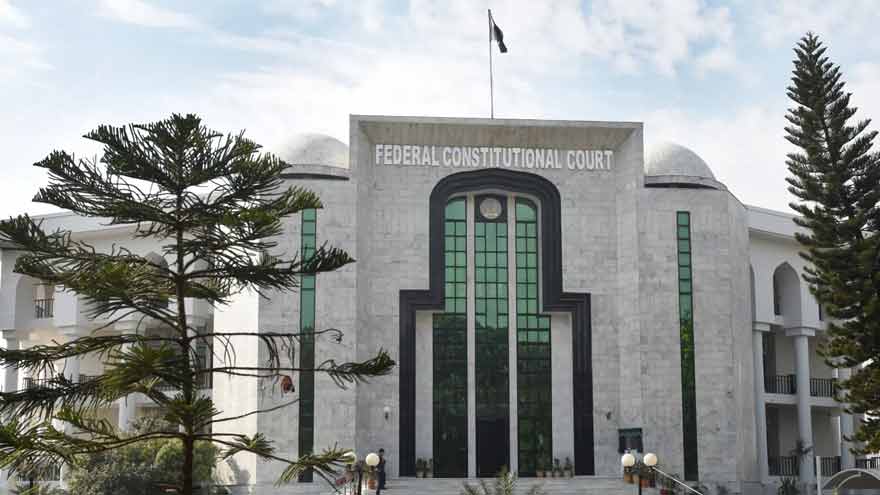
The Federal Constitutional Court has struck down the Sindh government’s removal of anti-terrorism court judges, ruling that a newly imposed upper age limit cannot be applied to judges appointed before the law changed.
In a written verdict issued by Justice Muhammad Karim Khan Agha, the court accepted the appeal of Muhammad Yamin, declared the provincial government’s removal notification invalid, and set aside the Sindh High Court’s December 22, 2025 judgment that had upheld the dismissals.
Retrospective Application Rejected
The court held that the new maximum age of 65 years does not apply to judges who were appointed for a fixed term before amendments were made to the Anti-Terrorism Act. It ruled that a right lawfully acquired in the past cannot be taken away without clear legislative provisions.
According to the verdict, judges appointed before the amendment will remain in office until the completion of their respective terms, and the Sindh Anti-Terrorism Amendment Act 2025 cannot be applied retrospectively.
Background of the Case
Yamin was appointed as a judge of Anti-Terrorism Court-IV in Karachi on September 19, 2024, for a period of two and a half years under the Anti-Terrorism Act 1997. He was approximately 70 years old at the time of his appointment, and the law then in force did not prescribe an upper age limit for ATC judges.
The Sindh Anti-Terrorism Amendment Act 2025 subsequently introduced a maximum age limit of 65 years for the appointment and continuation of judges in office. Acting on the amendment, the Sindh government issued a notification removing three judges, including Yamin, with immediate effect.
- The Sindh High Court had upheld the provincial government’s action.
- The Federal Constitutional Court accepted Yamin’s appeal against that ruling.
- Both the high court judgment and the removal notification were declared invalid.
Yamin to Serve Full Term
Under the verdict, Yamin will complete his two-and-a-half-year tenure as a judge of Anti-Terrorism Court-IV in Karachi. The decision affirms that fixed-term appointments made under the earlier legal framework are protected from later legislative changes.