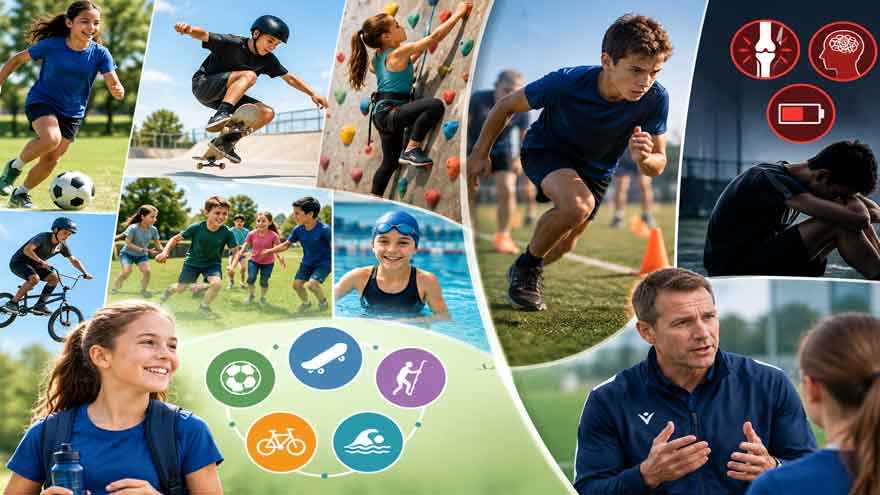
The Australian Sports Commission (ASC) has urged parents, coaches and sporting bodies to think twice before pushing promising young athletes into a single sport, warning that early specialisation is linked to injury, burnout and declining enjoyment of sport.
In a position statement released on Tuesday, the ASC expanded on its 2019 guidance, concluding that encouraging children to take part in a range of physical activities — including unstructured play — is often the better recipe for long-term sporting outcomes.
Growing Trend Toward Early Specialisation
The commission noted a rising trend of youth athletes narrowing their focus to one sport at a young age, and cautioned that any decision to restrict a child to a single discipline should be driven by the child and reflect their individual circumstances.
“There is evidence that sport specialisation in youth athletes is associated with a range of potential adverse outcomes,” the statement said. “The strongest and most consistent evidence relates to overuse injury and burnout, particularly where specialisation involves high volumes of repetitive training, year-round competition and insufficient recovery.”
Risks Beyond Physical Injury
The ASC warned that early specialisation may also erode an athlete’s enjoyment of sport and contribute to psychological stress and a lower quality of life. Those risks, it said, may be heightened when specialisation begins early, occurs before an athlete is developmentally ready, or is imposed by external pressures rather than the child’s own motivation.
The statement acknowledged that the evidence is not entirely clear-cut, noting it remains uncertain whether some adverse outcomes stem directly from specialisation or mainly reflect the heavy training loads, limited recovery and restricted experiences that often accompany it.
Play-Based Sports Offer a Different Path
Action sports such as skateboarding, BMX cycling and sport climbing — where some young athletes have already reached Olympic success — were singled out as less of a concern, because skill acquisition in these disciplines tends to be play-based, exploratory and self-directed.
Matti Clements, Director of the Australian Institute of Sport, stressed that there is no universal route to elite performance.
“There is no single pathway through athlete development,” Clements said. “The appropriate timing and approach to sport specialisation will vary depending on the athlete, the sport and the environment in which development takes place.”
Key Takeaways for Parents and Coaches
- Encourage children to sample multiple sports and free play rather than committing to one discipline early.
- Watch for warning signs of overuse injury, fatigue and loss of enjoyment linked to repetitive, year-round training.
- Let the child’s own interest guide any decision to specialise, and factor in their stage of development.
- Recognise that pathways to elite sport differ widely across disciplines and individuals.