In a significant political shift, Germany’s conservative bloc, comprised of the Christian Democratic Union (CDU) and its Bavarian ally, the Christian Social Union (CSU), emerged victorious in the federal elections, according to exit polls released on Sunday. The results marked a notable rise for the far-right Alternative for Germany (AfD), which finished in a strong second place.
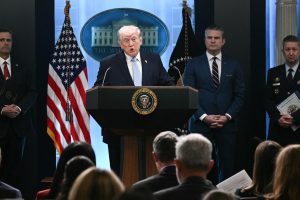
U.S. President Donald Trump celebrated the conservative victory as a pivotal moment for Germany, expressing his sentiments on his social media platform, Truth Social. The CDU and CSU secured approximately 29% of the vote, heralding what Trump described as “a great day for Germany and for the United States of America.”
Meanwhile, Elon Musk, CEO of SpaceX and Tesla, openly expressed his satisfaction with the AfD’s historic performance. Musk, who has frequently engaged in commentary on European politics, particularly in Germany, has previously voiced support for the far-right party. At a recent rally attended by around 4,500 AfD supporters in Halle, Musk encouraged Germans to take pride in their national identity and to strive for a prosperous future.
In the wake of the election results, German business leaders have called for the swift formation of a stable government capable of implementing necessary reforms to revitalize Europe’s largest economy. Friedrich Merz, the leader of the opposition CDU-CSU, declared his intention to quickly establish a governing coalition following the conservative victory. Despite the challenges of coalition negotiations, the economic sector is pressing for decisive action.
Peter Leibinger, president of the Federation of German Industries (BDI), emphasized the urgent need for a functional government with a clear majority to address key issues such as bureaucracy reduction, public investment, energy, and security. Germany’s economy has been in recession for two consecutive years, with bleak growth forecasts for 2025.
Aside from the AfD, whose policies are met with apprehension by the business community, other parties such as the Social Democrats and the Greens, who were part of the outgoing coalition, may be invited to discuss forming a government with the CDU-CSU.
Christian Sewing, president of the Association of German Banks and CEO of Deutsche Bank, echoed the need for an efficient government to restore Germany’s leadership role in Europe, especially in light of shifting U.S. policies under the Trump administration.
Christiane Benner, president of the influential IG Metall union, highlighted the urgency for clear proposals to address the needs of industry and workers, underscoring that prolonged uncertainty is untenable.
As Germany navigates this period of political change, the pressure mounts on its leaders to swiftly establish a coalition capable of steering the nation towards economic stability and growth.