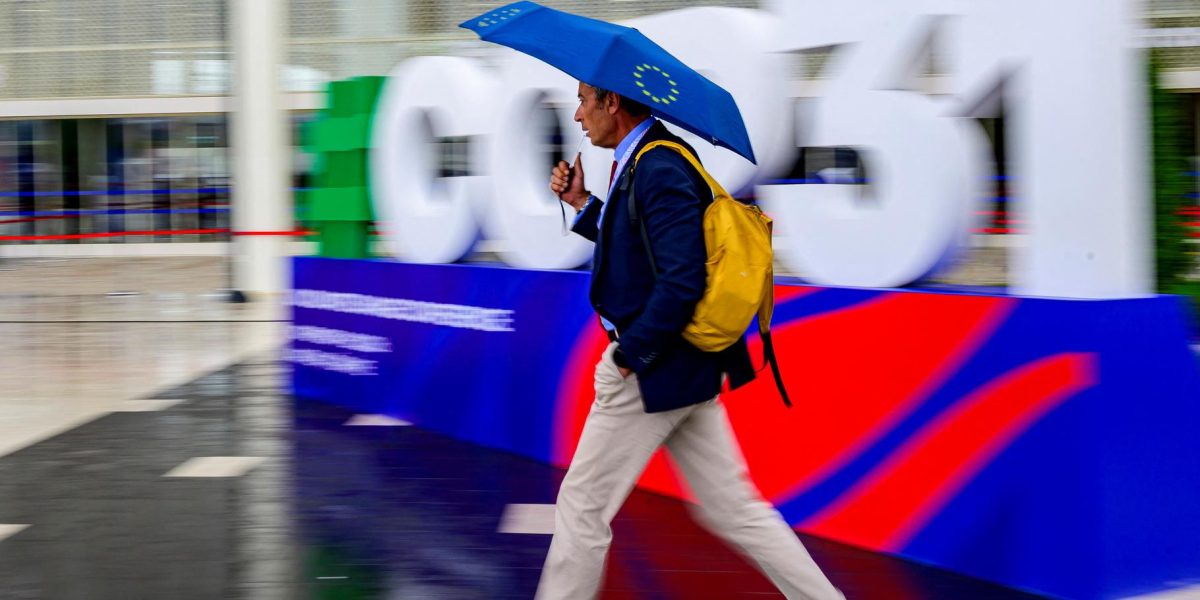
ANTALYA — The COP31 climate summit ended on Sunday without a common final text, after more than two weeks of negotiations and two days of overtime, leaving delegates with an outcome that recalls one of the darkest chapters in the history of global climate diplomacy.
Conference president Murat Kurum of Turkey announced that his proposed final decision had been rejected. The draft made no explicit reference to fossil fuels, a gap the European Union and several other countries deemed unacceptable. Instead, the text leaned heavily on carbon capture technologies, a solution that NGOs denounce as a means of delaying the phase-out of oil, gas and coal.
A Parallel With The Hague, 26 Years Later
The deadlock carries striking echoes of COP6, held in The Hague in November 2000, which also ended without an agreement and, in the words of former French chief negotiator Paul Watkinson, “in chaos.”
At the time, participating countries were meant to agree on the implementation rules for the Kyoto Protocol, adopted three years earlier to cut greenhouse gas emissions. Talks quickly stalled over deep divisions between the United States and Europe. Washington pushed to count CO2 absorbed by forests and farmland toward its targets, while Europeans feared such mechanisms would let industrialized nations keep polluting without sufficiently reducing emissions.
While the sticking points differed, the breakdown mirrors that of COP31, where Europeans likewise refused to endorse a text they considered too unambitious. In The Hague, another factor further complicated discussions: political uncertainty in the United States, where the results of the presidential election between George W. Bush and Al Gore were still pending.
A Suspended Summit, Revived Months Later
“There was this uncertainty. They couldn’t agree. Ministers started to leave and they had to suspend the COP,” Alden Meyer, an expert at the E3G think tank who has attended nearly every climate conference, told AFP. The decision was unprecedented. “It is the only time” in COP history that a “suspension” has occurred, Meyer recalled.
Unlike COP31, the Hague conference did not simply fail to adopt a final text: it was officially interrupted, with the aim of resuming talks later. That is precisely what happened eight months later, in July 2001 in Bonn, Germany, where a “COP6 bis” was convened to break the impasse.
In the interim, George W. Bush had entered the White House and announced that the United States would not support the Kyoto Protocol. Despite that American reversal, other countries decided to press on with negotiations. The Bonn meeting produced a political compromise, before the protocol’s detailed implementation rules were finalized a few months later in Marrakech.
A Political Failure, but Tangible Progress
Twenty-six years on, the COP31 failure shares common ground with The Hague: in both cases, disagreements between states prevented adoption of the hoped-for political compromise.
Will a “COP31 bis” be held in a few months? Not necessarily. While the two situations appear comparable, their contexts differ considerably. As the Climate Action Network notes, several decisions were in fact adopted during COP31. The absence of agreement on a final political declaration does not automatically mean the entire conference failed.
Above all, “not all COPs adopt a final declaration,” the NGO network points out. While the Antalya impasse is indeed a political failure, it does not require the organization of a new conference — unlike the 2000 suspension.
Another precedent illustrates the distinction. In 2009, COP15 in Copenhagen, Denmark, ended in deep confusion after negotiations on a binding global agreement to cut greenhouse gas emissions collapsed. Participating countries nonetheless managed to negotiate a separate political text, which the conference took note of. It provided in particular for mobilizing $100 billion a year by 2020 to help developing countries cope with climate change. Despite that diplomatic failure, COP15 was not suspended, and no “COP15 bis” was ever organized.