Israeli opposition leader Gadi Eisenkot has condemned arson attacks by militant settlers on Palestinian villages in the occupied West Bank as acts of “Jewish terrorism,” sharply escalating a political row as he attempts to assemble a governing coalition.
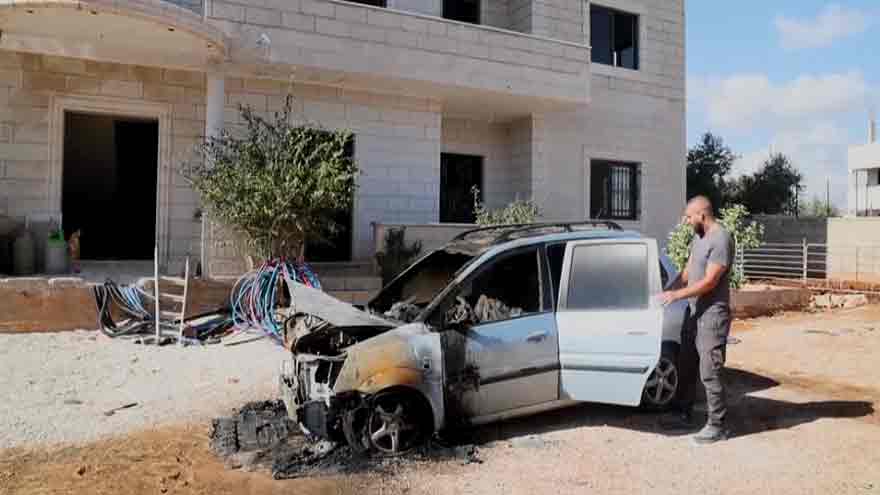
Residents said settlers struck several Palestinian communities near Ramallah early on Sunday, setting vehicles alight and scrawling racist graffiti on walls. Reuters journalists at the scene saw burned-out cars and slogans including “Revenge” spray-painted across village walls. No group immediately claimed responsibility, and no injuries were reported.
Attacks Follow a Pattern of Escalation
The assaults are the latest in a wave of settler violence that intensified after Hamas launched its attacks on Israel from the Gaza Strip in 2023. They come nearly a month after an inconclusive election stripped incumbent Prime Minister Benjamin Netanyahu of his parliamentary majority, leaving the country’s political future uncertain.
Eisenkot, who heads the centre-right Yashar party and has been tasked by President Isaac Herzog with forming a government, said the perpetrators were undermining Israel’s standing at home and abroad.
“Extremist groups that set fire to vehicles and homes are undermining regional stability, putting lives at risk and doing grave damage to Israel’s national security and foreign relations,” he said, describing the attacks as “Jewish terrorism.”
He laid blame at the feet of Itamar Ben-Gvir and Bezalel Smotrich, ultra-nationalist ministers in Netanyahu’s cabinet, saying their policies had “brought the area to the brink of anarchy, and the authorities have yet to address the crisis.”
Police Open Investigation as Military Condemns Violence
Israeli police said they had opened an investigation into the attacks. The military condemned the violence, saying soldiers and police had been dispatched to the areas of Deir as-Sudan, Deir Abu Masha’al, Kafr Malik and At-Tuwani “following reports and footage showing vehicles being set on fire and graffiti being sprayed in the area.”
Ben-Gvir responded on X that Eisenkot’s condemnation amounted to selling out to Arab parties, whose support could prove essential to any new government. Smotrich advocates settlement expansion and has called for Israel to annex the West Bank.
The settlements are considered illegal under international law by UN bodies and most countries, a position Israel disputes. The expansion of settlements is widely seen as making the prospect of an independent Palestinian state increasingly remote.
Arab Party Leader Points to Government Policy
Yousef Jabareen, head of the Joint List, the largest Arab party in parliament, said the attacks were “the direct result of the deepening occupation and a government policy under which violence against Palestinians has become an everyday occurrence,” citing encouragement from Ben-Gvir and Smotrich.
Israel’s parliament was sworn in on November 10 without a new government after the October 27 election left Netanyahu without a majority but offered no clear path to power for his rivals. Netanyahu remains caretaker prime minister while Eisenkot attempts to build a coalition.
Unless Eisenkot forms a unity government with Netanyahu, he will likely need the support of Arab parties to command a majority in the 120-seat Knesset. If no candidate can form a government, Israel will head to another election next year.