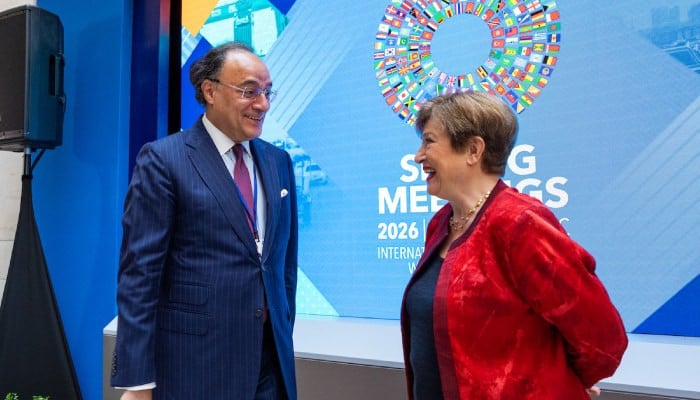
International Monetary Fund (IMF) Managing Director Kristalina Georgieva has publicly commended Pakistan for its adherence to a $7 billion financial programme, stating that rigorous implementation has been crucial in maintaining macroeconomic stability. The endorsement came following a meeting with Pakistan’s Finance Minister, Muhammad Aurangzeb, on the sidelines of the IMF–World Bank Spring Meetings in Washington, D.C.
Public Endorsement on Key Reforms
In a post on the social media platform X, Georgieva highlighted the positive outcomes of Pakistan’s efforts. “Strong programme implementation has helped Pakistan maintain macroeconomic stability and build confidence,” she wrote. She further emphasized that sustained progress hinges on continued prudent policies. “Sound policies and deeper structural reforms remain key to sustaining growth and raising welfare for all Pakistanis,” the IMF chief added.
The Pakistani Ministry of Finance welcomed the remarks, interpreting them as growing international recognition of the country’s reform agenda and its commitment to economic stability through disciplined fiscal management.
Progress Towards New Funding and Economic Forecasts
The public support follows a critical milestone reached in late March, when IMF staff and Pakistani authorities concluded a staff-level agreement (SLA). This agreement is a key step toward the disbursement of approximately $1.2 billion in financing. Upon approval by the IMF Executive Board, Pakistan will access about $1 billion under an Extended Fund Facility and $210 million under a Resilience and Sustainability Facility. This would bring total disbursements under the current programme to around $4.5 billion.
Concurrently, the IMF’s latest World Economic Outlook for 2026 maintains Pakistan’s growth forecast at 3.6% for the fiscal year. This figure remains below the government’s official target of 4.2%, a revision influenced by a downgraded global growth outlook due to ongoing regional conflicts.
Structural Reforms and Future Challenges
Under the programme, the Washington-based lender continues to advise Pakistani policymakers to maintain a tight, data-dependent monetary policy. This approach is seen as essential to anchor inflation expectations and strengthen the country’s external financial buffers. The IMF’s guidance aligns with recent observations from credit rating agencies. Fitch Ratings noted that Pakistan has made tangible progress on fiscal consolidation and macroeconomic stability measures, actions that are broadly in line with its IMF commitments and support its overall funding capacity.
While the path forward requires persistent structural reforms, the IMF’s public acknowledgment signals a vote of confidence in Pakistan’s current economic trajectory and its management of a challenging external environment.