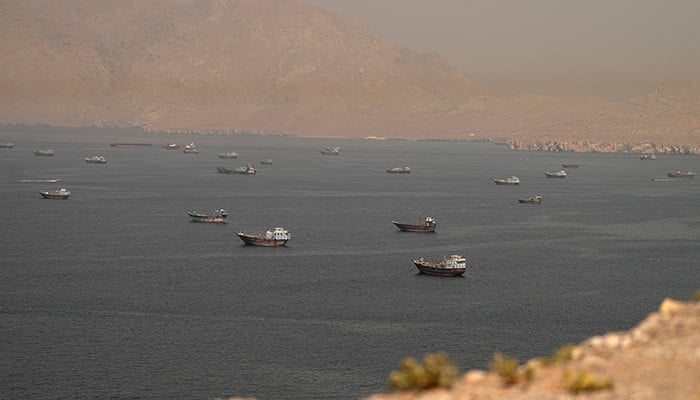
Iran announced on Saturday it was closing the strategic Strait of Hormuz, directly linking the blockade to Israeli military operations in Lebanon and accusing the United States of a “breach of contract The dramatic escalation threatens to unravel a preliminary US-Iran agreement just as diplomatic delegations were en route to Switzerland for follow-up negotiations.
The Iranian military command declared the waterway closed to vessel traffic, with the Revolutionary Guards’ naval force issuing explicit warnings that any approaching ships would face jeopardized security. The Strait of Hormuz, a critical artery for global oil and gas shipments, had only recently begun to see a recovery in traffic after Tehran agreed to lift a wartime blockade under the accord signed earlier this week by President Donald Trump and Iranian President Masoud Pezeshkian.
Washington immediately pushed back against Iran’s announcement. US Central Command stated that safe passage through the international waterway had “remained intact” and that American forces were “present and vigilant.” President Trump later escalated the rhetoric on Truth Social, warning that the United States could impose its own tolls on the strait if negotiations failed, writing there would be no tolls “unless they are imposed by and for the United States of America.”
Ceasefire Violations Spark Diplomatic Crisis
The closure was triggered by a rapidly deteriorating security situation in southern Lebanon. A renewed ceasefire, announced by Washington late Friday as a condition of its deal with Iran, collapsed almost immediately. Israeli troops clashed with Hezbollah fighters on Saturday, with each side accusing the other of breaking the truce. The Israeli military reported that one soldier was killed, marking the fifth Israeli fatality since the US-Iran deal was signed.
An Israeli army official later said the military had received orders from the political leadership to cease fire, adding that troops were operating defensively within a security zone and not conducting proactive strikes. However, Hezbollah accused Israel of carrying out “under the cover of the ceasefire…an infiltration attempt” towards strategic hills near Nabatieh, stating its fighters responded with “appropriate weapons.” Lebanese state media reported Israeli air raids on approximately 20 locations, and the civil defence agency said 16 people were killed in the Nabatieh area alone. Lebanon’s health ministry reported the overall death toll has now surpassed 4,000.
Negotiations Hang in the Balance
Despite the military brinkmanship, diplomatic channels remained active. An Iranian delegation departed for Switzerland on Saturday afternoon, state media reported, including parliamentary speaker Mohammad Bagher Ghalibaf and Foreign Minister Abbas Araghchi. Foreign ministry spokesman Esmaeil Baqaei warned the delegation would “dem implementation of the other party’s commitments,” cautioning that “otherwise, the entire understanding will be in trouble.”
US Vice President JD Vance departed Washington for Switzerland to join the talks, telling reporters he could only stay for a day or two but hoped to make progress on the nuclear issue and the Lebanon ceasefire. US negotiators Jared Kushner and Steve Witkoff were on the ground handling technical elements, with Vance noting in a Fox News interview that “things are going well.”
Mediator Pakistan confirmed that “technical-level talks” were scheduled for Sunday in Burgenstock, with Pakistani and Qatari mediators joining US and Iranian representatives. The negotiations are designed to open a two-month period to address unresolved issues, most critically Iran’s nuclear programme.
A Cycle of Accusations
The latest violence underscores the fragility of any diplomatic framework. Hezbollah lawmaker Hassan Fadlallah asserted the group retained “the full right to confront this enemy when it attacks us,” while Israel’s US ambassador Yechiel Leiter maintained Israel was “defending itself against terrorist attacks.” Hezbollah had initially pulled Lebanon into the wider Middle East conflict in early March by firing rockets at Israel in retaliation for the killing of Iran’s supreme leader in US-Israeli strikes. A previous ceasefire intended for April was never honoured, with both sides justifying continued attacks by citing alleged violations.As negotiators gather in Switzerland, the dual crises of the Hormuz blockade and the Lebanon conflict present an immense challenge, with global energy markets and regional stability hanging in the balance.